
Sony Patents a Display That Beams Images Directly Onto Your Retina
Sony has filed a patent for a display system that skips the screen entirely, projecting focused light beams straight through your pupil and onto the back of your eye. The idea is that the image forms on your retina itself, not on a panel you look at.
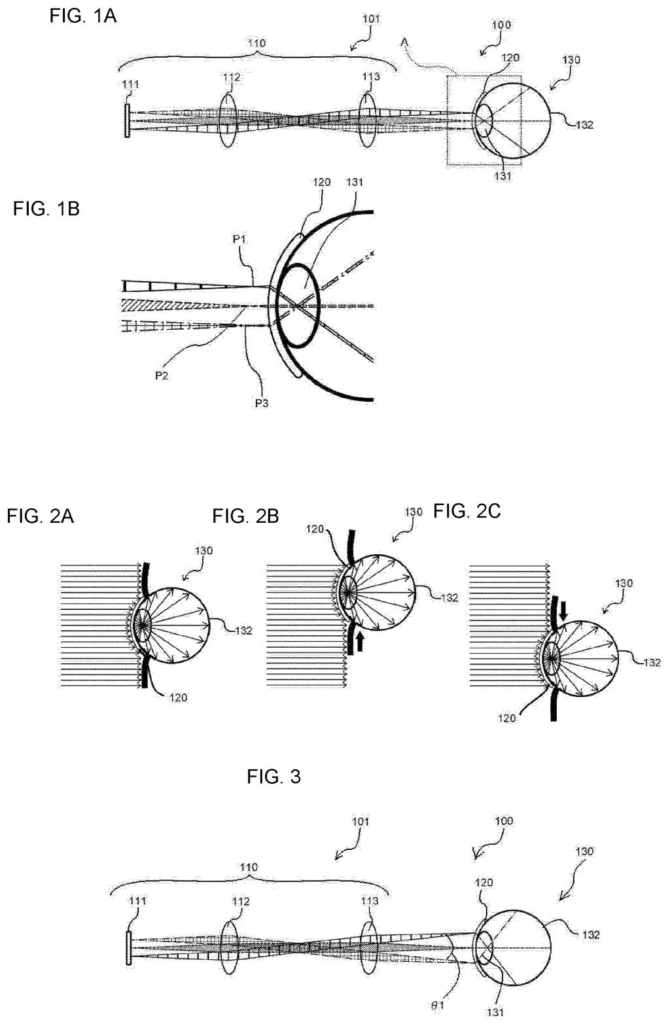
What Sony's retina-projection display actually does
You're wearing a pair of AR glasses and you can't tell where the display ends and the real world begins. That experience depends on how precisely light reaches the back of your eye, and most current systems are nowhere near precise enough.
Sony's patent describes a projection setup where a small device fires multiple beams of light toward your eye, and a fixed optical element (think a specialized lens or film positioned in front of your pupil) collects those beams and channels them to land on your retina. The key word is fixed: the optical element stays in a set position relative to your eye the whole time, which gives the system a predictable, repeatable path for the light.
The practical result is that the image doesn't live on a tiny screen you're magnifying. The image is the light arriving at your retina. That distinction matters for clarity, compactness, and how natural the picture looks.
… an optical element ( 120 ) configured to cause the video display light to be collected near a pupil and then to reach a retina.
Translation: A special lens focuses light right through your pupil so it hits the back of your eye.
How the optics focus light through the pupil to the retina
The system has two main parts: a projection device that emits structured image light, and at least one optical element that sits between the projector and the eye.
The image light is made up of multiple individual beams. Each beam has a central ray running through its middle and several surrounding rays fanning outward. Critically, each beam is focused to a point in front of the optical element, not behind it or at the retina itself. The optical element then re-collects that diverging light near the pupil and sends it onward so it lands on the retina in the right pattern.
There is also a geometric rule baked into the design: the central rays from all the beams arrive at the optical element parallel to the optical axis (meaning they travel in the same direction as the centerline of the system, not at angles). This is a classical optics condition that makes it much easier to compute and correct for distortions.
- Fixed positioning: the optical element and the eye do not move relative to each other during use, removing tracking errors.
- Pupil-plane focus: light converges near the pupil, which controls how wide the beam entering the eye is and helps manage brightness and depth of focus.
- Retinal delivery: the final image forms on the retina rather than on an intermediary screen.
… each light beam of the plurality of light beams has a focal point in front of the at least one optical element …
Translation: The system converges multiple beams of light before they pass through the lens.
What this means for wearable and AR display design
For anyone wearing AR or VR headgear, the quality of what you see comes down to how cleanly light reaches your retina. Most headsets today use a tiny display panel plus magnifying lenses, which introduces bulk, distortion at the edges, and a narrow sweet spot where the image looks sharp. A retinal projection system removes the panel from the equation entirely, which opens the door to thinner, lighter wearables.
The fixed-position constraint is both the strength and the challenge here. A system that knows exactly where the eye sits can be finely tuned for optical quality, but it also means the hardware has to stay reliably positioned, which is a real engineering problem for everyday wearables. Sony has been filing around near-eye display optics since at least the mid-2010s, and this patent adds a specific structural approach to that body of work.
Sony's 27th filing we've tracked in our AR glasses race watchlist since July adds to a run that includes an application for on-demand virtual objects and a tap-to-control finger ring.
The payoff Sony is chasing is real: if you can reliably land a focused image on a person's retina without a screen in the way, you get sharper images in a smaller package, which is the central unsolved problem in AR glasses.
The catch is that phrase "fixed positional relationship." Eyes move. Heads shift. Anyone who has worn glasses knows they slide down your nose within the hour. A system that depends on precise, stable geometry between an optical element and a moving eyeball has a significant comfort and fit problem to solve before the optics pay off in the real world.
This is a foundational building block patent, not a finished product design. The optical logic is sound, but the reader-facing payoff (clearer, lighter AR glasses) is several hard engineering problems away from arriving in a box on a shelf.
There are more where this came from
We read every patent application Big Tech publishes and send you the ones worth knowing. Plain English, free, every week.
The drawings
20 drawing sheets from US 2026/0276999 A1 · click any drawing to enlarge


Want this weekly breakdown for a company we don't cover? Patentlyze Pro →