
Google Patents a Way to Break Your Messy Questions Into Focused Searches
When you ask an AI a question that has three different problems baked into it, most systems just... guess at the main one. Google has patented a method that splits your question apart, runs separate searches for each piece, and stitches an answer together from all of them.
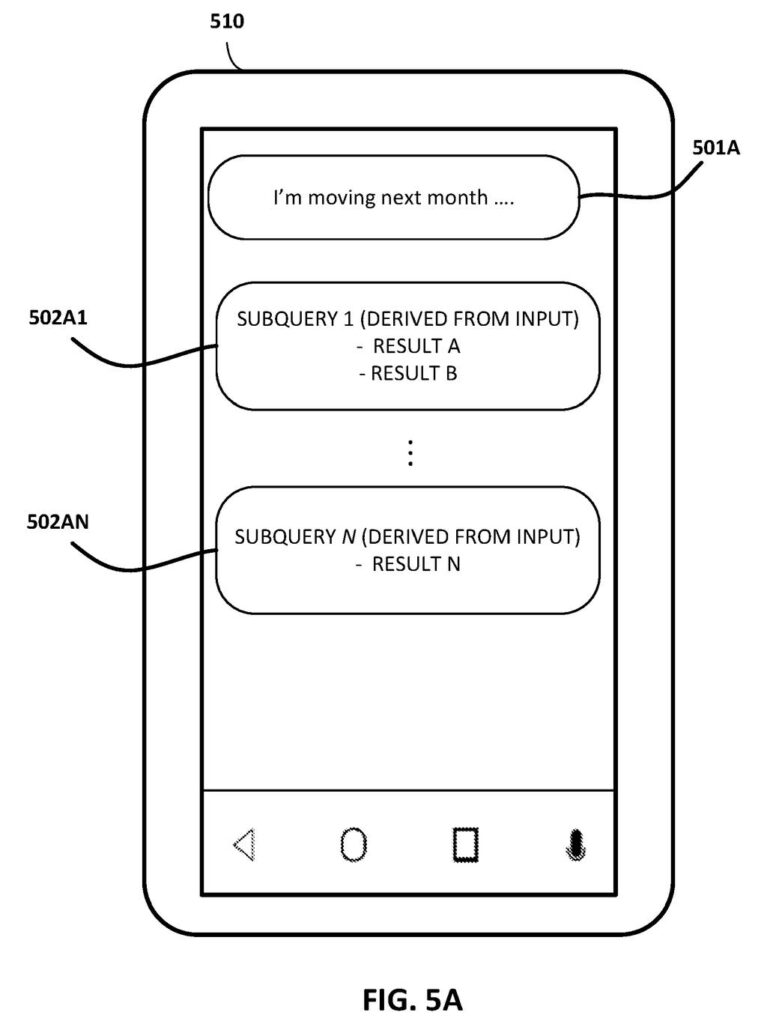
How Google's AI handles questions with multiple parts
Every time you type a long, rambling question into a search box or AI assistant, the system has to figure out what you actually need. Often, you are asking about several things at once without realizing it.
Google's patented system uses an AI to read your full question and generate a list of smaller, focused sub-questions that together cover everything you were asking. It then filters that list, keeping only the sub-questions that are genuinely relevant and spread across different angles of your problem, so you do not end up with five searches that all ask the same thing in slightly different words.
Each surviving sub-question gets its own search results. A final AI pass reads all those results and writes a single, unified answer back to you. The goal is a response that actually addresses all the pieces of what you asked, not just the most obvious one.
generating a plurality of candidate subqueries for the NL based input based on processing, using a generative model, a subquery generation prompt that is based on the NL based input; …
Translation: An AI takes a messy question and breaks it down into several smaller, targeted search terms.
How the system scores and filters candidate sub-searches
The system receives a natural language query from a user's device. A generative model (such as a large language model, or LLM) is fed a specially constructed prompt that instructs it to produce multiple candidate sub-queries, each aimed at one facet or dimension of the original question.
Once that list of candidates exists, the system applies evaluation metrics (scoring rules) to filter it down to a working subset. The metrics assess two things:
- Relevance: does each sub-query actually connect to what the user asked?
- Diversity: does the set of chosen sub-queries cover different angles, rather than repeating the same search in different words?
Each sub-query in the surviving subset is then sent out as its own search, pulling back at least one result each. The results from all those searches are fed back into the same generative model (or a separate one) which synthesizes them into a single coherent response.
The final answer is rendered directly on the user's device. No single step is particularly exotic, but the overall pipeline is designed to handle questions where a single search would miss most of what the user actually needs.
What this means for AI search answers you actually trust
For everyday users, this is about getting a complete answer when you ask something complicated rather than a confident-sounding reply that ignores half your question. Multi-part questions are extremely common, and most AI systems today handle them poorly.
Google's bet on AI-powered search means the company has a direct financial reason to make these answers more accurate. A system that covers all the angles of a question also reduces the temptation to ask follow-up questions, which matters for keeping AI assistant interactions short and satisfying. The approach described here is almost entirely software, meaning it could slot into existing infrastructure without new hardware.
Google's 88th filing in the Language AI patents we've tracked since May joins one on searching chosen documents and one on a text zoom slider.
From a ship-path perspective, this patent describes something that is close to deployable today. There is no new hardware required, no exotic sensor array, no specialized chip. The building blocks (a language model that generates text, a search index, another language model that reads results) are all things Google already runs at scale.
The interesting design question is how well the diversity metric actually works in practice. Picking sub-queries that are both relevant and non-redundant is harder than it sounds, and the patent does not specify a particular algorithm for doing it, only that it should be done. That leaves a lot of engineering work between filing and shipping.
Still, this reads like internal plumbing for a product team, not a speculative research paper. The kind of improvement described here would be invisible to users but measurable in satisfaction scores, which is exactly the type of incremental work large search teams ship constantly.
There are more where this came from
We read every patent application Big Tech publishes and send you the ones worth knowing. Plain English, free, every week.
The drawings
8 drawing sheets from US 2026/0277895 A1 · click any drawing to enlarge


Want this weekly breakdown for a company we don't cover? Patentlyze Pro →
Be the first to weigh in