
Apple Patents a Touchscreen That Knows the Difference Between Water and Your Finger
A wet finger is one thing. A puddle of water sitting on your screen is another. Apple has patented a way for a touchscreen to tell them apart, which could finally make phones usable in the rain without constant misfires.
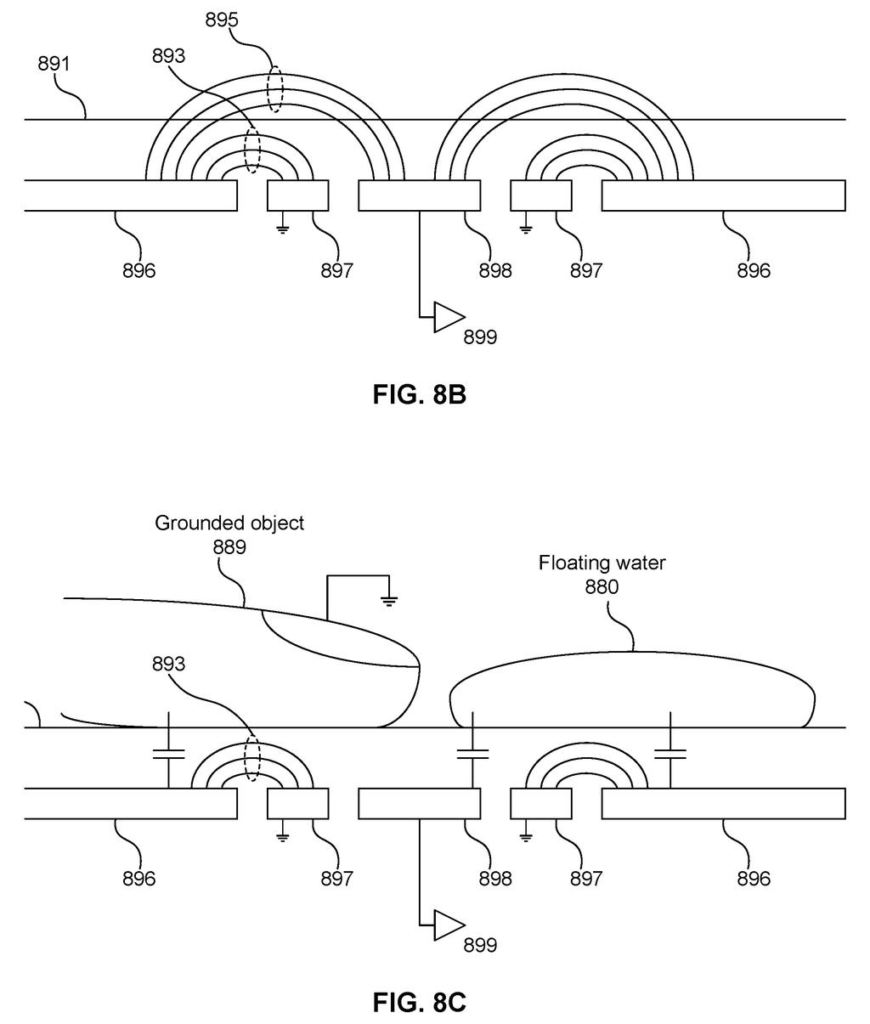
How Apple's screen would spot water, not just touches
A security camera stares at an empty hallway all night, picking up every shadow and calling it a threat. Your phone's touchscreen has the same problem in the rain: it can't tell the difference between your finger and a bead of water, so it treats everything as a tap.
Apple's patent describes a new way to arrange the tiny sensors inside a touchscreen so the screen can actually distinguish between the two. The key insight is physics: water sitting on glass behaves differently than a grounded human finger. Water increases the electrical signal the screen picks up, while a real touch decreases it. By watching which direction the signal moves, the screen knows what it's dealing with.
The practical payoff is a phone that can ignore water droplets and respond only to actual touches, even when your hands are wet or you're caught in the rain.
… each first sense pixel including a first sense region and a first ground region, each first sense pixel positioned with respect to the one or more first drive pixels for capacitively coupling with the one or more first drive pixels …
Translation: Each sensing pixel splits its space into a sensing zone and a grounded zone to interact with the driving pixels.
How the checkerboard pixel layout separates water from skin
The patent describes a pixelated mutual capacitance sensing layout, a rearrangement of the microscopic electrodes already inside every modern touchscreen.
Instead of the usual grid, the electrodes are organized into a checkerboard pattern of alternating "drive" pixels (which send out an electrical signal) and "sense" pixels (which listen for that signal). Each sense pixel is further divided into sub-pixels: a small inner sense region surrounded by a ground region. The ground region acts as a buffer, reducing background electrical noise so the sense region only picks up meaningful changes.
Here's the critical distinction the design exploits:
- A real finger touch: your body is electrically grounded, so it absorbs some of the signal and the measured capacitance (the strength of the electrical coupling) drops.
- Floating water: a water droplet sitting on the screen is not grounded, so it adds an extra electrical path and the measured capacitance rises.
The sense circuit monitors the direction of the change, not just whether a change happened. A drop in signal means finger. A rise in signal means water. That directional test is what makes the detection reliable even when both a finger and water are present at the same time.
The presence of grounded objects shunts some charge to ground and reduces the mutual capacitance, while floating water provides and additional parallel mutual capacitance path that increases the mutual capacitance.
Translation: Fingers drain away electrical charge and lower the signal, whereas pools of water add extra charge and raise it.
What this means for using your iPhone in the rain
Touchscreen misfires in wet conditions are one of the most annoying everyday phone problems, and no software patch fully solves it because the underlying sensor can't tell water from skin. Apple's approach attacks the problem at the hardware level, in the sensor geometry itself, which means a fix could work without the software constantly second-guessing every tap.
For your daily life, this could mean a phone that works properly while you're cooking with wet hands, caught in a drizzle, or scrolling by the pool. It also matters for wearables: an Apple Watch exposed to sweat and splashes faces exactly the same problem, and the same sensor design could apply there.
Apple's 46th filing in our cell phone patents we've tracked since May follows split-screen across two devices and a wireless charging data fix.
The change described here is a new pattern etched into the electrode grid already inside every touchscreen, rearranging which tiny patches send signals and which ones listen. That keeps the path to a real product short: no extra chip, no added sensor layer, just a retool at the component level with suppliers Apple already works with.
What still has to happen is confirming the new pattern does not hurt normal finger-tracking, then training the software to tell a water droplet from a fingertip reliably. Neither step requires technology that does not already exist, which makes this closer to a shipping feature than most patent filings suggest.
Touchscreens that ignore your finger in the rain are a persistent, everyday frustration, and a fix built directly into the screen with no added hardware cost is exactly the quiet improvement that lands in one product cycle and makes people wonder why it took so long.
There are more where this came from
We read every patent application Big Tech publishes and send you the ones worth knowing. Plain English, free, every week.
The drawings
9 drawing sheets from US 2026/0277365 A1 · click any drawing to enlarge


Want this weekly breakdown for a company we don't cover? Patentlyze Pro →
Be the first to weigh in