
Apple Patents a System for Splitting Your Screen Across Two Devices
When your iPhone connects to another screen, who decides what goes where? Apple has filed a patent describing exactly how two devices negotiate, in real time, which part of a shared display each one owns.
How Apple's two-device UI handoff actually works
A driver's-seat screen lights up in a car, showing a navigation map on one half and a music player on the other. Two separate devices built that display together, and they had to agree on who draws what.
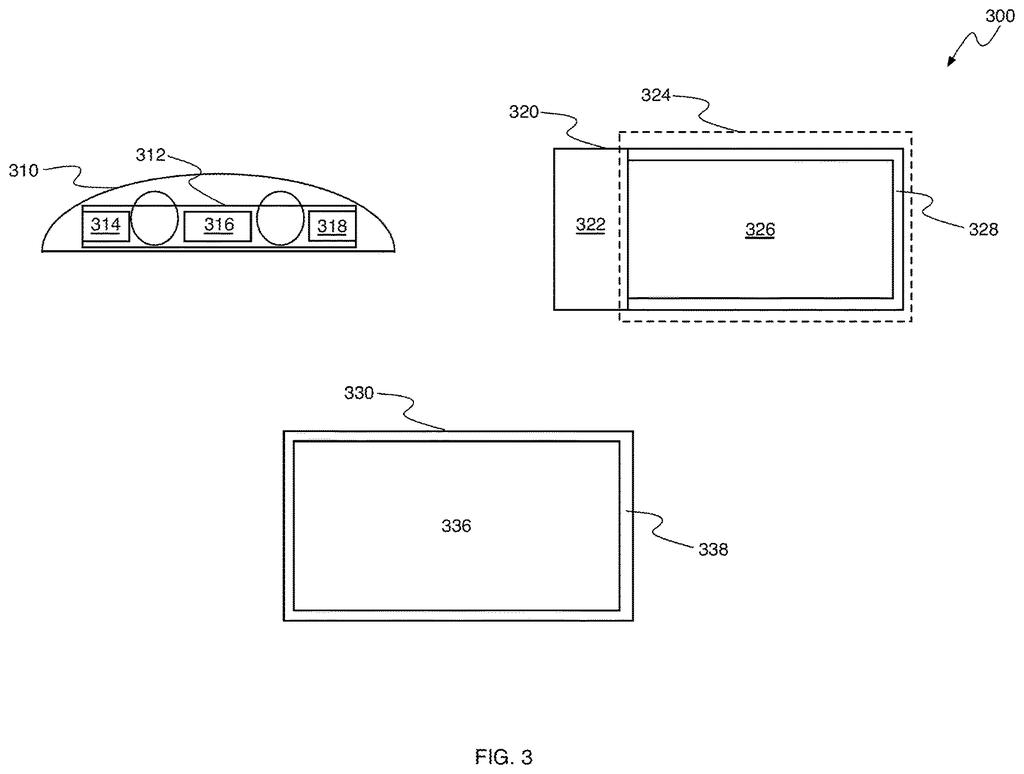
That coordination problem is what Apple is solving here. When your iPhone (or another Apple device) connects to an accessory that has its own screen, like a car console, a Vision Pro-style headset, or a smart display, the accessory tells your iPhone exactly how much screen space it has and which rectangular region it is allowed to use. Your iPhone then draws only into that region, sends the image over, and the accessory stitches both pieces together into one finished display.
The system also handles transitions. If the accessory reassigns your iPhone to a different portion of the screen, your iPhone gets updated instructions and redraws its content to fit the new area automatically. You would not see a glitch or a black box; the handoff is coordinated before the frame is shown.
… receiving, by the first device from the second device, information defining a second view area of the display screen having at least one characteristic different from the first view area; …
Translation: The main device learns how the second screen changed its layout.
How the host device maps UI regions to a shared buffer
The patent describes a protocol between a primary device (the iPhone or iPad doing the computing) and an accessory device (a secondary screen that assembles the final display).
Here is how the exchange works:
- The accessory sends the primary device a configuration payload that specifies its total screen dimensions and one or more named view areas (sub-regions, defined by coordinates and size).
- The primary device allocates a display buffer the size of the accessory's full screen, then renders its interface only inside whichever view area the accessory has currently assigned to it.
- It then transmits complete video frames covering the entire buffer to the accessory. Most of the buffer is empty (transparent or black); the content lives only in the assigned region.
- When the accessory wants to resize or move the primary device's portion of the screen, it sends a new view-area definition. The primary device regenerates its interface to match and begins sending updated frames.
The accessory then composites (layers) those incoming frames on top of its own locally generated interface to produce the unified display the user sees. The claim covers the protocol from the primary device's side: receiving the region definition, drawing to it, and transmitting the result.
The user device can generate a display buffer based on the maximum GUI display area, generate a graphical user interface in an area of the buffer corresponding to a current view area specified by the accessory device, and send to the accessory device video frames corresponding to the display buffer.
Translation: The main device renders the graphics to fit the accessory screen dimensions before sending over video.
What this means for iPhone-powered external displays
For you as a user, this is the plumbing behind any scenario where your iPhone should act as the brain for a screen it does not fully control. Car infotainment systems, external monitors, mixed-reality headsets, and smart displays all need a way to tell the connected phone exactly where to draw, and to update that instruction without causing visible tearing or blank patches.
Several Apple filings on multi-device display coordination this year point toward a future where the boundary between your phone and a nearby screen is meant to feel invisible. This patent handles the low-level agreement that makes that feel possible: both devices stay in sync on layout before any pixel is shown, so transitions look deliberate rather than broken.
Apple's 23rd filing we've tracked since May on passing control between devices adds to earlier work like shared device permissions and nearby content sharing.
The moment you'd notice this working is when you move an app from one part of a shared screen to another and nothing flickers. The display stays smooth because your phone has already prepared the image for wherever it might need to appear, rather than scrambling to repaint after the fact.
That seamlessness matters because flicker reads as cheapness, and cheapness erodes trust in a product. Apple is solving for the feeling of the experience, not just the function.
The open question is whether a display accessory that actually uses this protocol ever ships. The patent describes rules for a conversation between your phone and an external screen, but someone still has to build the screen.
There are more where this came from
We read every patent application Big Tech publishes and send you the ones worth knowing. Plain English, free, every week.
The drawings
9 drawing sheets from US 2026/0277528 A1 · click any drawing to enlarge


Want this weekly breakdown for a company we don't cover? Patentlyze Pro →