
Wing Aviation Patents a System That Parks Delivery Drones in a Queue After Landing
Landing a delivery drone is only half the problem. Wing Aviation has filed a patent for a system that tells the drone where to go next, moving it off the landing pad and into a holding queue so another drone can land right behind it.
What Wing's drone parking track actually does
You're standing near a Wing delivery hub as a drone drops off a package and sets down on the landing pad. The pad is small, there are more drones inbound, and the one that just landed needs to get out of the way fast.
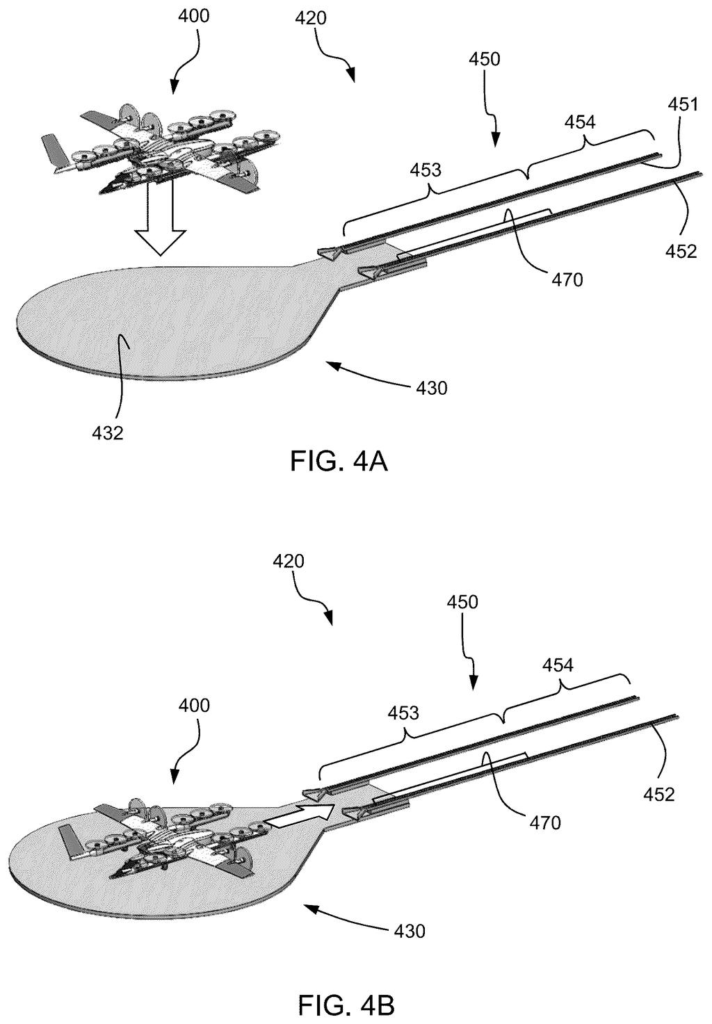
That's exactly the problem this patent tackles. Wing describes a setup where a landing pad connects to one or more tracks, like short runways branching off a runway threshold. After a drone touches down, a guidance system nudges it to roll or slide sideways off the pad and onto the track, freeing up the pad for the next arrival. The track is long enough to hold several drones queued up in a row.
Think of it like a parking lot exit lane at an airport gate. The plane (or drone) pulls forward so the next one can dock. It's a logistics fix, not a flying fix, and that makes it immediately practical for anyone building out drone delivery infrastructure at scale.
a landing pad including a support surface for receiving a UAV; a first track extending from the landing pad, the first track having a length sufficient to hold one or more UAVs; and at least one guidance component configured to direct the UAV to laterally navigate along the landing pad onto the first track after landing on the landing pad.
Translation: A landing area connects to a track that guides landed drones into a parking line.
How the landing pad guides a drone onto its track slot
The patent describes a holding system made up of three main pieces: a landing pad, at least one track extending from that pad, and a guidance component that manages the handoff between the two.
The landing pad has a support surface sized to receive an incoming UAV. Once the drone lands, the guidance component, which could be physical rails, electronic signals, or some combination, directs the drone to move laterally (sideways or forward along the pad's edge) until it transitions onto the track. The track is designed to hold one or more drones lined up in sequence, essentially a parking queue.
The key design detail is that this navigation happens after landing, on the ground, not in the air. The drone doesn't need to hover or reposition aerially; it shuffles along the surface. This keeps the airspace above the pad clear and the landing surface available for the next inbound drone with minimal delay.
- Landing pad: receives the incoming UAV
- Track: holds queued UAVs after they clear the pad
- Guidance component: directs the lateral ground movement from pad to track
A holding system is described for uncrewed aerial vehicles (UAVs). The holding system includes a landing pad including a support surface for receiving a UAV. The holding system further includes a first track extending from the landing pad, the first track having a length sufficient to hold one or more UAVs.
Translation: The invention provides a structured way to line up multiple landed drones in an organized queue.
What this means for high-volume drone delivery hubs
The bottleneck in drone delivery isn't the flight, it's the throughput at the endpoints. If a landing pad can only serve one drone at a time and each drone sits on it for several minutes while it's unloaded or recharged, your delivery capacity is severely limited no matter how many drones are in the air.
A queuing track turns a single-slot landing pad into something closer to a multi-bay loading dock. Wing's string of drone infrastructure filings suggests the company is thinking hard about the physical systems needed to run deliveries at real commercial volume, not just demonstration scale. For neighborhoods that could eventually rely on drone drops for everyday packages, getting the ground-side logistics right is what makes the whole system viable.
Google's second filing in Robotics patents we've tracked since September follows a drone rail calibration system.
The problem this patent addresses is real and underappreciated. Most public attention to drone delivery focuses on flight range, battery life, or regulatory approval. Far less attention goes to what happens at the landing end, specifically how you keep drones moving through a hub without creating a traffic jam on the ground.
A track-and-queue approach is a reasonable match for the problem's size. It borrows from decades of ground logistics thinking: assembly lines, baggage carousels, airport taxiways. Applying that thinking to UAV hubs is not a stroke of genius, but it is a necessary engineering step for anyone serious about running dozens or hundreds of daily drone deliveries from a fixed location.
The patent is narrow in scope and light on technical novelty. Its value is probably more about establishing ownership of a specific physical configuration than about solving a hard engineering puzzle. Whether Wing ever deploys hardware that matches this description is the more interesting question.
There are more where this came from
We read every patent application Big Tech publishes and send you the ones worth knowing. Plain English, free, every week.
The drawings
26 drawing sheets from US 2026/0274470 A1 · click any drawing to enlarge


Want this weekly breakdown for a company we don't cover? Patentlyze Pro →