
Sony Patents a Robot Hand That Corrects Its Own Grip by Sensing Pressure
Inserting a small part into a tight socket is one of the hardest things for a robot to do reliably. Sony's new patent teaches a robotic hand to feel when something is off-center and nudge itself back into alignment before the part even touches the hole.
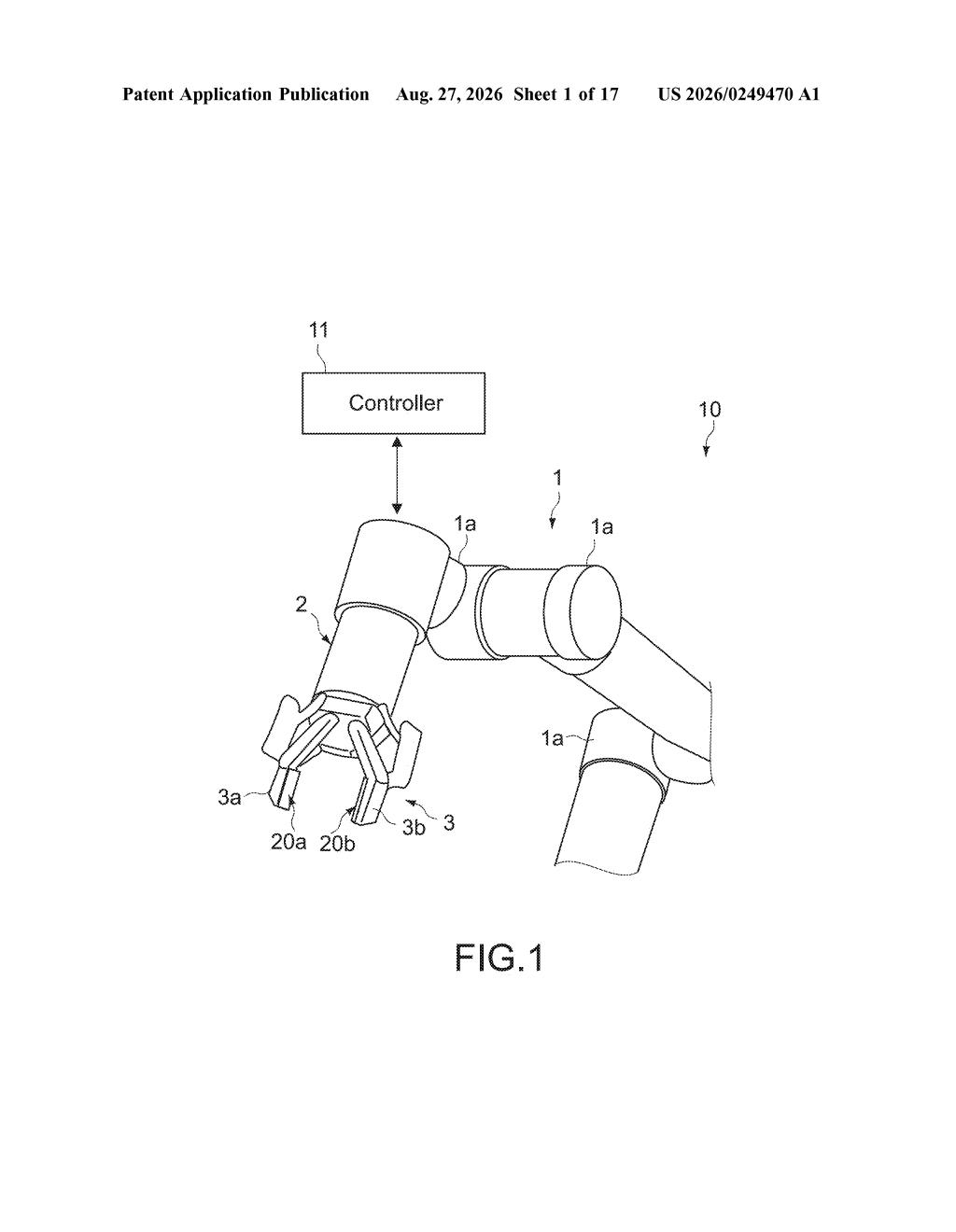
How Sony's pressure-reading robot hand fixes its own aim
Ever tried to plug a USB cable into a port in the dark, and realized you had to tilt the connector slightly before it would slide in? Robots face that exact problem, millions of times a day on factory floors, except they usually can't feel the cable at all.
Sony's patent describes a robot hand with pressure sensors spread across each fingertip. When the hand pushes a part toward a socket and the part isn't quite lined up, it tilts slightly and presses harder on one side of the fingers than the other. The sensors detect that uneven pressure, and the hand's computer works out which direction the part needs to shift, then moves the whole hand to fix the alignment.
The result is a robot that can correct its own insertion attempts in real time, without a camera or a human watching. It uses touch the same way you'd use feel to guide a key into a lock without looking.
… a sensor portion which is provided to at least one of the plurality of finger portions, the sensor portion being capable of detecting a distribution of a pressure acting on the gripping surface …
Translation: The robot has sensors on its fingers that can measure exactly how much pressure is being applied to the object it holds.
How fingertip pressure maps guide the hand's correction
The system has three main parts working together:
- A multi-fingered hand that grips a workpiece (any small part being inserted) from the sides, holding it along what the patent calls the "second axis" while the insertion direction runs along the "first axis."
- Pressure-distribution sensors on at least one finger, capable of reading not just whether pressure is present but where across the fingertip surface it is concentrated. Think of it like a tiny touch screen on each fingertip that maps out a pressure heatmap.
- A control device that interprets the heatmap. When the part is pushed toward the socket opening and catches on the edge instead of sliding in, the uneven contact creates a moment (a rotational force) on the part. The sensor reads how pressure shifts across the fingertip, the controller calculates the direction of that rotational force, and it generates a correction command to reposition the hand.
The correction happens before the system tries to push any harder. By detecting the direction of the off-center tilt rather than just the fact that something is stuck, the robot can make a targeted adjustment instead of backing off and trying again blindly.
This is a tactile-feedback loop, the robot equivalent of the small wrist adjustments a technician makes instinctively when assembling precision parts by hand.
The control device is configured to determine a direction of a moment that acts on the piece of work, on the basis of an output from the sensor portion that is obtained when the piece of work is pressed against the opening surface …
Translation: The robot senses the twisting force on an object when it hits a surface to figure out if it is tilted or misaligned.
What this means for factory robots handling tight-fit parts
Tight-tolerance assembly is one of the last places on the factory floor where human hands still outperform robots. Pressing a connector into a circuit board, inserting a shaft into a bearing, or fitting a lens into a housing all require the kind of real-time feel that cameras and standard force sensors struggle to replicate cheaply. A system that reads pressure distribution across the fingertip and translates it into a precise directional correction could make robots reliable for that class of task without expensive vision systems or custom jigs for every part.
For Sony specifically, the technology sits close to its existing robotics and precision electronics manufacturing interests. The patent does not require exotic new materials, just sensor arrays already within reach of current production, which shortens the path from a research filing to something that could appear in an assembly line. Robotics assembly sensing is one area where new Big Tech patents keep clustering, as companies race to close the gap between human dexterity and what an automated hand can actually feel.
This is the fourth Sony filing we've tracked since July on robot grasping and moving, building on two-layer artificial skin and the thumb work.
The sensors and gripping fingers this system needs are already manufactured and sold today, so the biggest lift here is writing the correction logic that ties them together, not building new physical parts from scratch. The patent is narrowly focused on pushing a part straight into a socket, which means a factory could validate this on one specific task without betting on a sprawling, unproven system.
That tight scope is actually an advantage for getting something real onto a production line quickly. Slippery materials or curved insertion paths would need more work before this could cover a full factory floor, but for the defined problem it addresses, the distance between this document and a working product is unusually short.
Get our take in your Top Stories
Liked this breakdown? Add Patentlyze as a preferred source on Google, and our plain-English take shows up more often in your Top Stories the next time Sony patent news breaks.
There are more where this came from
We read every patent application Big Tech publishes and send you the ones worth knowing. Plain English, free, every week.
The drawings
17 drawing sheets from US 2026/0249470 A1 · click any drawing to enlarge


Want this weekly breakdown for a company we don't cover? Patentlyze Pro →
Be the first to weigh in