
Wing Aviation Patents a System That Reorders Delivery Drones Before They Launch
Loading drones for delivery in the wrong order could mean a rush package leaves last. Wing Aviation is patenting a track system that lets operators rearrange the queue before any drone takes off.
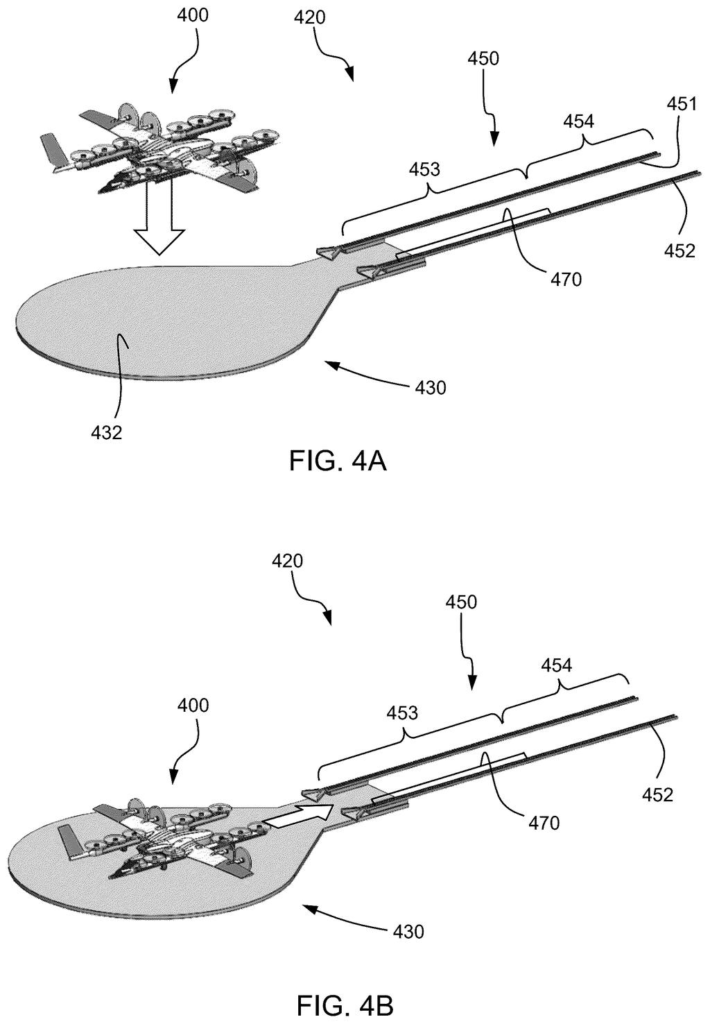
How Wing's drone queue-shuffling track actually works
A row of delivery drones sits lined up on a track, waiting to launch. The one at the front goes first, the one at the back goes last, and if priorities change, you're stuck with whatever order they were loaded in.
Wing's patent describes a smarter setup. The holding track connects to at least one open area where a drone can pull off the main line, let others pass, and then rejoin in a different spot. Think of it like a passing lane on a highway, except it's for drones waiting their turn on a launch rail.
The practical payoff is flexibility. If a time-sensitive delivery gets added to the schedule after the drones are already lined up, the system can shuffle the queue so that drone moves to the front without having to physically unload and reload everything by hand.
a first track having: a retaining section with a length sufficient to hold a sequence of UAVs; and a takeoff section enabling vertical UAV takeoff; and at least one UAV navigable area configured to receive the UAV from the first track to change the sequence of UAVs prior to the UAVs taking off from the takeoff section.
Translation: A track holds a line of drones before they launch straight up, while an open area lets the system shuffle their departure order.
How the holding track and side area change launch order
The patent describes a physical holding system with two main parts: a retaining section (a long track that can hold a line of drones) and a takeoff section (the end of the track from which each drone launches vertically, straight up).
The key addition is a UAV navigable area, a side zone off the main track that individual drones can enter and exit. By pulling a drone off the main line into that area, the system allows the drones behind it to advance, effectively changing the launch sequence on the fly.
- Drones queue along the retaining section in initial order
- A drone that needs to move in priority pulls into the navigable side area
- Other drones advance along the main track past it
- The repositioned drone rejoins the line at its new position
- Drones then reach the takeoff section and launch vertically one by one
The claim is written around the hardware itself, meaning a physical track-and-side-area configuration, not a software scheduling algorithm. That distinction matters for what would actually have to be built to use this.
What reorderable drone queues mean for delivery speed
For a drone delivery service, launch order is delivery order. If a drone carrying a medical item or a late-priority package gets stuck behind drones loaded for earlier, lower-priority runs, the system can't respond without manual intervention. A reorderable queue removes that bottleneck without requiring operators to physically unload and reload drones.
The design also hints at scale. A fixed first-in, first-out launch rail works fine with a handful of drones but becomes a problem when a facility is managing dozens at once. a growing pile of Wing Aviation delivery-infrastructure filings suggests the company is thinking about depot operations as a real engineering challenge, not just airspace and routing.
Google's 14th chip filing we've tracked since May adds to a run that includes one on quantum hardware diagnosis and one reusing CPU instructions for AI, all within our Chip patent coverage.
Getting this from blueprint to reality requires building new physical hardware, not writing new software. The system depends on actual metal rails and side parking spots that have to be bolted onto a real facility before anything else can happen.
The document skips over several problems that matter before shipping: how a drone stays put while waiting in a side area, what decides which drone moves next, and whether any of it works in rain or wind. Those are construction and operations questions, not research questions, which means the timeline depends on money and effort rather than breakthroughs.
If Google is already running depots with multiple drones queued up, controlling the order they leave is a practical necessity, not a luxury. The shortest path to a working product is probably a physical prototype attached to an existing facility, and this document reads like the early blueprint for exactly that.
There are more where this came from
We read every patent application Big Tech publishes and send you the ones worth knowing. Plain English, free, every week.
The drawings
27 drawing sheets from US 2026/0274469 A1 · click any drawing to enlarge


Want this weekly breakdown for a company we don't cover? Patentlyze Pro →
Be the first to weigh in