
Google Patents a Fix That Keeps Rich Photo Detail When Hardware Falls Short
Google is filing patents on a compression trick that lets its image processors handle richer, more detailed photos than those chips were originally designed to support, without throwing away the extra color and brightness data.
What Google's HDR photo compression actually does
A smartphone camera captures a stunning sunset. The image is packed with color detail across very bright and very dark areas at the same time. The chip inside the phone responsible for saving that photo, though, was built for a simpler era and can only handle a certain amount of information. Something has to give.
Google's patent describes a method that works around that hardware ceiling. Before the image gets handed off to the compression chip, the system runs the photo through two mathematical steps: one that reorganizes its colors, and one (called a discrete cosine transform, borrowed from JPEG technology) that breaks the image into frequency patterns. The system then carefully rounds those patterns in a way that keeps errors small, producing a compressed file that carries more bit depth than the chip was supposed to be able to handle.
The result, if this works as described, is that high dynamic range photos (the kind that capture both the bright sky and the shadowy details beneath it) could be compressed and stored without losing the richness that makes them worth taking.
… applying, based on the first number of bits, a linear transform to the received image, wherein the linear transform comprises: (i) a color transform, and (ii) a discrete cosine transform (DCT), to generate a frequency spectrum comprising one or more frequency components …
Translation: The system converts the photo's data into frequency waves using color and mathematical transforms.
How the color transform and DCT squeeze extra bit depth in
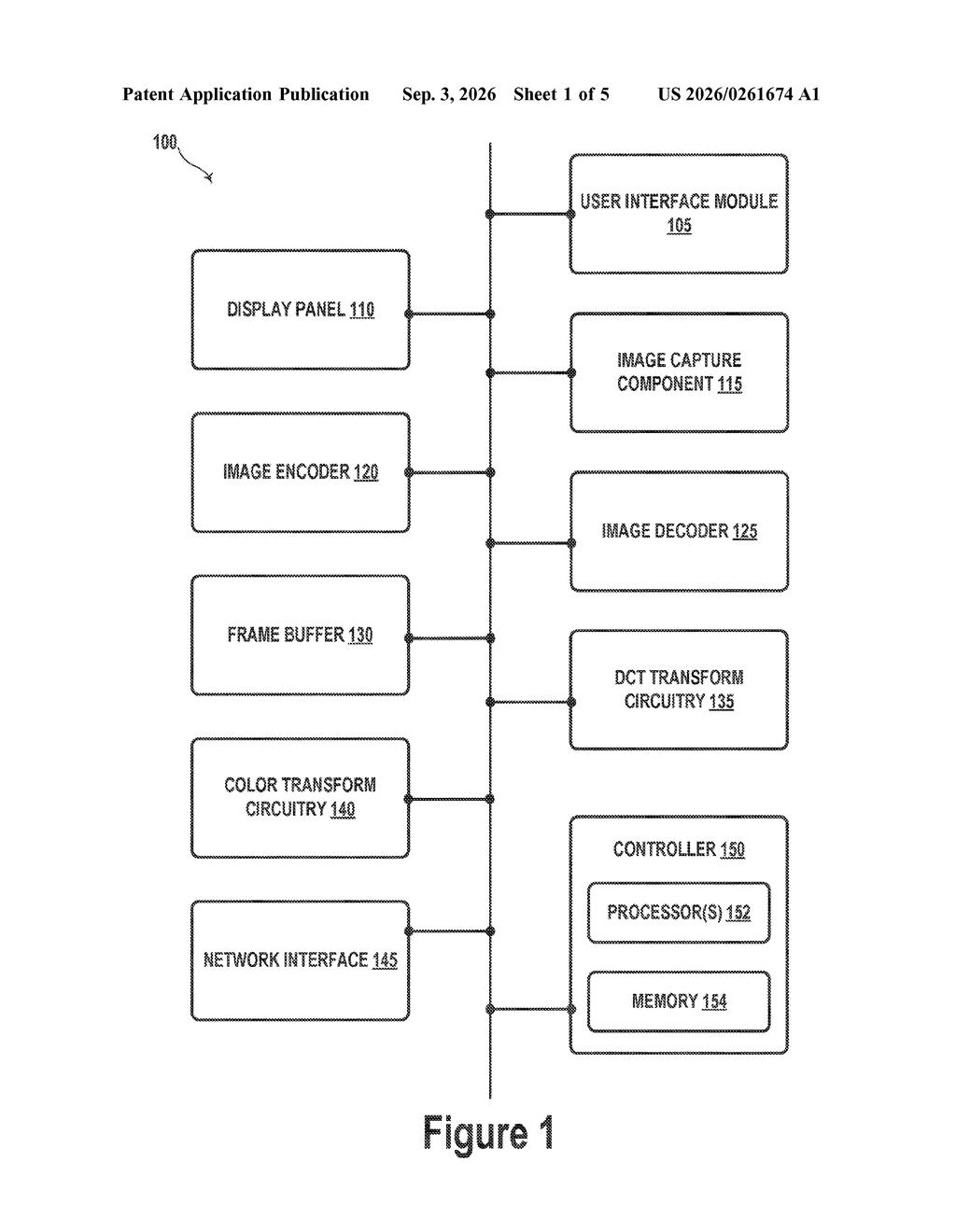
The patent describes a pipeline that sits between a camera's frame buffer (a temporary holding area for raw image data) and the device's dedicated image-compression hardware.
The core steps are:
- Color transform: the image's color channels are mathematically remixed into a form that's easier to compress without losing important detail.
- Discrete cosine transform (DCT): the same mathematical tool at the heart of JPEG, which converts the image from a grid of pixels into a set of frequency components, essentially describing the image as waves of light and color rather than individual dots.
- Quantization with reduced error: each frequency component's strength is rounded to fit the chip's limits, but the number of rounding steps is tuned specifically to keep the rounding error small, preserving more information than a naive approach would.
The critical claim is that the final compressed image ends up carrying a second number of bits that is larger than the bit capacity the image processor was designed for. In other words, the pipeline extracts more fidelity from the hardware than the hardware officially supports, by being clever about how it packages the data before the chip ever touches it.
The method applies this linear transform dynamically based on how many bits the incoming image contains, so the processing adjusts to different camera modes or sensor configurations.
A number of quantization steps to be applied is configured to reduce error in the one or more frequency components. The method includes generating, by an image processor and based on the quantizing, a compressed image comprising a second number of bits. The second number of bits is larger than a bit capacity for compression associated with the image processor.
Translation: It carefully tunes the compression quality so the resulting file safely exceeds the processor's normal limits.
What this means for high-end phone photography
For everyday users, this is about whether your phone's best photos actually survive the act of saving them. High dynamic range shooting has become a standard feature on flagship phones, but the gap between what sensors can capture and what compression chips were built to handle is a real engineering constraint. A patent like this targets that gap directly.
Google's run of computational photography filings suggests the company sees image processing as a long-term hardware differentiator. If this technique ships in a future Pixel or in Android's camera stack more broadly, it could mean HDR photos stored on your device retain more of the detail the camera actually captured, rather than being downgraded the moment you hit the shutter.
Google's 44th filing we've tracked since May in the AI photo editing race adds to a pattern that includes one rebuilding video in layers and a step-by-step noise removal method.
Claim 1 covers any software method that takes a high-detail image from a camera, runs it through two mathematical steps (a color adjustment and a frequency-sorting process), trims down the data to fit the hardware, and spits out a compressed image. There are no limits on what kind of device, chip, or camera must be involved.
That scope matters in practice. Because the claim names no specific thresholds, error measurements, or hardware requirements, it could apply to nearly any phone or tablet pipeline that compresses camera images, which is almost all of them.
If granted, this patent could give Google standing to challenge a wide range of image-processing software built around standard compression techniques, on the basis that they receive a high-detail image and reduce it through color and frequency steps. That is a broad gate to hold.
Get our take in your Top Stories
Liked this breakdown? Add Patentlyze as a preferred source on Google, and our plain-English take shows up more often in your Top Stories the next time Google patent news breaks.
There are more where this came from
We read every patent application Big Tech publishes and send you the ones worth knowing. Plain English, free, every week.
The drawings
5 drawing sheets from US 2026/0261674 A1 · click any drawing to enlarge


Want this weekly breakdown for a company we don't cover? Patentlyze Pro →
Be the first to weigh in