
Samsung Patents a Shaped Wheel That Guides Robot Vacuums Straight onto Their Charging Base
Missing the dock is one of the most common ways a robot vacuum fails at its one job. Samsung's new patent tackles it with a mechanical trick borrowed from old-school rail transport.
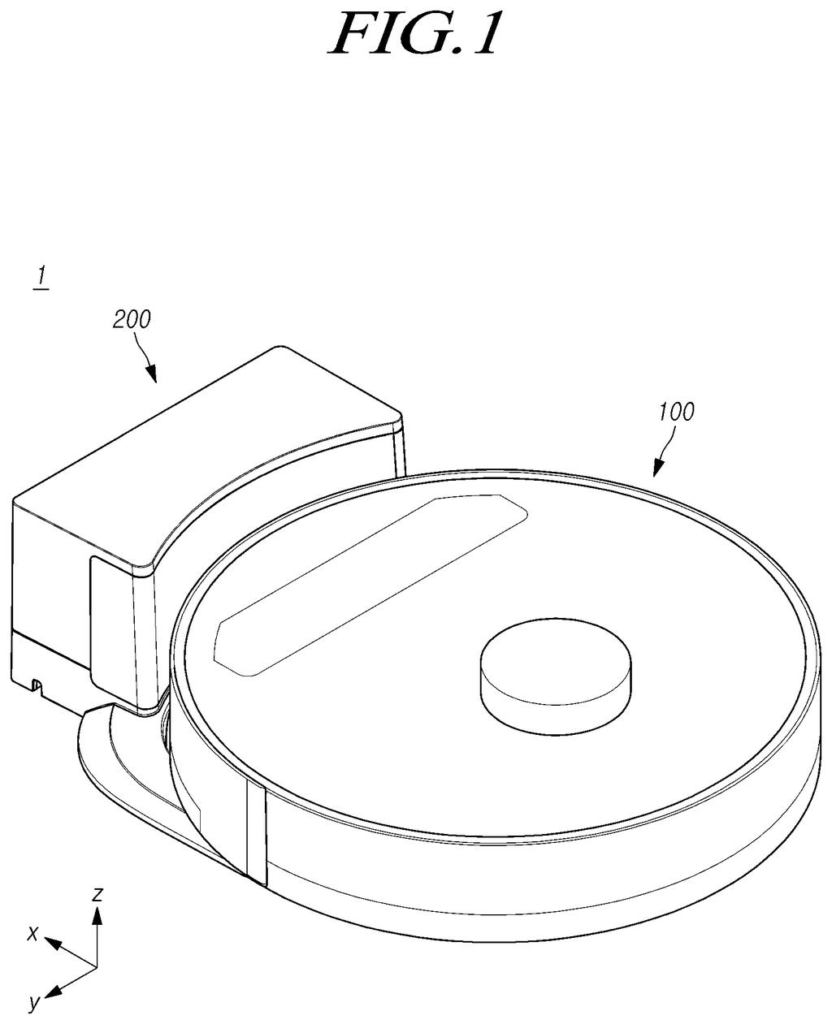
What Samsung's guide-wheel docking system actually does
Robot vacuums are supposed to handle themselves, but docking correctly is harder than it looks. If the vacuum rolls onto its charging base even slightly off-center, it can miss the contacts, sit uncharged, and stop cleaning until you notice and fix it manually.
Samsung's patent describes a fix that is entirely physical, no extra sensors required. The robot has a special wheel whose middle is narrower than its edges, giving it an hourglass or spool shape. The docking station has a raised rail on its surface that fits into that narrower center section. When the vacuum rolls toward the base, the rail catches the wheel and physically steers the robot into the correct position, the way a train wheel is kept on a track.
The result is that the vacuum lines up accurately every time, even if it approaches from a slightly wrong angle. Your robot should charge reliably without you needing to babysit it.
… a guide wheel configured such that a diameter of a central portion thereof is less than a diameter of longitudinal edges thereof …
Translation: The special wheel is narrower in the middle than it is on the outer edges.
How the hourglass wheel and rail keep alignment locked
The patent covers two components working together: a modified guide wheel on the robot and a guide rail on the docking station's upper surface.
The guide wheel has a smaller diameter at its center than at its two outer edges. Picture a spool of thread or a bobbin: the middle pinches inward while the flanges flare out. This shape is what makes the alignment possible.
The guide rail on the docking station protrudes upward from the base's surface. When the robot rolls toward the dock, the rail slides into the narrowed center section of the guide wheel. The flanges on either side of the wheel then sit around the rail, locking lateral movement and correcting any small angle errors in the robot's approach.
The robot still has its standard pair of drive wheels for normal floor movement. The guide wheel appears to be a separate, passive component whose only job is interfacing with the rail during docking. The claim covers the combination of that specific wheel shape (center diameter smaller than edge diameters) and the corresponding rail geometry, which together create a self-centering mechanical system without requiring camera or sensor-based correction.
… a base portion and a guide rail formed on an upper surface of the base portion, the guide rail being configured to guide the movement of the guide wheel …
Translation: The charging base uses a built in track to steer the vacuum into place.
What this means for robot vacuum reliability at home
For anyone who owns a robot vacuum, a reliable dock means the robot is actually ready to clean the next time you need it. A mechanical centering system adds no software complexity and doesn't depend on a camera staying clean or a sensor staying calibrated. It either works or it doesn't, and the geometry here means it should work consistently.
From an engineering standpoint, this is a low-cost fix to a problem that has frustrated users across every brand. If Samsung builds this into future models, it could become a selling point in a product category where reliability is a bigger differentiator than most companies admit.
Samsung's 45th filing in home robots we've tracked since May adds to a series that includes a self-extending charging dock and a mid-scan laser system.
Claim 1 is narrow in the most useful sense: it covers a specific physical combination, a wheel with a center diameter smaller than its edge diameters, paired with a guide rail that matches it. That precision actually gives the claim real teeth. A competitor cannot sidestep it by changing software or sensors; they would have to use a different wheel shape or a different docking mechanism entirely.
The flip side is that the claim does not cover every approach to docking alignment, only this rail-and-spool geometry. Competitors could pursue magnetic alignment, optical centering, or friction-pad approaches without touching this filing.
Still, the claim describes something that is cheap to manufacture, easy to test, and solves a real consumer annoyance. For a product category where the entire value proposition is "it runs itself," that is a meaningful engineering choice.
There are more where this came from
We read every patent application Big Tech publishes and send you the ones worth knowing. Plain English, free, every week.
The drawings
16 drawing sheets from US 2026/0272249 A1 · click any drawing to enlarge


Want this weekly breakdown for a company we don't cover? Patentlyze Pro →