
Samsung Patents a Robot Charging Dock That Extends Its Own Contacts on Impact
A charging dock that doesn't need precise parking: Samsung's new patent describes a station that physically slows an approaching robot and then slides its own charging contacts forward to meet the robot's terminals, all triggered by a single bump.
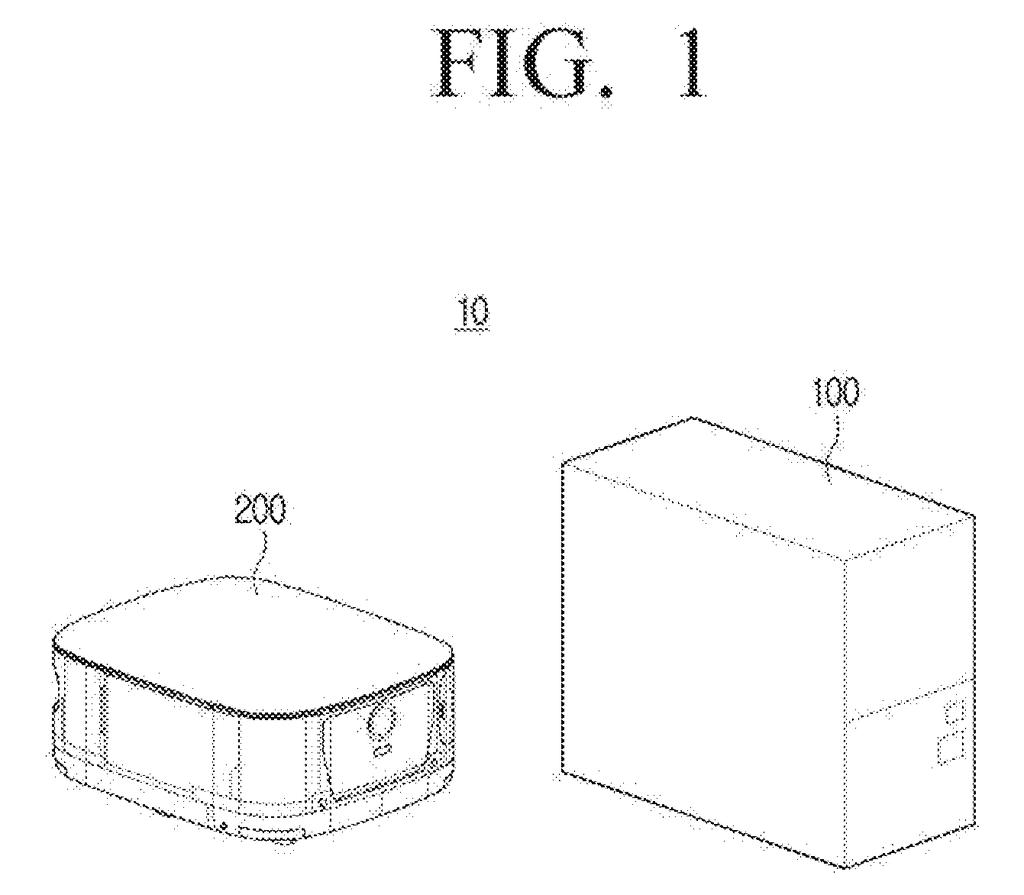
How Samsung's robot charging bump-and-lock system works
Ever tried to plug in a cable in the dark and missed the port three times? Robots face something like that every time they try to dock and recharge on their own.
Samsung's patent describes a charging station with a protruding piece, something like a small bumper or pin, that sticks out from the front of the dock. When the robot rolls in and touches that bumper, two things happen at once: the bumper pushes inward, slowing the robot down, and that same motion mechanically pushes the dock's charging contacts outward toward the robot. The faster the contact extends, the more surface area it shares with the robot's own terminal, so the connection gets stronger as the robot settles in.
The key idea is that no software alignment is needed. The physical design handles the slowing, the extending, and the connecting in one linked motion. If the robot is a little off-center or coming in at slightly the wrong speed, the system still works.
… based on the robot contacting the protruding member, the protruding member is retracted into the frame and reduces a traveling speed of the robot …
Translation: When the robot bumps into the dock, the bumper pushes in to slow it down.
How the bumper, spring, and terminal move together
The station has three core parts that work together as a single mechanical sequence.
First, a protruding member (think of it as a spring-loaded pin or paddle) sticks out from the front face of the dock. When the robot makes contact with it, that member compresses inward into the frame. The compression acts as a physical brake, absorbing some of the robot's forward momentum and reducing its speed before it fully seats in the dock.
Second, as that bumper retracts, it is mechanically linked to the dock's first charging terminal, which starts inside the frame at a resting position. As the bumper goes in, the terminal comes out, moving from an internal position to an external one where it can touch the robot's own charging terminal.
Third, the design ensures that the contact area between the two terminals grows gradually as the terminal extends. This means a brief or partial dock still makes some electrical contact, and a full dock makes maximum contact. The gradual increase likely helps avoid arcing or sudden current spikes that could happen if full contact happened instantaneously.
The claim does not specify whether the linkage between bumper and terminal is a spring, a cam, or a lever arm, leaving Samsung room to implement it in several ways. The core invention is the coordination of three effects from one physical event: slow, extend, connect.
… as the first charging terminal protrudes to the outside of the frame, a contact area between the first charging terminal and a second charging terminal of the robot gradually increases …
Translation: As the parts shift, the electrical connection grows to securely link the two devices.
What this means for home robots that charge themselves
For home robots like robotic vacuums or future household assistants, reliable self-docking is one of the hardest everyday problems. Most current systems rely on infrared beacons, cameras, or software to guide the robot in with precision. Those approaches work, but they add cost and can fail if the dock is slightly moved or the lighting changes.
Samsung's mechanical approach trades software complexity for physical simplicity. the pattern in Samsung's home-robot filings points toward robots that handle more of daily life autonomously, and a charging dock that works without a software handshake fits that direction. The tradeoff is that a purely mechanical system can wear out over thousands of docking cycles, and the bumper tolerances have to be tight enough to work even when a robot arrives at an angle. Whether the mechanical durability holds up over years of daily use is the real question this patent leaves open.
Samsung's 44th filing we've tracked since May in our home robot work builds on ideas like a mid-scan laser switch and slowing near high surfaces.
Samsung's dock skips the software and uses a physical bumper to slow the robot, extend the charging pins, and complete the connection automatically. That simplicity is real, but every part that moves is a part that wears out, and after thousands of docking cycles, the small gaps and springs that make the sequence work reliably can drift just enough to make it stop working reliably.
The design also assumes the robot arrives close to straight and at a reasonable speed. A bumper can absorb momentum, but it cannot steer a robot that rolls in at a bad angle the way a camera or sensor system could.
For most households, none of that may matter for years, and a dock that just works without setup is a meaningful thing to offer. The question is whether the moving parts are built to last, because if they are, this is a smart simplification, and if they are not, the customer pays for the manufacturing shortcut in year three.
There are more where this came from
We read every patent application Big Tech publishes and send you the ones worth knowing. Plain English, free, every week.
The drawings
8 drawing sheets from US 2026/0274101 A1 · click any drawing to enlarge


Want this weekly breakdown for a company we don't cover? Patentlyze Pro →