
Qualcomm Patents a Way to Fix Inaccurate Distance Readings Between Phones
When two phones try to measure how far apart they are, radio signals bouncing off the floor can corrupt the result. Qualcomm's new patent proposes a fix: swap to a different radio channel the moment things start going wrong.
What Qualcomm's channel-switching distance fix actually does
Every time your phone figures out how far it is from another device, a radio signal makes a round trip between them. That sounds simple, but signals bounce off floors, walls, and ceilings, and those reflections can fool the system into thinking the two devices are much farther or closer apart than they really are.
Qualcomm's patent describes a process where two phones agree upfront on a list of radio channels they could use for distance measuring. They start on one channel, and if that channel produces noisy or unreliable readings, or if the distance between the devices changes enough to make a different channel more accurate, the lead device tells the other to switch. The switch happens mid-session, without starting over.
The goal is to keep distance measurements accurate and consistent even as conditions change around the devices, whether they're sitting on a table, moving through a room, or dealing with a concrete floor that's bouncing signals in every direction.
… switch to a second channel in the set of channels for the ranging based on at least one of (1) a distance between the first UE and the second UE or (2) a channel quality associated with the first channel or the second channel; …
Translation: The phones change the wireless frequency they use when distance or signal conditions change.
How the two devices negotiate and swap ranging channels
The patent addresses a specific problem in UWB or similar radio-based ranging (distance measurement by timing how long a signal takes to travel between two devices). Ground reflections, sometimes called multipath interference, arrive at the receiver a fraction of a second after the direct signal, muddying the timing data and throwing off the distance calculation.
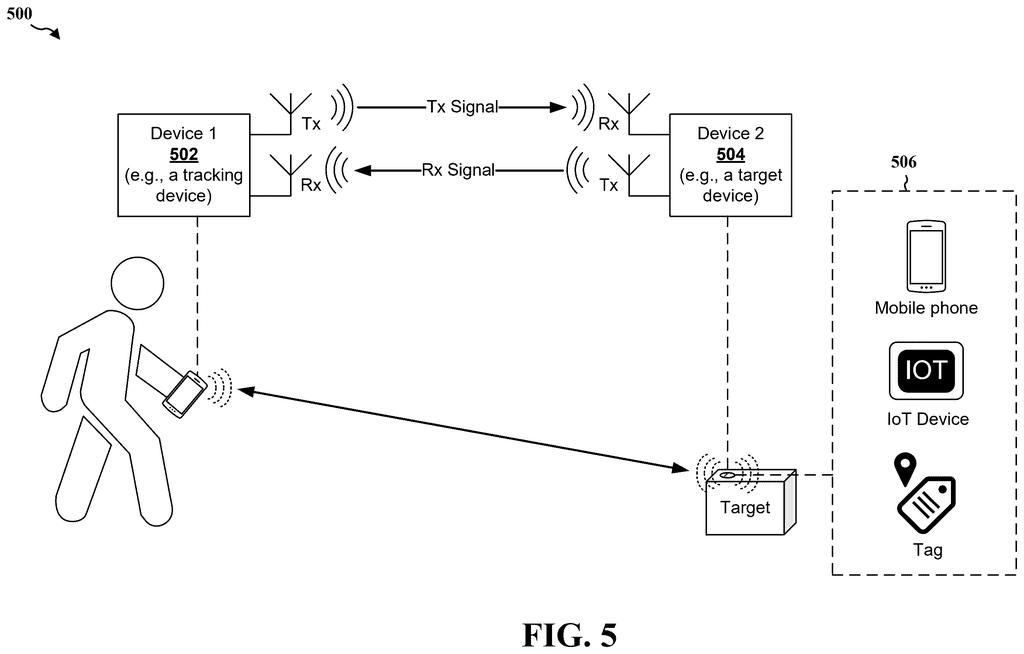
Qualcomm's solution uses multi-channel diversity, meaning the devices maintain a pre-agreed list of candidate radio channels. The first device (labeled UE1 in the patent) monitors two triggers:
- Distance thresholds: as the gap between the two devices grows or shrinks past certain points, a different channel may propagate more cleanly.
- Channel quality: real-time signal quality metrics flag when the current channel is degrading, even if distance hasn't changed much.
When either trigger fires, UE1 transmits a short control message telling UE2 to move to the new channel. Both devices shift together, and ranging resumes without the user noticing anything. The patent covers the signaling protocol for coordinating that switch, not just the decision logic.
The system is designed for peer-to-peer ranging, meaning two handsets talking directly to each other, not through a base station. That's the topology you'd see in proximity-based features like sharing files, paying at a register, or finding a friend in a crowd.
Aspects presented herein may enable a first user equipment (UE) to switch between different ranging channels during ranging with a second UE based on distance and/or channel quality, thereby improving the overall performance of the ranging.
Translation: Two devices can dynamically switch their connection channels to make distance measurements much more accurate.
What this means for phones that guide or locate each other
Distance measurement between consumer devices has been around in various forms for years, but accuracy has always been the weak link. A reading that's off by a meter doesn't matter much for navigation, but it matters a lot for precise handoffs, like automatically unlocking a car door only when you're right next to it, or directing you to the exact spot where a lost item is sitting.
Qualcomm's string of proximity and ranging filings suggests the company sees this as a core capability for the next wave of device interaction. If channel-switching makes ranging reliable enough to trust in messy real-world environments, features that currently feel finicky could start working the way they were always supposed to.
Qualcomm's 430th filing in our Qualcomm coverage since May adds to a body of work that includes a bouncing-signal locator and a light-based fingerprint sensor.
The fix described here lives entirely in software and communication rules, not in new radio chips. Devices that already support the underlying wireless standard could potentially gain this capability through a firmware update alone.
The catch is that both devices in a ranging session have to follow the same playbook. That means the approach needs to be written into an industry standard that phone makers and chipmakers adopt together before it reaches everyday products.
So the shortest road to a shipping feature runs through a standards body, not a factory floor, which is encouraging and slow in equal measure.
There are more where this came from
We read every patent application Big Tech publishes and send you the ones worth knowing. Plain English, free, every week.
The drawings
38 drawing sheets from US 2026/0292759 A1 · click any drawing to enlarge


Want this weekly breakdown for a company we don't cover? Patentlyze Pro →
Be the first to weigh in