
Qualcomm Patents an AI System for Routing Phone Data Across Radio Channels
Your phone juggles multiple invisible radio channels at once, and choosing the wrong one for a video call or a file download kills performance. Qualcomm's new patent applies AI to make that routing decision automatically.
What Qualcomm's AI traffic-sorting system actually does
You're streaming video on your phone while a background app syncs files, and somewhere inside the device, a decision is being made about which radio channel carries which chunk of data. Get that decision wrong and your video stutters even though the connection looks fine.
Modern phones connect to 5G or LTE networks through several separate "data radio bearers", think of them as dedicated lanes on a highway, each with different speed limits and priority rules. Today, which lane a packet of data goes into is usually decided by fixed rules written long before the network knew anything about your specific situation.
Qualcomm's patent describes letting an AI model make that lane-assignment call instead. The AI looks at the incoming data flow and picks the bearer most likely to deliver it well, in real time, rather than following a static rulebook.
… perform a bearer selection process to select, from among a plurality of data radio bearers configured for use by the UE to transmit flows on a network, a data radio bearer for transmission of the flow …
Translation: The device picks the best available radio channel for routing your phone's data traffic.
How the bearer selection process picks a radio channel
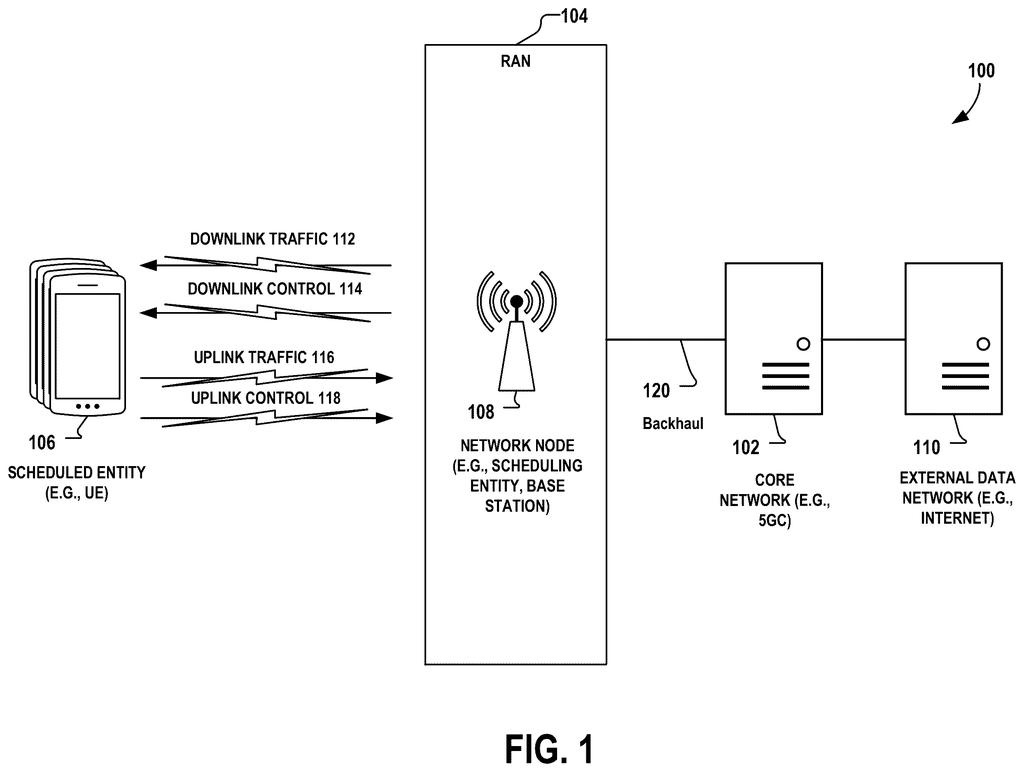
The patent covers a User Equipment (UE), the technical term for any device that connects to a cellular network, most commonly a smartphone, that runs an AI-driven "bearer selection process."
In cellular networks, a data radio bearer (DRB) is a configured logical pipe between the device and the base station. A phone can have several DRBs active at once, each tuned for different traffic types: one might be optimized for low-latency signaling, another for high-throughput bulk data. Traditionally, a fixed set of rules called QoS (Quality of Service) flow-to-bearer mapping decides which pipe carries which packet, based on pre-set priority labels.
Qualcomm's invention replaces or supplements that fixed mapping with an AI model running on the device itself. The model receives a data flow, evaluates context (the patent's broader description covers network conditions, flow characteristics, and bearer states), and selects the bearer dynamically.
- Obtain a flow: the processor identifies an incoming or outgoing data stream that needs to be transmitted.
- Bearer selection process: the AI model scores the available radio bearers and picks one.
- Transmission: the radio sends the data on the chosen bearer.
The AI approach matters because real-world traffic patterns are irregular and network conditions shift faster than static rules can adapt.
What this means for 5G call and data quality
For everyday users, better bearer selection means fewer mid-call quality drops, more consistent video streaming, and background app traffic that doesn't crowd out whatever you're actively doing. The phone's radio would be making smarter trade-offs in real time rather than following rules written for an average scenario that rarely matches yours.
The broader stakes are in 5G network design. As carriers push network slicing and increasingly complex bearer configurations, the static mapping rules that worked in 4G become a real bottleneck. several Qualcomm filings on AI-assisted radio resource management this year suggest the company sees on-device AI as the answer to that complexity, which would also differentiate its modem chips in a market where rivals are making the same hardware-spec claims.
Qualcomm's 471st filing in our Qualcomm coverage since May adds to a pattern that includes training AI across phones and smarter in-car network switching.
Claim 1 covers any phone that picks up a data flow, runs a selection process to choose which radio channel carries it, and then transmits. The claim text sets no requirement on how the AI works, how accurate it is, or whether it outperforms anything. That scope is sweeping by design.
In practice, that means any device using an AI-assisted routing step before sending data on a multi-channel network would fall inside this claim. The claim does not care whether the AI is a large model or a small one, whether it improves performance, or whether it ever makes a correct decision.
The harder question is whether the selection step itself is new. Wireless standards have required phones to sort data flows onto different channels based on quality rules for years, and the USPTO will press that point hard. How Qualcomm draws a line between those existing rules and what this claim covers will decide how much of it survives.
There are more where this came from
We read every patent application Big Tech publishes and send you the ones worth knowing. Plain English, free, every week.
The drawings
6 drawing sheets from US 2026/0304205 A1 · click any drawing to enlarge


Want this weekly breakdown for a company we don't cover? Patentlyze Pro →
Be the first to weigh in