
Meta Patents a Controller That Swaps Thumb-Stick Input for Full-Hand Motion Tracking
Meta has filed a patent for a controller that can silently switch input modes mid-session, translating the physical movement of your entire hand into the same coordinate data a thumb stick would normally produce. No extra buttons, no setup.
What Meta's automatic controller mode-switch actually does
Today's VR and AR controllers rely on physical thumb sticks and buttons for input. When you tilt a stick, the controller sends coordinate data to the headset. But what happens when you want to steer or aim by moving your whole hand instead?
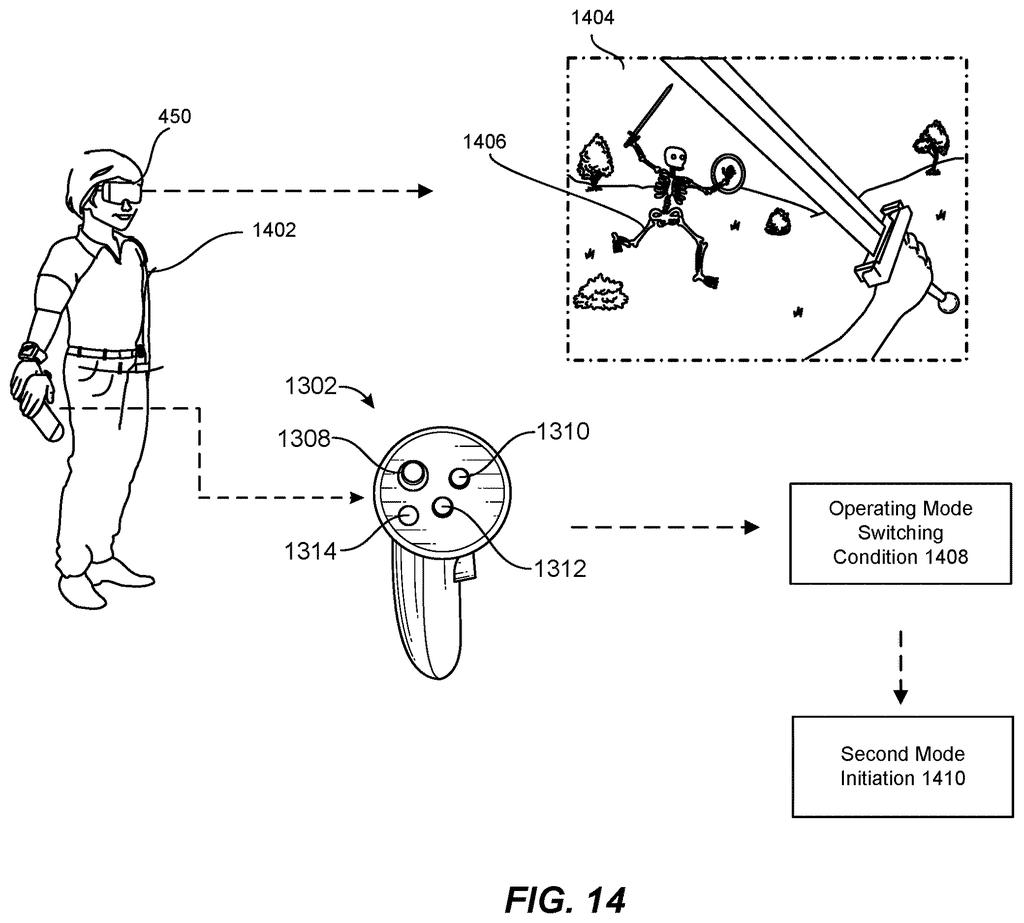
This patent describes a controller that watches for a specific trigger condition and, when that condition is met, switches to a second mode. In that mode, it reads the motion of the entire controller from built-in sensors and converts that physical movement into the same coordinate format the headset already understands. The headset receives identical-looking data regardless of which mode is active.
The result is that your app or game doesn't need to be rewritten to support whole-hand motion. The controller handles the translation silently, producing output that looks exactly like a thumb stick moving.
… determining, by the computer, whether an operating mode switching condition is satisfied with respect to the input actuator; activating at least in part based on satisfaction of the operating mode switching condition, by the computer, operation of the handheld device in a second mode; …
Translation: The controller automatically detects when you want to switch from standard buttons to hand tracking.
How the device detects a trigger and converts motion into coordinates
The system has two operating modes. In mode one, the controller reads a physical input actuator (a thumb stick, a touchpad, a trigger) and sends coordinate data in a defined format to whatever device it is paired with.
In mode two, the controller ignores that physical actuator and instead reads an internal motion sensor (an accelerometer or gyroscope) that tracks the real-world movement of the controller itself. It then runs a conversion step to produce synthesized coordinate data, meaning fake thumb-stick coordinates generated from hand motion, that are formatted identically to what mode one would have produced. The receiving device sees the same data structure either way.
The switch between modes is triggered by an operating mode switching condition, a rule the device evaluates continuously. The patent does not lock this down to one specific trigger; it could be a button press, a sensor threshold, or a timeout.
Key components:
- An input actuator (physical control surface)
- A motion sensor on the controller body
- A conversion layer that maps 3D motion onto the existing coordinate format
- A mode-switching evaluator that decides when to flip between the two
… generating, when the handheld device is operating in the second mode, synthesized coordinate data from the second motion data, the synthesized coordinate data corresponding to the first data format, and transmitting the synthesized coordinate data.
Translation: It converts your physical hand movements into standard controller signals so the system can understand them.
What this means for VR controllers and hands-free input
For you as a user, this could mean more natural aiming or steering in VR by tilting the controller rather than nudging a thumb stick, with no visible mode toggle and no interruption to the experience.
For developers, the appeal is backward compatibility: because the synthesized data matches the existing format, games and apps built for traditional controller input would work without modification. Meta has been expanding its controller input research alongside its work on the Quest platform and its Ray-Ban smart glasses line, and this kind of format-bridging patent fits that pattern.
Meta's 149th filing in our Meta coverage since May adds to a pattern that includes hand-lighting for AR cameras and audio zones in virtual spaces.
Claim 1 covers any handheld device that detects a triggering condition, switches into a secondary mode, reads movement from a sensor, and delivers the result in a translated output format. The claim names none of those elements specifically, leaving the trigger, the sensor, and the output format all undefined.
That openness means the claim could reach a wide range of motion-based controllers, not just one product. Any device that automatically shifts modes and reformats physical movement into coordinates a receiving system can read would fit the description the claim provides.
Whether that breadth holds up depends on whether the combination, a mode switch tied to automatic format translation, is new territory or a pattern courts will find familiar from years of motion-sensing hardware.
There are more where this came from
We read every patent application Big Tech publishes and send you the ones worth knowing. Plain English, free, every week.
The drawings
16 drawing sheets from US 2026/0288266 A1 · click any drawing to enlarge


Want this weekly breakdown for a company we don't cover? Patentlyze Pro →
Be the first to weigh in