
Meta Patents a System That Organizes Audio Into Zones in Virtual Spaces
In a virtual room with dozens of people talking at once, audio quickly becomes a wall of noise. Meta's new patent describes a way to carve that chaos into organized audio zones, so your headset plays the right voices at the right volume without you having to sort it out manually.
How Meta's audio zoning splits up crowded virtual rooms
A crowded concert hall is noisy, but your brain still manages to follow your friend's voice nearby. In a virtual reality space, that same instinct breaks down, because the software has no idea who is "next to" you and who is across the room.
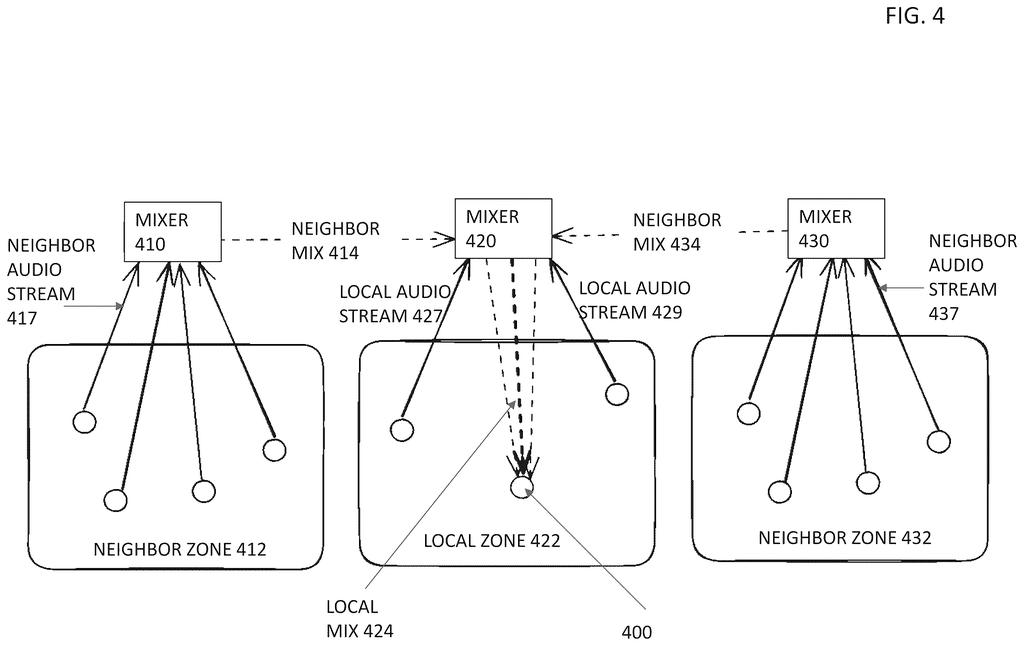
Meta's patent takes on this problem by splitting audio into two streams: one for the people in your immediate zone and one for the people in a neighboring zone nearby. Your headset renders both streams, but through separate mixing systems, so the software can apply different rules to each group, like adjusting volume, adding spatial cues, or filtering out background chatter.
When you speak, your voice is captured and sent back into your own local mixer, so the people in your zone hear you clearly. The system keeps each zone's audio self-contained but still lets sound travel between adjacent zones, mimicking the way sound actually spreads through a physical space.
rendering, at a local device, a local audio stream and a neighbor audio stream, the local audio stream comprising a local audio mix generated by a local audio mixer from a plurality of local audio sources …
Translation: Your device plays two separate sound feeds at once, one for your immediate area and one for nearby zones.
How local and neighbor audio mixers divide the sound feed
The patent describes a layered audio architecture for virtual environments. At its core, two separate software components called mixers handle the audio work. A local audio mixer collects sound from everyone in your immediate zone and blends it into a single stream you hear. A neighbor audio mixer does the same for an adjacent zone, producing a second stream that also plays in your headset but under different mixing rules.
Your device renders both streams simultaneously. That distinction matters: the two audio feeds can be processed differently. For example, voices from your local zone might be louder and more spatially precise, while the neighbor zone's audio is mixed down to a lower level or a more diffuse sound field.
When you speak, a collocated audio source (meaning a microphone traveling with your avatar in the virtual world) captures your voice and sends it back upstream to the local mixer. That means your voice enters the same pipeline that other people in your zone are hearing, keeping the audio consistent.
- Local mixer: handles audio from people in your immediate virtual area
- Neighbor mixer: handles audio from an adjacent zone you are close to
- Outgoing stream: captures your own voice and routes it back to the local mix
The system is designed to scale: as a virtual environment grows to hundreds of users, this zoning approach means no single device needs to process every voice at once.
… generating, at the local device, an outgoing audio stream comprising audio collected from a collocated audio source, the collocated audio source collocated with a user for which the local device renders the local audio stream and the neighboring audio stream …
Translation: The system captures your voice to send back into the local mix so other people can hear you.
What this means for VR social spaces and digital meetings
Virtual social spaces like Meta's Horizon Worlds, enterprise meeting rooms, and multiplayer games all run into the same wall: audio does not scale well when many people talk at the same time. Today, developers mostly handle this by muting distant users entirely or letting app designers hard-code distance limits, which feels artificial.
A zone-based system that your device manages automatically could make large virtual gatherings feel much more like real rooms, where you naturally hear the people near you and the general hum of the crowd farther away. For Meta's VR headsets, where audio immersion is a central selling point, getting this right is an infrastructure bet that affects every social experience on the platform. Meta's track record in spatial audio patents suggests this is part of a longer engineering push rather than an isolated filing.
Meta's 65th filing we've tracked in the AR glasses race since May adds to a pattern that includes a focus-controlling camera housing and a pupil-matching display.
Anyone who has joined a virtual event with dozens of people knows the experience: everyone sounds equally loud, conversations bleed into each other, and the room feels less like a space than a conference call with avatars. That problem scales badly, and it is why large virtual gatherings still feel broken in a way that in-person crowds do not.
This patent attacks the routing problem underneath that mess, automating how audio gets sorted between nearby and neighboring groups without anyone having to manage it manually. The ambition matches the scale of the problem, because manual workarounds have never been enough.
Whether this ends up inside a headset update or as a tool developers can build on, the underlying gap it closes matters more as virtual spaces try to host real communities rather than small group calls.
There are more where this came from
We read every patent application Big Tech publishes and send you the ones worth knowing. Plain English, free, every week.
The drawings
8 drawing sheets from US 2026/0292436 A1 · click any drawing to enlarge


Want this weekly breakdown for a company we don't cover? Patentlyze Pro →
Be the first to weigh in