
Meta Patents a VR Controller That Tracks Position Even When Your Fingers Block the Lights
Every time you grip a VR controller, your fingers cover part of it, and that turns out to be a real problem for the cameras trying to figure out where your hands are. Meta's new patent tries to fix that by placing tracking lights in a way that accounts for exactly where your fingers will land.
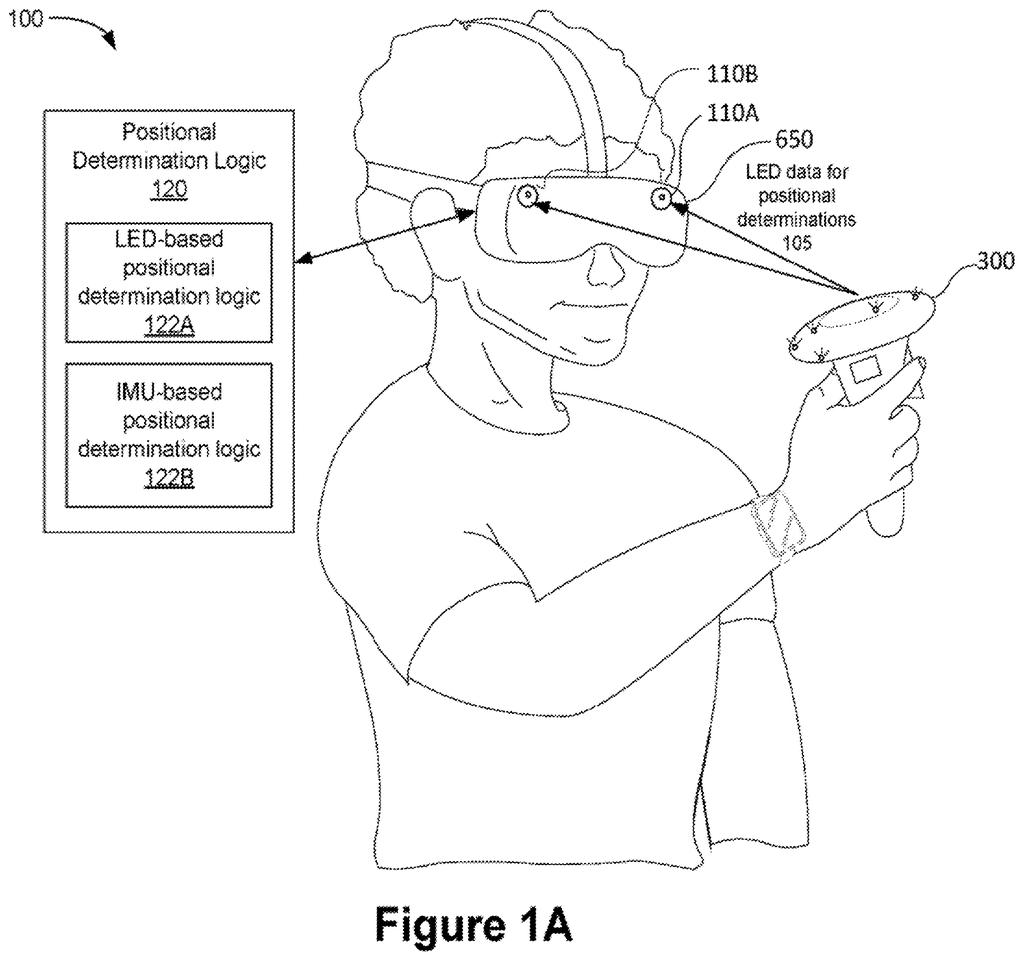
How Meta keeps your VR controller from getting lost
Every time you pick up a VR controller, your fingers and thumb naturally wrap around the top of it. That's fine for holding, but the cameras in a VR headset track your hands by watching small lights on the controller, and your fingers are sitting right on top of them.
Meta's approach here is to spread the tracking lights across different spots: some under where your fingers rest, and some outside that zone. The lights underneath the finger area sit along the outer edge of the controller's top surface, so they can still peek out and be seen by the cameras even when your hand is fully wrapped around it. A third light sits on a completely open part of the surface that fingers never block.
The idea is that no matter which way you rotate or tilt the controller, at least one or two of these lights should always have a clear line of sight to the headset's cameras. Your VR system then uses those visible lights to calculate exactly where your controller is in 3D space.
a body having an outer surface including a first region configured to be in contact with a digit of a user who is holding the handheld controller and a second region different from the first region …
Translation: The controller has a surface built to touch a user's finger while they hold it.
How the three lights work around a gripping hand
The patent describes a controller with a top surface divided into two zones: the region where a user's digit (finger or thumb) naturally rests, and everything else. Meta calls the covered zone the "digit-occluded region."
Three illumination sources (small lights, likely infrared LEDs) are placed at specific positions:
- A first light sits inside the finger-covered zone, but right at the perimeter edge of the top cover, where it can escape the shadow of the hand when the controller is held in certain orientations.
- A second light is also inside the finger-covered zone but at a different edge position, so it becomes visible when the controller rotates to a different angle.
- A third light sits completely outside the finger zone, on an open part of the surface away from the edge, always exposed.
The key insight is that "occluded" doesn't have to mean "invisible." Lights placed along the perimeter of the covered area can still be seen by cameras at certain angles, even while fingers press down on the same surface.
The external system (the headset) monitors these lights with its cameras and uses the data from whichever lights it can see to compute the controller's current position and orientation in three-dimensional space. Across a full range of controller movements and rotations, the arrangement ensures at least some lights are always camera-facing.
A first illumination source is disposed within the digit-occluded region at a first position along the perimeter of the top cover.
Translation: A tracking light sits right where the user's fingers normally block the view.
What this means for VR players who move fast
For VR users, this is the kind of problem you don't notice until tracking breaks. If your controller's lights go dark from the camera's perspective because your grip covers all of them, the headset loses track of your hand and your virtual weapon, tool, or pointer jumps or disappears. That's disorienting, and in fast-paced games or training applications it can ruin the experience entirely.
Meta's interest in inside-out tracking reliability shows up in how this patent handles the problem at the hardware level rather than relying purely on software guesswork. By placing lights where a real human hand is least likely to fully block all of them at once, the design gives the tracking system redundancy baked right into the physical object.
This is the 61st Meta filing we've tracked since May in the AR glasses race, joining a lower-memory display sharpening idea and one on explainable AI headsets.
The moment a VR controller loses tracking, whatever you were doing in that virtual world collapses. Your hands disappear, your aim drifts, a menu stops responding, and the spell breaks.
This patent addresses that failure by placing small indicator lights around the controller's rim at positions where your own fingers are least likely to block all of them at once. No matter how you rotate or tilt the controller, at least some lights stay in view of the headset's cameras.
The fix is structural, baked into where the lights physically sit, so it requires nothing from the user and no extra software. People will never notice it working, only that their experience stopped breaking the way it used to.
There are more where this came from
We read every patent application Big Tech publishes and send you the ones worth knowing. Plain English, free, every week.
The drawings
22 drawing sheets from US 2026/0278966 A1 · click any drawing to enlarge


Want this weekly breakdown for a company we don't cover? Patentlyze Pro →