
Google Patents a Way for AI Assistants to Remember What You Actually Asked For
Anyone who has tried to book a flight or make a restaurant reservation through a voice assistant knows the frustration of having to repeat yourself the moment the conversation gets slightly complicated. This Google patent tackles that exact problem head-on.
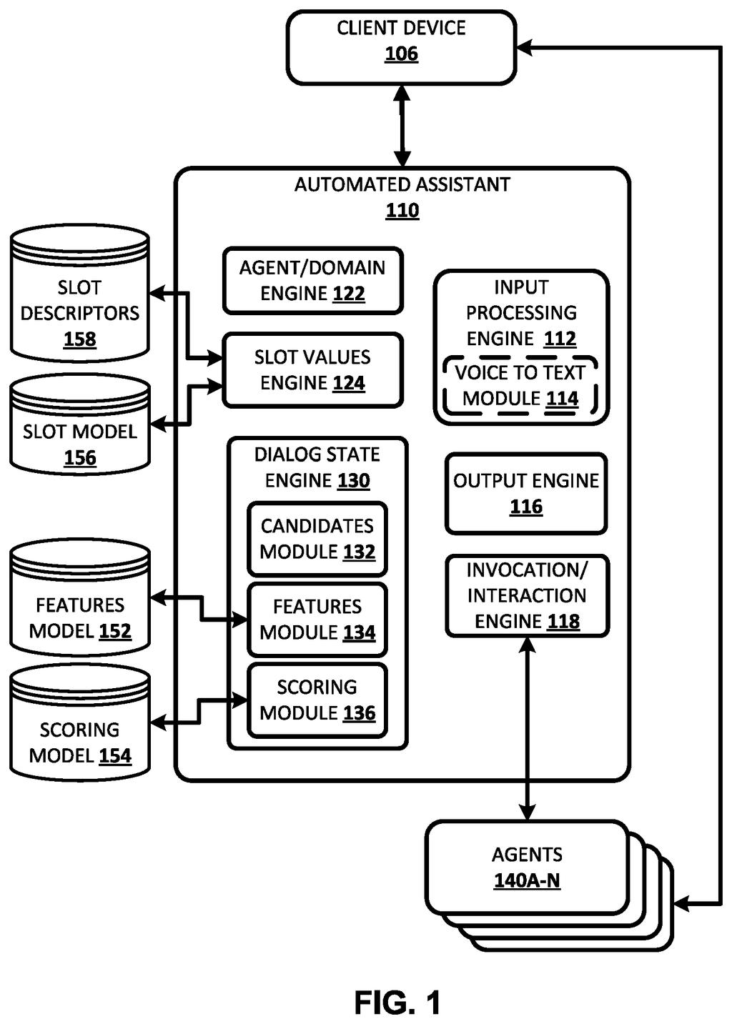
How Google's assistant tracks what you're asking for
Today's AI assistants often lose track of what you told them two sentences ago. If you say "I want a table for four, somewhere Italian, near downtown" and then add "actually, make it Saturday," many systems forget the earlier details and force you to restate everything. Google's patent describes a system designed to hold all of that information together.
The idea is to break your request into named "slots" (things like date, cuisine, party size, and location), and score every possible value for each slot as the conversation continues. Rather than treating each thing you say in isolation, the system reads the whole conversation up to that point and weighs which answer is most likely correct for each slot.
The result, if it works as described, is an assistant that can follow a back-and-forth conversation the way a human would: keeping score of what you've said, updating when you change your mind, and never asking you to repeat a detail you already gave.
… identifying, based on the conversation context, a textual descriptor for a slot instantiated in the electronic dialog, wherein the textual descriptor is a natural language description of parameters that can be defined by candidate values for the slot; …
Translation: The system figures out what kind of information it is trying to collect by looking at the ongoing conversation.
How the neural network reads context and slot descriptions
The patent describes a method for dialog state tracking (working out exactly what a user wants at any point in a multi-turn conversation) using neural networks trained to read both what the user said and what the assistant said.
Here is what happens at each turn of the conversation:
- The system identifies every active slot in the dialog. A slot is a named parameter the assistant needs to fill (for example, "departure city" or "check-in date").
- For each slot, it retrieves a plain-language description of what that slot means. So instead of just looking for any date, it knows it is looking for "the date the user wants to arrive," which helps it ignore unrelated dates mentioned in passing.
- A memory network (a type of neural network that can look back over earlier parts of the conversation, not just the most recent sentence) processes both the conversation history and that plain-language slot description together.
- A separate scoring model then rates every candidate value for each slot (is the departure city "Chicago" or "Austin"?) and picks the highest-scoring one to act on.
The system can update these scores dynamically as new things are said, so a correction or clarification from the user propagates through all the relevant slots automatically.
Determining a dialog state of an electronic dialog that includes an automated assistant and at least one user, and performing action(s) based on the determined dialog state.
Translation: The software figures out what is happening in a chat and takes the next step based on that understanding.
What this means for everyday AI assistant conversations
For anyone who uses a voice or chat assistant to do something with more than one moving part (booking travel, ordering food, scheduling appointments), this kind of system is the difference between a conversation that flows naturally and one that feels like filling out a form out loud. The assistant would handle mid-conversation corrections, follow-up questions, and ambiguous phrasing without making you start over.
the pattern in Google's AI assistant filings shows a sustained effort to close the gap between what users say and what assistants actually understand. This patent sits squarely in that work. In practical terms, if this approach reaches a shipping product, you should notice it most in situations where you change your mind partway through a request or where a conversation spans several back-and-forth exchanges.
Google's 30th filing we've tracked in our AI assistants that remember you watchlist since May follows its earlier applications on a face-recognizing TV and wake-detection alarm canceling.
When you tell a voice assistant "actually, make that Friday instead," it often wipes everything else you just settled on. This patent addresses that by having the system weigh every plausible interpretation of what you said, drawing on the full conversation rather than just your last sentence.
The practical difference is that a date you mentioned in passing gets treated differently from a date you are actively trying to book. The system is tracking what each piece of information means in context, not just logging words.
The result is fewer moments where fixing one thing forces you to rebuild the entire conversation from scratch, which is the failure most people have given up expecting assistants to solve.
There are more where this came from
We read every patent application Big Tech publishes and send you the ones worth knowing. Plain English, free, every week.
The drawings
8 drawing sheets from US 2026/0290334 A1 · click any drawing to enlarge


Want this weekly breakdown for a company we don't cover? Patentlyze Pro →
Be the first to weigh in