
Samsung Patents a Fingerprint Reader Hidden Inside a Phone's Structural Skeleton
Samsung is patenting a way to tuck optical sensors behind a phone's screen by cutting a precise hole through the device's internal skeleton. It's a structural approach to a problem every phone maker is still trying to solve cleanly.
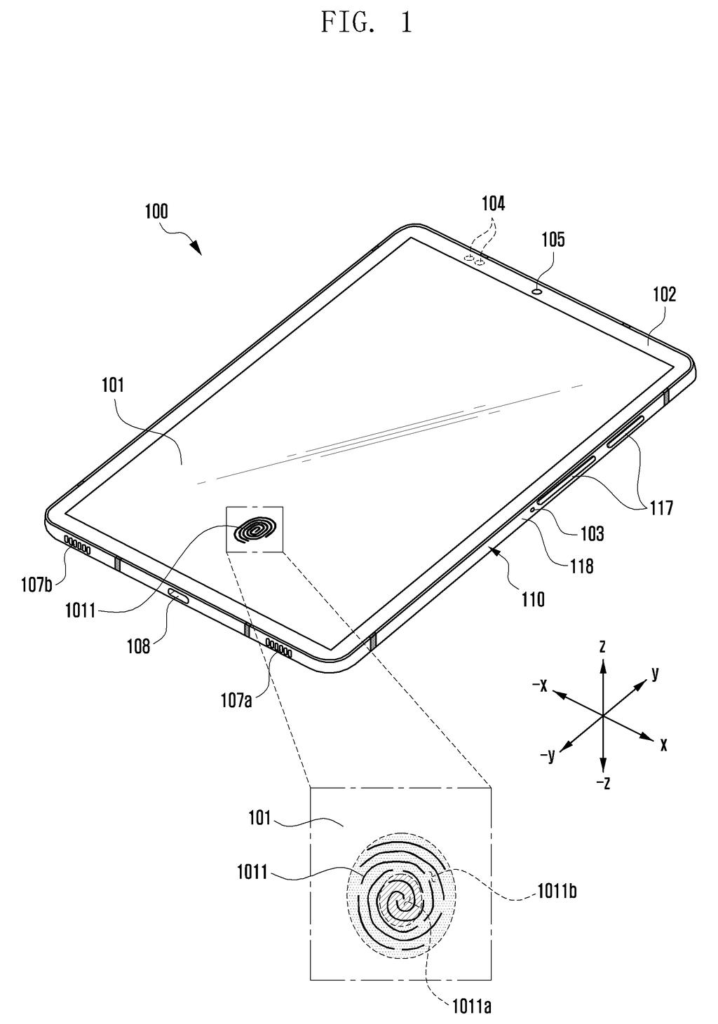
What Samsung's under-display sensor setup actually does
You're looking at your phone and there's no visible camera hole, no notch, no punch-out dot interrupting the screen. That unbroken display has been a goal for phone designers for years, and getting the sensors underneath the glass without ruining image quality is the hard part.
This Samsung patent describes a specific mechanical approach: a rigid internal frame sits between the front and back covers of the phone, and that frame has a hole drilled straight through it. An optical sensor sits on the back side of the frame, lined up with that hole, so light can travel through it from the front of the phone. A flexible circuit connects the sensor to the main circuit board.
The design is less about the sensor itself and more about where it sits and how it connects. By anchoring the sensor to the structural frame rather than to the screen or the cover glass, Samsung may be aiming for more precise, stable alignment between the sensor and the display above it.
… a support frame disposed in a space between the front cover and the rear cover, the support frame comprising a first surface facing the front cover, a second surface opposite facing the rear covdr and a through-hole penetrating from the first surface to the second surface; …
Translation: The internal metal skeleton has a direct hole drilled straight through it from front to back.
How the frame hole lines up the sensor with the display
The patent describes a sandwich of components: a front cover (the screen glass), a rear cover, and a rigid support frame in between. That frame has three relevant faces: one side supports the display, the opposite side holds the sensor, and a through-hole runs from one side to the other.
The optical sensor module sits on the inner (rear-facing) surface of the support frame, positioned directly beneath the through-hole. This means whatever the sensor is reading, whether that's a fingerprint, ambient light, or something else, the signal path runs through the frame itself rather than around it.
A flexible printed circuit board (FPCB), which is a thin, bendable ribbon of circuitry, connects the sensor module to the main PCB. Flexible connectors are standard in tight phone interiors because rigid wires would crack under the slight flex a phone body experiences.
The claim is deliberately broad: it covers the structural arrangement (frame, hole, sensor on the back, display on the front) without locking in what type of optical sensor is used. That breadth suggests Samsung is protecting the placement architecture, not a specific sensing technology.
What this means for future Samsung phone designs
For everyday users, this is about what you see, or rather what you don't see. Mounting sensors under the display without a visible cutout has been one of the persistent cosmetic and engineering challenges in phone design. Aligning a sensor precisely enough to work well through a screen requires stable, repeatable positioning, and tying the sensor to the structural frame (rather than to the glass or the display panel itself) is one way to get that.
The design does make repairs and manufacturing more interdependent. If the sensor module, the frame, or the flexible connector go out of alignment, all three layers become relevant to the fix. the pattern in Samsung's display-integration filings suggests the company is building toward a phone interior where more components are embedded in the structure, which trades repairability for thinner, cleaner form.
Samsung's 134th filing we've tracked in our camera sensor push watchlist since May builds on earlier applications like an AI slow-motion method and a frame-by-frame movement predictor.
Anchoring the sensor to the phone's rigid internal frame keeps it perfectly still, but the thin wire connecting it to the rest of the phone becomes the weakest link. Bend or stress the device enough times and that wire can fail before anything else does.
For a fingerprint reader hidden under the screen, where a millimeter of drift causes misreads, that tradeoff probably earns its place. For a basic light sensor adjusting your screen's brightness, the added complexity is harder to justify.
Samsung is solving a stability problem, and stability matters. If this works as intended, your phone becomes a little more durable in ways you would never see on a spec sheet but might feel two years in when it still works fine.
There are more where this came from
We read every patent application Big Tech publishes and send you the ones worth knowing. Plain English, free, every week.
The drawings
14 drawing sheets from US 2026/0290067 A1 · click any drawing to enlarge


Want this weekly breakdown for a company we don't cover? Patentlyze Pro →
Be the first to weigh in