
Google Patents a Compact Optical Element to Fix High-Speed Fiber Dispersion
When light travels through fiber at very high speeds, different colors of light arrive at slightly different times — and that timing smear destroys data. Google's new patent describes a single compact component that corrects this problem without bulky add-on hardware.
What Google's prism-plus-grating dispersion fix actually does
Imagine you're streaming a video, and every frame arrives slightly scrambled because the red parts of the light signal took a different path than the blue parts. That's essentially what happens inside high-speed fiber optic cables — a problem called chromatic dispersion, and it gets worse the faster you push data.
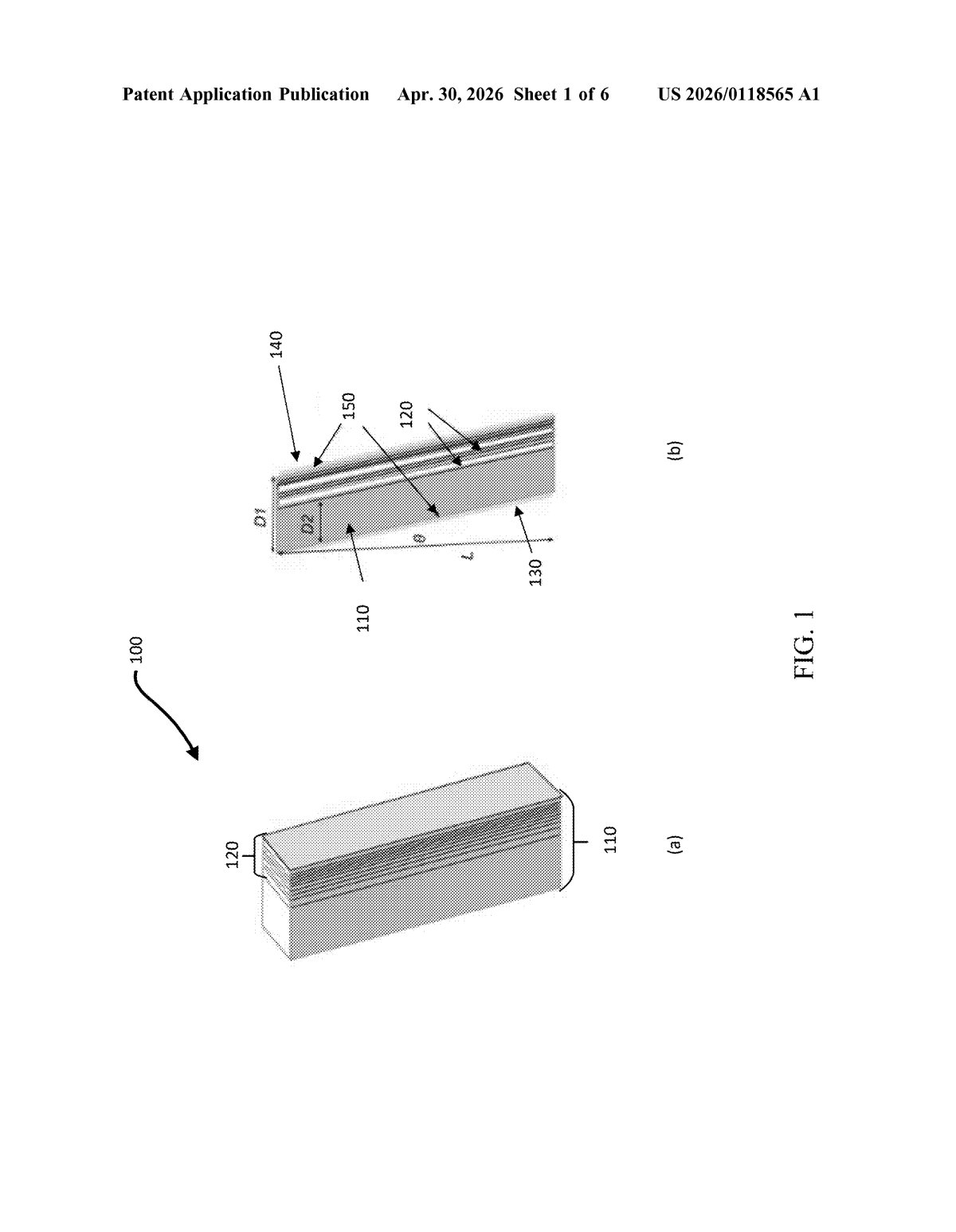
Google's patent describes a single compact optical element that tackles this problem in one shot. It combines a prism — the kind of wedge-shaped glass that splits light — with a special internal structure called a chirped volume Bragg grating (CVBG). The grating reflects different wavelengths of light at different depths, effectively delaying some colors just enough to bring everything back into sync.
The key word here is compact. Traditional dispersion compensation requires bulky spools of special fiber or separate modules. Baking the fix into a single integrated piece could make high-speed optical links smaller, cheaper, and easier to deploy — exactly what you'd want inside a massive data center.
How the CVBG region corrects wavelength timing inside the prism
The patent claims a single optical element that merges two functions into one piece of glass: a prism region that receives multi-wavelength optical signals, and a chirped volume Bragg grating (CVBG) region formed within the prism itself — not bolted on as a separate component.
A chirped volume Bragg grating is a periodic structure recorded inside a glass or crystal where the spacing between grating planes gradually changes (that's the "chirped" part — like a chirp in audio, the frequency shifts across the structure). Because different wavelengths of light satisfy the Bragg reflection condition at different depths, the grating reflects each wavelength after it has traveled a slightly different distance. That introduces a controlled time delay per wavelength — exactly the tool you need to compensate for dispersion, which itself is a wavelength-dependent delay introduced by the fiber.
By integrating the CVBG inside the prism region, Google's design lets the prism handle the angular separation and beam routing of the incoming multi-wavelength signal while the grating simultaneously applies dispersion compensation. The result is a monolithic element that does the work of what would otherwise require:
- A dispersion-compensating fiber module
- A separate beam-steering or routing optic
- Additional alignment hardware
The patent's first independent claim is deliberately broad, covering the combination of prism geometry and internal CVBG without specifying exact grating parameters — leaving room for Google to cover a wide range of implementations.
What this means for Google's fiber and data center networks
Google operates one of the largest private fiber networks on the planet, connecting data centers that handle Search, YouTube, Cloud, and AI workloads. As those links push toward 400G, 800G, and beyond, dispersion compensation becomes a harder and harder engineering problem — more components, more insertion loss, more space, more cost. A compact, integrated element that handles compensation in a single monolithic piece directly addresses that scaling pain.
For you as an end user, this is invisible infrastructure — but it's the kind of component-level work that determines whether Google can keep squeezing more bandwidth out of existing fiber without laying entirely new cable. It also signals Google's continued investment in custom photonic hardware, a space where it has been quietly building expertise alongside its custom silicon (TPU) efforts.
This is unglamorous but genuinely useful photonics engineering. Dispersion compensation is a real bottleneck at high line rates, and integrating a CVBG into a prism body is a clever way to reduce component count. The claim is broad enough to be strategically valuable, but this is clearly infrastructure IP — not a consumer product story.
There are more where this came from
We read every patent application Big Tech publishes and send you the ones worth knowing. Plain English, free, every week.
Want this weekly breakdown for a company we don't cover? Patentlyze Pro →