
Google Patents a Self-Correcting LED Architecture for Light Field Displays
LEDs don't age gracefully — they dim and shift color over time, and that's a real problem for high-precision light field displays. Google's new patent describes a display that watches its own LEDs degrade and quietly reassigns the workload to keep the image consistent.
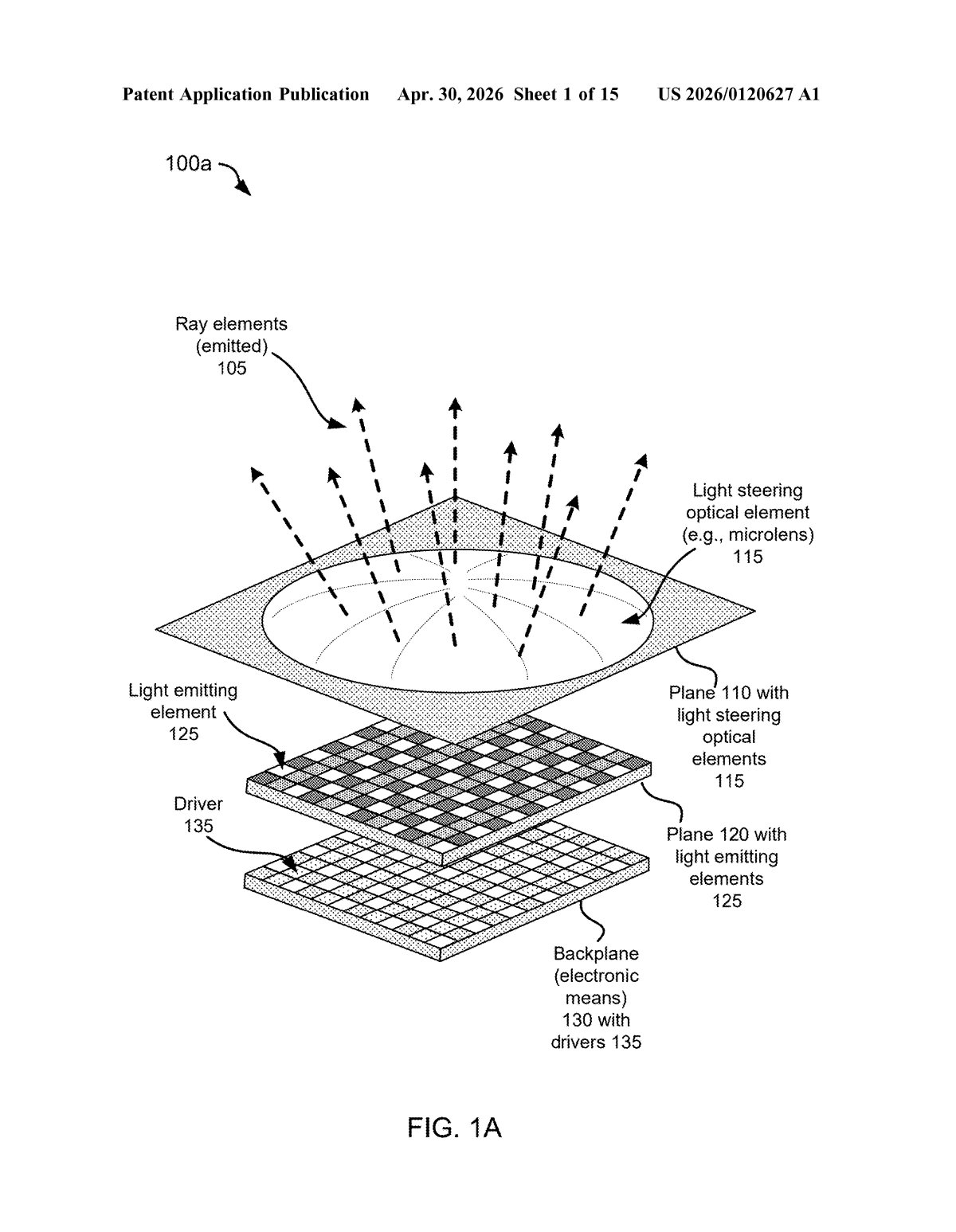
How Google's display heals itself as LEDs age
Imagine a concert venue where some of the stage lights start flickering and dimming after years of use. A smart system might automatically reroute the show's lighting cues to the bulbs that still work well — keeping the performance looking right without anyone in the audience noticing. That's essentially what Google is describing here for display screens.
Google's patent covers a light field display — a type of screen that can send different images in different directions simultaneously, which is key for glasses-free 3D or augmented reality. The problem is that individual LEDs in these displays degrade at different rates over time, which can ruin the carefully calibrated light directions the display depends on.
The solution is a processor that keeps track of which LEDs belong to which group, and dynamically reassigns those group memberships as some LEDs age. Instead of a degraded LED ruining a specific directional channel, the system shuffles the deck so the display keeps performing like new — at least for much longer than it otherwise would.
How the processor remaps logical LED groups over time
At the core of this patent is an array of light emitting elements (LEDs or similar micro-emitters) organized into logical groups. Each group is responsible for emitting light in a particular direction — that directional control is what makes a light field display special compared to a regular flat screen.
The key innovation is in how those groups are defined. Rather than hardwiring each LED to a fixed group forever, the system's processor maintains a dynamic correspondence table — think of it like a routing table in a network switch. At any point, the processor can rewrite that table to reassign which physical LEDs map to which logical group.
- Aging compensation: When an LED starts to dim or shift, the processor remaps it out of a critical group and substitutes a fresher neighbor.
- Monolithic integration: Sub-picture elements are fabricated on the same semiconductor substrate, keeping latency and alignment tight.
- Light steering optics: Each sub-picture element pairs its LED array with a microlens, a diffraction grating, or both to control emission direction.
The directional resolution of the display — how many distinct angular views it can produce — depends on the number of logical groups. By keeping group assignments flexible, the system trades a small amount of directional precision for a much longer useful lifespan.
What this means for Google's AR and VR ambitions
Light field displays are central to the promise of compelling AR and VR — they're what would let a headset show you a 3D scene that actually feels like it exists at different depths. But these displays are notoriously fragile over time because they depend on precise, per-LED calibration. A display that can self-correct for LED aging is far more viable in a consumer product than one that degrades visibly within a year or two of use.
For Google, which has been investing heavily in AR hardware, this kind of longevity engineering matters. You don't want to buy a $1,500 AR headset only to watch the display quality deteriorate in 18 months. If this architecture ships in a real product, it could quietly become one of the more important reasons that device holds up over time.
This is genuinely clever, unglamorous engineering — the kind that rarely makes headlines but separates products that last from products that don't. The dynamic LED remapping idea is a smart workaround for a real physics problem, and it's the sort of solution that suggests Google's display team is thinking seriously about productizing light field technology, not just prototyping it.
There are more where this came from
We read every patent application Big Tech publishes and send you the ones worth knowing. Plain English, free, every week.
Want this weekly breakdown for a company we don't cover? Patentlyze Pro →