
Sony Patents a System for Training AI Across Devices Without Sharing Raw Data
Training an AI model across thousands of devices without ever pooling their private data is one of the harder problems in machine learning. Sony's new patent tries to make that process faster and more accurate by periodically swapping or blending the model pieces each device trains on its own.
How Sony's decoder-swapping AI training actually works
A hospital's AI assistant learns from patient records it's never allowed to share. A camera system gets better at recognizing faces using footage that can't leave the building. You probably use services every day that face exactly this problem: how do you improve an AI model using data scattered across many devices when none of that data can be sent to a central server?
Sony's approach, described in this patent, centers on a component called a decoder (the part of an AI model that produces a final output, like a translated sentence or a recognized image). Instead of always combining everyone's trained decoders into one averaged-out version, the system can sometimes just swap decoders between devices, giving each device a fresh perspective from another device's training without fully merging them.
The system decides, round by round, whether to swap or blend based on a configurable threshold. That flexibility is the core idea: not every training round needs a full merge, and sometimes a straight exchange gets better results faster.
distribution circuitry configured to distribute a first decoder to each of a plurality of client devices, wherein each of the client devices is configured to perform a respective training process for the first decoder to generate a corresponding trained decoder …
Translation: The system sends a base AI component to multiple user devices so each device can train it locally.
Inside Sony's decoder exchange and aggregation logic
The patent describes a central server coordinating what's called federated learning (a technique where AI models train locally on individual devices, and only the model weights, not the raw data, travel to the server). The twist here is what happens to the decoder, which is the output-producing portion of a neural network.
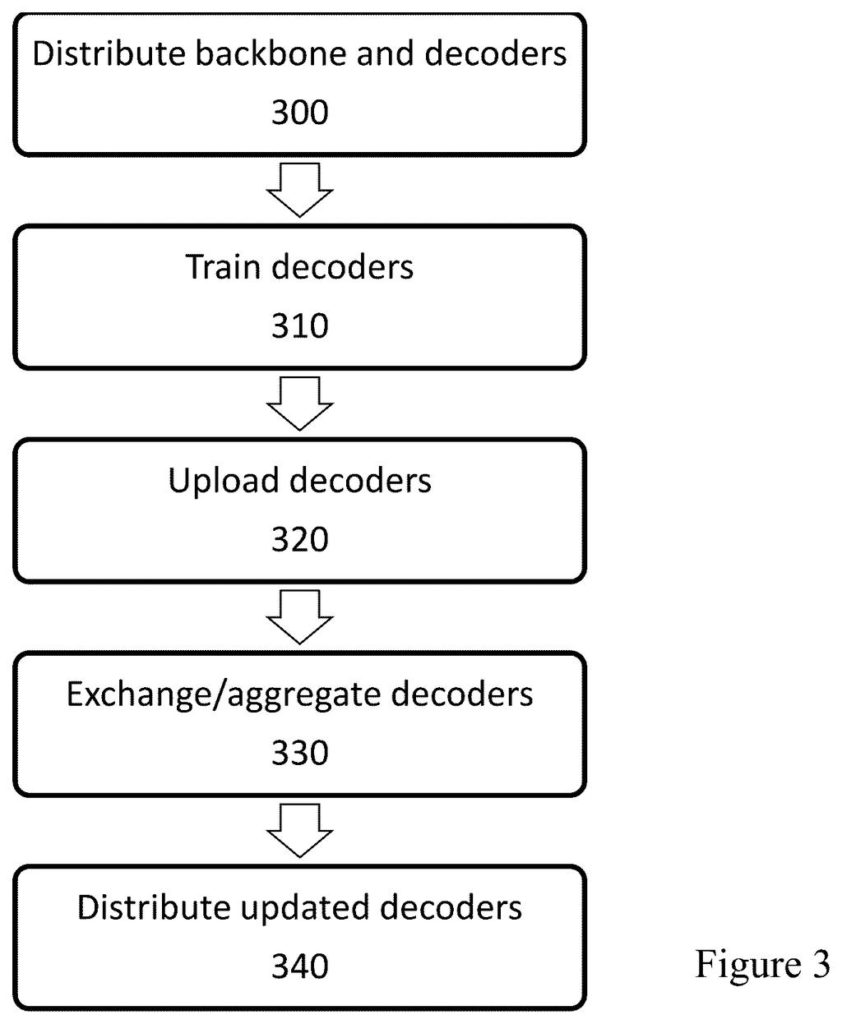
Here's the basic loop:
- The server sends a starting decoder to every participating device (called a client).
- Each client trains that decoder on its local data, producing a trained decoder specific to its own dataset.
- The clients send their trained decoders back to the server.
- The server checks a condition based on an aggregation rate (essentially, how often full merging should happen versus simpler swapping) and decides: either blend all the decoders together into one aggregate, or just redistribute them so each client gets a different client's decoder instead of its own.
The exchange option is the novel piece. In standard federated learning, every round ends with aggregation, which averages out all the decoders and can wash away useful specialization. By sometimes just cross-distributing decoders, the system lets each device benefit from another device's learning without erasing the differences. The aggregation rate parameter controls how often the full blend happens versus the simpler swap.
… perform, responsive to a first condition defining an aggregation rate, a decoder exchange process or a decoder aggregation process using the plurality of trained decoders …
Translation: Based on set rules, the server either swaps the trained AI parts among devices or combines them into a single upgraded version.
What this means for private, on-device AI training
For end users, this is about AI that improves without your personal data ever leaving your device. That matters for anything privacy-sensitive: medical records, financial data, personal photos, or corporate documents. Sony keeps filing on on-device and privacy-preserving AI suggests this is part of a longer-term platform strategy, not a one-off research patent.
For the AI field more broadly, federated learning has always had a tension between privacy and model quality. A model trained only on one device's data is narrow; a model that pools everything gets better but raises privacy concerns. Sony's decoder-exchange idea tries to thread that needle by letting diversity survive longer in the training loop before it gets averaged away.
Sony's eighth filing we've tracked since July in our on-device AI privacy watch builds on earlier ideas like checking surroundings before sharing data and label-free network design.
The deliberate cost baked into this design is temporary degradation: when a device receives a model trained entirely on strangers' data, it gets worse at its job before it gets better. That is a real price paid by real users, and the filing makes no attempt to hide it.
Whether that price is acceptable depends entirely on a single tuning number controlling how often swapping happens versus blending. Set it too aggressively and performance could slide below what a simpler approach would deliver, with no guidance in the document about how an engineer finds the safe range.
The underlying problem is one any team building shared learning across many separate devices will recognize immediately. But without empirical results showing the tradeoff resolves favorably, this reads as a promising idea still waiting on its proof.
There are more where this came from
We read every patent application Big Tech publishes and send you the ones worth knowing. Plain English, free, every week.
The drawings
4 drawing sheets from US 2026/0301400 A1 · click any drawing to enlarge


Want this weekly breakdown for a company we don't cover? Patentlyze Pro →
Be the first to weigh in