
Qualcomm Patents a Method for 5G Devices to Share AI Training Without a Central Server
What if your phone could help train an AI model by talking directly to nearby devices on the cellular network, instead of sending all your data to a distant server? That's the core idea in Qualcomm's latest patent filing.
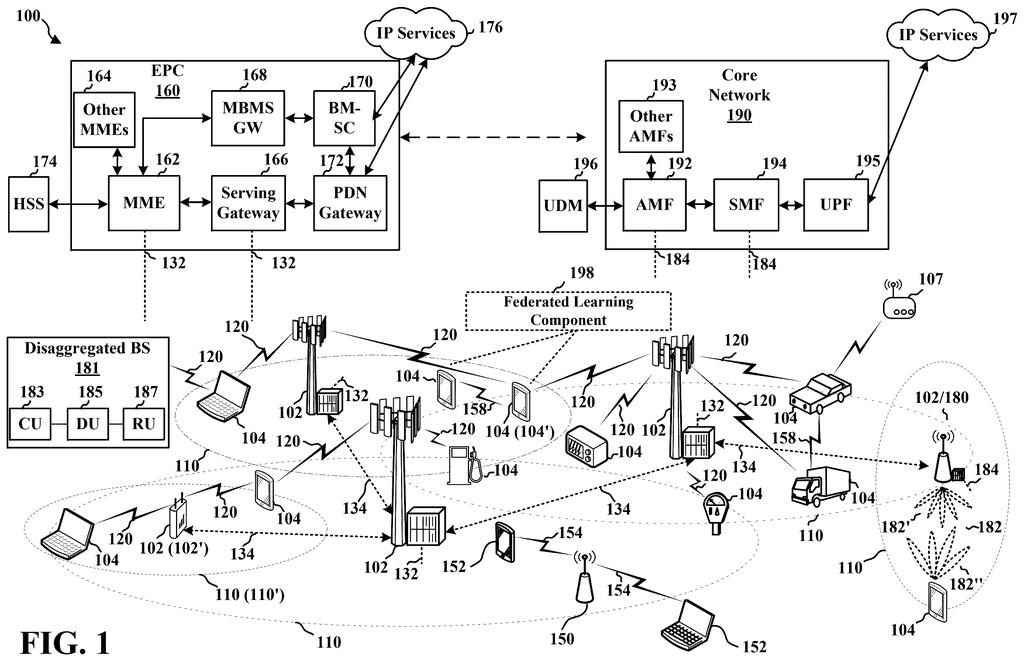
What Qualcomm's phone-to-phone AI training actually does
Imagine you're on a crowded train, and every passenger's phone is helping improve a shared AI model (say, one that predicts network congestion) by sharing only a condensed summary of what it learned, not your actual data. That's the general shape of what Qualcomm is describing here.
Right now, most AI training happens in large data centers. A company collects data from millions of devices, runs it through powerful computers, and sends the finished model back out. The alternative approach, called federated learning, lets devices train the model locally and only share the results. Qualcomm's patent focuses on making that work on cellular networks, where phones can discover each other or connect to a nearby network node and exchange AI updates without routing everything through one central bottleneck.
The system involves a handshake: your device sends a message describing its own AI setup, receives information back about the other device or network node, and then sends a model update based on both. It's designed to handle the messy reality that different phones have different processing power, different data, and different tasks.
… provide a machine learning (ML) model information update to the network node based on the first FL information and the second FL information.
Translation: The device shares its AI learning progress after comparing its setup with the network node.
How devices discover each other and share model updates
The patent describes a signaling protocol that lets a wireless device (what Qualcomm calls a UE, or user equipment, meaning a phone or tablet) participate in two kinds of distributed AI training arrangements.
The first is clustered federated learning, where devices are grouped and coordinate through a nearby network node acting as a local aggregator, rather than a central cloud server. The second is peer-to-peer federated learning, where devices exchange model updates directly with each other, skipping any central coordinator entirely.
The core mechanism in claim 1 is a three-step exchange:
- The device sends a message containing its own federated learning information (its capabilities, its local model state, what task it's working on).
- It receives back a message with the other node's corresponding information.
- It then sends a model information update, shaped by what both sides disclosed.
This discovery-and-update handshake is meant to solve several real friction points in distributed AI training: heterogeneity (devices with wildly different compute power can still participate), communication overhead (only summaries move, not raw data), and privacy (your underlying data never leaves your device). The patent also flags security as a motivation, since peer-to-peer architectures can be harder to attack than a single central server.
… perform ML model training in a clustered FL or peer-to-peer FL environment through various signaling procedures between the UE and the network node(s).
Translation: Devices train artificial intelligence together directly without needing a central server to coordinate them.
What this means for AI privacy on wireless networks
For everyday users, the most direct implication is privacy. If AI models can be trained across devices without your raw data ever leaving your phone, that's a meaningful architectural shift away from the current model where user data travels to and lives on corporate servers. Federated learning has been a stated goal for years; the challenge has always been making the coordination work reliably over real wireless networks with real device variety.
For Qualcomm specifically, this sits at the intersection of two things the company cares about: cellular network standards and on-device AI. Qualcomm keeps filing on on-device and distributed AI for wireless networks, and a patent covering the actual signaling procedures that glue those systems together is the kind of infrastructure claim that could matter a great deal if this approach gets standardized into 5G or 6G specifications.
Qualcomm's 15th filing we've tracked since July in our on-device AI privacy watch builds on earlier work around training AI locally and silencing idle mics.
Claim 1 covers any device that sends a description of its AI capabilities to a network node, receives a description back, and then sends an AI model update. That three-step exchange is written broadly enough to reach virtually any coordinated AI training happening between phones and network equipment over a cellular connection.
The practical consequence is significant. Any phone or network component participating in distributed AI training across a next-generation wireless network could fall within the claim's reach, meaning companies building AI features into future wireless standards may need to clear this patent first.
Whether the claim survives in this form depends on whether prior art in distributed machine learning forces a narrowing to the specific message formats described later in the document. A narrower claim is easier to design around; the current one is not.
There are more where this came from
We read every patent application Big Tech publishes and send you the ones worth knowing. Plain English, free, every week.
The drawings
23 drawing sheets from US 2026/0291824 A1 · click any drawing to enlarge


Want this weekly breakdown for a company we don't cover? Patentlyze Pro →
Be the first to weigh in