
Samsung Patents a GNN-Driven Atomic Force Predictor for Faster Molecular Simulations
Running a molecular simulation is brutally expensive — every atom's movement depends on forces from every neighbor, and you have to recalculate those forces thousands of times per second. Samsung's new patent tries to break that cycle by letting a trained model predict most of those forces instead of computing them from scratch.
What Samsung's atomic force shortcut actually does
Imagine you're trying to simulate how atoms in a new material move and interact — think of it like a very detailed physics game where every particle is constantly pushing and pulling on its neighbors. Normally, a computer has to calculate all those pushes and pulls from first principles every single time step, which is extraordinarily slow.
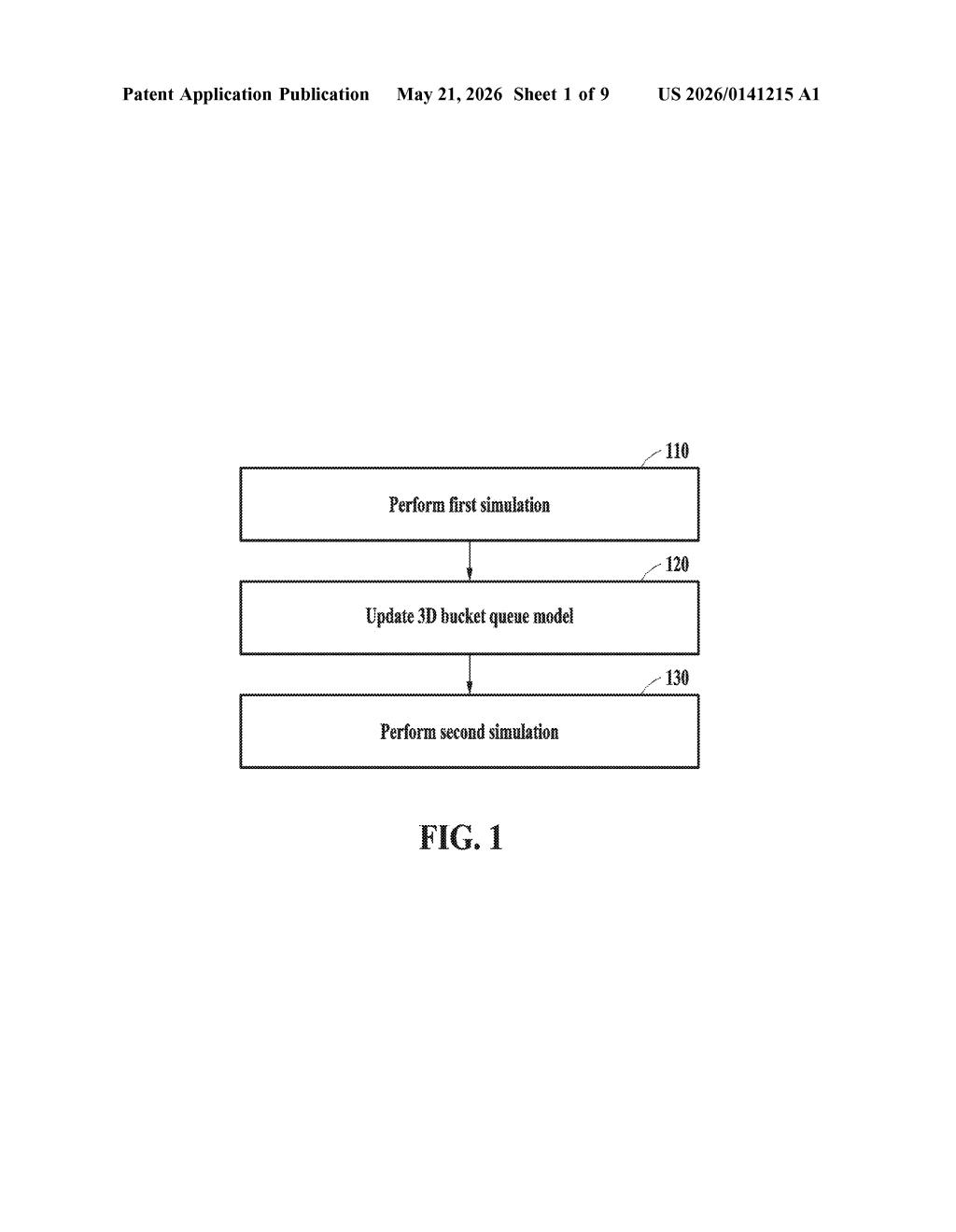
Samsung's idea is to use two tools together. First, a graph neural network (a type of AI that's good at reasoning about connected structures, like atoms bonded to each other) runs a set of simulations to build up a picture of how forces behave. Then a second tool — the 3D bucket queue model — learns patterns from those results and starts predicting what the forces will be in future steps, skipping the heavy computation.
The result is that you do the expensive, accurate calculation only when you have to, and let the learned model handle the rest. If it works as described, simulations that currently take days could finish much faster.
How the GNN and 3D bucket queue split the workload
The patent describes a two-phase simulation pipeline designed to reduce the computational cost of molecular dynamics (MD) — the process of simulating how atoms move over time by repeatedly calculating the forces acting on each one.
Phase 1 — GNN simulation: A graph neural network model treats the molecular system as a graph where atoms are nodes and bonds (or proximity relationships) are edges. It runs a first batch of simulation steps, computing atomic potential energies and deriving forces from them. This is the expensive, high-accuracy pass.
Phase 2 — 3D bucket queue prediction: The 3D bucket queue model is a data structure that organizes previously computed atomic forces in three-dimensional space into discrete spatial bins ("buckets"). After the GNN phase, its parameters are updated with those results. In subsequent simulation steps, the model looks up nearby buckets and predicts forces for each atom based on prior simulation history rather than recomputing from the potential energy surface.
The key claim is that the two simulation types run for different numbers of repetitions — the GNN phase establishes ground truth, while the bucket queue phase handles the bulk of ongoing steps at lower cost. Think of it like priming a cache: you pay the full price once to fill it, then serve cheaper reads afterward.
What this means for materials science and chip design
Molecular dynamics simulations are a foundational tool in materials science, drug discovery, and semiconductor design — exactly the kinds of workloads Samsung cares about as both a chipmaker and a memory manufacturer. Anything that cuts simulation time without proportionally cutting accuracy is commercially meaningful, especially as AI-assisted materials research accelerates.
For everyday users, this is deeply under-the-hood work. But if Samsung applies this to its own R&D pipelines — designing next-generation memory materials or evaluating new process nodes — even modest speedups on simulations that take days to run translate directly into faster development cycles and potentially better products reaching your hands sooner.
This is niche but credible. Samsung has real skin in the game on computational materials research, and the combination of a GNN for accuracy and a spatial queue for prediction speed is a sensible engineering trade-off rather than a speculative moonshot. It won't make headlines outside of computational chemistry circles, but it's the kind of practical infrastructure patent that tends to quietly show up in production tools.
There are more where this came from
We read every patent application Big Tech publishes and send you the ones worth knowing. Plain English, free, every week.
Want this weekly breakdown for a company we don't cover? Patentlyze Pro →