
Verily Patents a Contact Lens Case That Knows When You Skip a Wear
Your contact lens case may soon know whether you actually wore your lenses today, or skipped. Verily has filed a patent for a case that uses a tiny light sensor to detect whether lenses are sitting inside, helping track whether wearers are sticking to a prescribed schedule.
What Verily's light-sensing lens case actually does
Ever kept a prescription but ignored the schedule? For contact lens wearers, especially those using therapeutic or specialty lenses, missing days is easy to do and easy to hide.
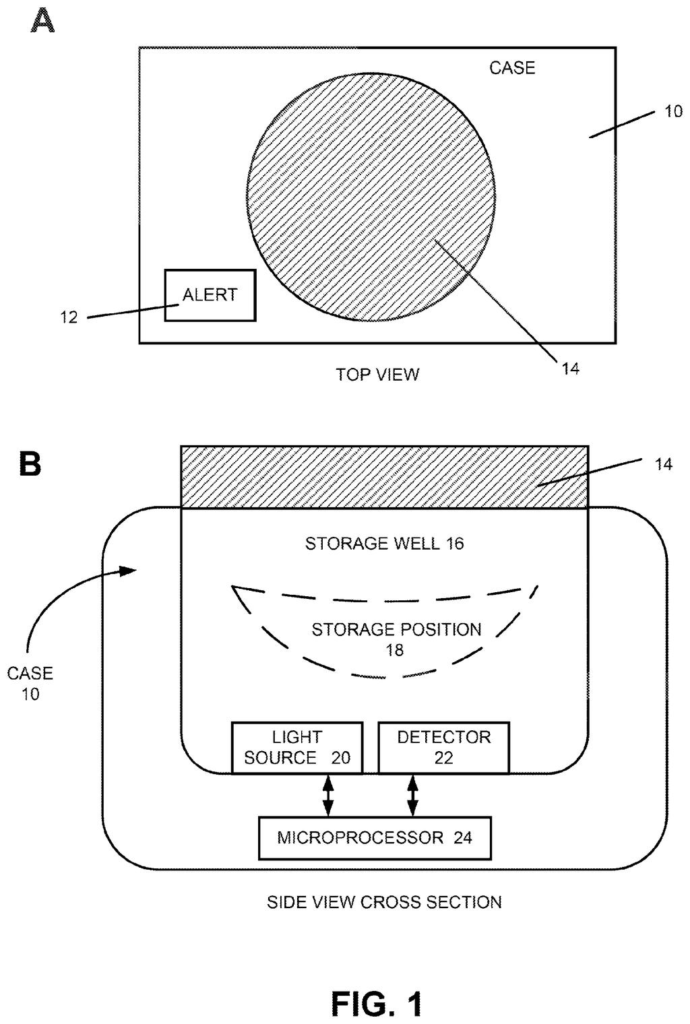
Verily's patented case is designed to catch that. Inside each storage well (the small cup that holds a lens in solution), a light source fires a quick pulse of light. A detector picks up how that light bounces back. If a lens is sitting there, the reflected light looks different than if the well is empty. A small processor reads that difference and logs whether the lens is in or out.
The case can then cross-reference those readings against a wear schedule, essentially building a compliance record. Think of it like a pill bottle that knows when it's been opened, except for your eyes.
activate the light source to send a pulse of the light toward the storage position of the ophthalmic device; and receive data related to the reflected light of the pulse of the light from the detector …
Translation: It flashes a light inside the case and measures how much of it bounces back.
How the case detects a lens using reflected light
The patent describes a contact lens storage case with built-in optical sensing. Each storage well contains a designated position for a lens. A light source fires a short pulse of light into that well, and a photodetector (a sensor that reads light intensity) captures whatever bounces back.
The key insight is that a lens sitting in solution reflects light differently than an empty well or a well filled with solution alone. The case's microprocessor analyzes the reflected-light data to determine presence or absence of the ophthalmic device at that position.
This detection is then compared against a wear schedule (a prescribed timeline for how many hours per day a lens should be worn). If the lens is still in the case at a time when it should be in your eye, the system flags a compliance gap. The patent also covers cases with multiple wells, covering both eyes independently.
Verily's framing positions the case as a passive tracking tool. You don't have to log anything or press a button. Just using the case as normal generates the compliance data automatically.
What this means for contact lens compliance tracking
For most contact lens wearers, compliance is a personal-responsibility issue with low stakes on any given day. But for patients using therapeutic contact lenses (lenses prescribed to correct conditions like myopia progression in children, or to deliver medication), missing wear time can have measurable clinical consequences. Doctors currently have no reliable way to verify that a patient actually followed a lens schedule between appointments.
A case that passively logs wear history could change the conversation at the optometrist's office, giving clinicians real data instead of a patient's best recollection. For Verily, a life-sciences company that spins out of Google's research arm and focuses on health data, this fits a pattern of Verily's track record in passive health-monitoring patents: turning everyday objects into unobtrusive data collectors.
Google's 829th filing in our Google coverage since May adds to a health-sensing thread that includes a breath-based cancer detector and a sleep-and-fall-risk wearable.
The problem here is real, even if it sounds minor. Contact lens compliance is notoriously hard to study because self-reported data from patients is unreliable. For standard cosmetic lenses that's a nuisance; for therapeutic lenses prescribed to treat disease or slow vision changes in kids, inaccurate wear logs can skew both treatment decisions and clinical trial results.
The approach is proportionate to the problem. Using reflected light inside an existing case is low-cost, non-invasive, and requires no behavior change from the wearer. That last point matters enormously in health tech: the devices that succeed are almost always the ones you forget you're using.
The open question is what happens with the data. A compliance log is only useful if it feeds into something, a patient app, a clinician dashboard, or a clinical trial protocol. The patent doesn't settle that, which means the hardware is ahead of the system it would plug into.
There are more where this came from
We read every patent application Big Tech publishes and send you the ones worth knowing. Plain English, free, every week.
The drawings
8 drawing sheets from US 2026/0294060 A1 · click any drawing to enlarge


Want this weekly breakdown for a company we don't cover? Patentlyze Pro →
Be the first to weigh in