
Microsoft Patents an AI Engine That Gives Game Characters Memory and Boundaries
Most AI-powered game characters today feel either scripted to death or chaotic and unpredictable. Microsoft is patenting a middle path: an AI engine that remembers what your character has done and picks its next move from a list of approved options, rather than making things up as it goes.
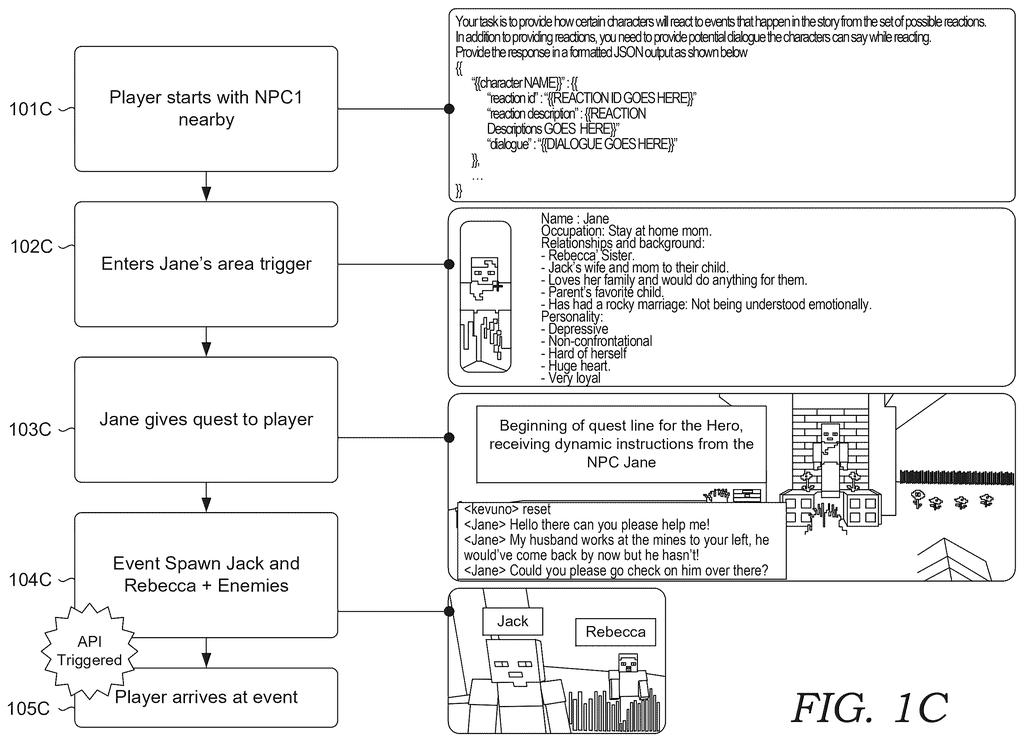
How Microsoft's NPC decision engine actually works
You're deep into an RPG and a guard NPC who saw you steal something three hours ago still acts like nothing happened. That's the classic problem: game characters forget, and their decisions don't add up.
Microsoft's patent describes a system where each character carries a profile, a kind of running memory of who they are, what's happened around them, and what options they're allowed to take. When that character hits a decision point in the story, the AI reads the profile, weighs the current situation, and picks from a pre-approved menu of actions that the game's developers already wrote.
The key detail is that the AI isn't writing new dialogue or inventing behavior on the fly. It's choosing between options the developers already defined, which means characters stay consistent with the game's world and story. Think of it less like ChatGPT for NPCs and more like a very context-aware director following a script the writers prepared in advance.
accessing character data associated with a character of a game; using the character data, generating a character profile associated with AI-driven decision-making for the character in the game; determining that the character has reached a decision point associated with the game …
Translation: The system looks up character details to build an AI profile whenever a game choice appears.
How the engine picks actions without free-form AI output
The system works in several distinct steps:
- Character profile generation: The system reads structured data about a character, their personality, role in the story, past interactions, and environment, and assembles a profile that the AI model can read.
- Decision-point detection: When the game engine determines a character has reached a moment requiring a choice (a conversation branch, a combat trigger, a narrative fork), it flags that event.
- Prompt construction: The system builds a prompt for an AI model using the character profile, current game-state variables (time of day, nearby objects, other characters present), and a structured description of the available actions. Developers define those actions in natural language ahead of time.
- Constrained selection: The AI model evaluates the prompt and selects from the predefined actions, rather than generating open-ended text. This is sometimes called a constrained decoding approach: the output space is bounded so the model cannot invent actions the developer didn't anticipate.
- Execution: The selected action triggers the corresponding game sequence, animation, dialogue branch, or scripted event.
The architecture is explicitly designed to fit inside existing game development frameworks, meaning studios wouldn't need to rebuild their tools from scratch to use it.
Rather than generating open-ended responses, the AI-driven narrative decision-making engine processes structured text inputs, evaluates game state variables, and determines the most appropriate action based on past interactions, character memory, and game world context.
Translation: Instead of talking freely, the AI picks from set choices using memory and the current game situation.
What this means for AI characters in future games
For players, this could mean NPCs that actually remember your choices and behave accordingly, without the unpredictable weirdness that comes from letting a language model say whatever it wants. The developer-approved action list keeps characters from going off the rails narratively while still letting AI handle the which action fits this moment judgment call.
Microsoft has been filing around AI-assisted game development since at least 2024, and this patent sits at the intersection of that work and the broader industry debate about how much creative control studios should hand to AI systems. For developers, the constrained model here is a practical answer to a real concern: AI that's useful but stays inside the guardrails you set.
Microsoft's 63rd filing in AI assistant and agent work we've tracked since May builds on earlier applications like hiding many agents behind one window and building agents from plain English.
Claim 1 is broad. It covers any system that generates a character profile, detects a decision point, builds a prompt from that profile, and executes a predefined action from model output. That description could apply to a wide range of NPC AI architectures, not just Microsoft's specific implementation.
If granted, that breadth could give Microsoft leverage over a significant slice of how AI is used in game character behavior generally. A narrower claim tied to specific data structures or a particular model architecture would be less threatening to independent studios building their own NPC AI tools.
The underlying idea, using AI to pick from developer-curated actions rather than generate free text, is the genuinely interesting part here. It's a practical design philosophy that takes the creativity question off the AI's plate while keeping the contextual judgment on it. Whether the patent claim is specific enough to survive examination is a separate question from whether the approach is good engineering.
There are more where this came from
We read every patent application Big Tech publishes and send you the ones worth knowing. Plain English, free, every week.
The drawings
13 drawing sheets from US 2026/0295428 A1 · click any drawing to enlarge


Want this weekly breakdown for a company we don't cover? Patentlyze Pro →
Be the first to weigh in