
Microsoft
Microsoft · AI / ML · Filed Mar 27, 2025 · USPTO published Oct 1, 2026 · Oct 1 release
Microsoft Patents an AI Engine That Gives Game Characters Memory and Boundaries
Most AI-powered game characters today feel either scripted to death or chaotic and unpredictable. Microsoft is patenting a middle path: an AI engine that remembers what your character has done and picks its next move from a list of approved options, rather than making things up as it goes.
- Publication number
- US 2026/0295428 A1(US20260295428A1)
- Applicant
- Microsoft Technology Licensing, LLC
- Filed · Published
- Mar 27, 2025 · Oct 1, 2026
- Inventors
- Lucas Fernán SALVADOR, Kailin ZHENG, Kevin Jusef BASTIAN, Peter BODIK, Francisco Jose BOLAÑOS MONTES DE OCA, Miles Daniel FERTEL, Kristine Kimiko Ishii GOLUS, Abdelrahman Khaled Abdo MOHAMED, Dylan OCHOA
- Status when we published
- Waiting for an examiner
- Document
- 20 claims
- US classification
- 463/42
- Examiner
- ELISCA, PIERRE E (Art Unit 3715)
How Microsoft's NPC decision engine actually works
You're deep into an RPG and a guard NPC who saw you steal something three hours ago still acts like nothing happened. That's the classic problem: game characters forget, and their decisions don't add up.
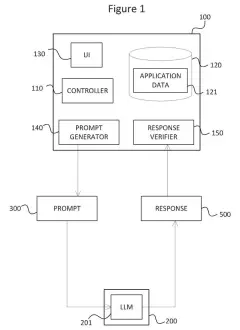
Microsoft's patent describes a system where each character carries a profile, a kind of running memory of who they are, what's happened around them, and what options they're allowed to take. When that character hits a decision point in the story, the AI reads the profile, weighs the current situation, and picks from a pre-approved menu of actions that the game's developers already wrote.
The key detail is that the AI isn't writing new dialogue or inventing behavior on the fly. It's choosing between options the developers already defined, which means characters stay consistent with the game's world and story. Think of it less like ChatGPT for NPCs and more like a very context-aware director following a script the writers prepared in advance.
accessing character data associated with a character of a game; using the character data, generating a character profile associated with AI-driven decision-making for the character in the game; determining that the character has reached a decision point associated with the game …
Translation: The system looks up character details to build an AI profile whenever a game choice appears.
How the engine picks actions without free-form AI output
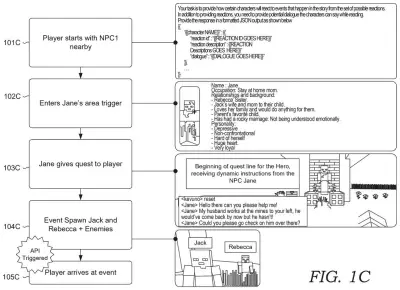
The system works in several distinct steps:
- Character profile generation: The system reads structured data about a character, their personality, role in the story, past interactions, and environment, and assembles a profile that the AI model can read.
- Decision-point detection: When the game engine determines a character has reached a moment requiring a choice (a conversation branch, a combat trigger, a narrative fork), it flags that event.
- Prompt construction: The system builds a prompt for an AI model using the character profile, current game-state variables (time of day, nearby objects, other characters present), and a structured description of the available actions. Developers define those actions in natural language ahead of time.
- Constrained selection: The AI model evaluates the prompt and selects from the predefined actions, rather than generating open-ended text. This is sometimes called a constrained decoding approach: the output space is bounded so the model cannot invent actions the developer didn't anticipate.
- Execution: The selected action triggers the corresponding game sequence, animation, dialogue branch, or scripted event.
The architecture is explicitly designed to fit inside existing game development frameworks, meaning studios wouldn't need to rebuild their tools from scratch to use it.
Rather than generating open-ended responses, the AI-driven narrative decision-making engine processes structured text inputs, evaluates game state variables, and determines the most appropriate action based on past interactions, character memory, and game world context.
Translation: Instead of talking freely, the AI picks from set choices using memory and the current game situation.
What this means for AI characters in future games
For players, this could mean NPCs that actually remember your choices and behave accordingly, without the unpredictable weirdness that comes from letting a language model say whatever it wants. The developer-approved action list keeps characters from going off the rails narratively while still letting AI handle the which action fits this moment judgment call.
Microsoft has been filing around AI-assisted game development since at least 2024, and this patent sits at the intersection of that work and the broader industry debate about how much creative control studios should hand to AI systems. For developers, the constrained model here is a practical answer to a real concern: AI that's useful but stays inside the guardrails you set.
Microsoft's 63rd filing in AI assistant and agent work we've tracked since May builds on earlier applications like hiding many agents behind one window and building agents from plain English.
Source: US 2026/0295428 A1 at the USPTO (PDF). Full patent text and figures are in the official publication.
Get our take in your Top Stories
Liked this breakdown? Add Patentlyze as a preferred source on Google, and our plain-English take shows up more often in your Top Stories the next time Microsoft patent news breaks.
Add Patentlyze on Google
One click.
There are more where this came from
We read the new patents from Big Tech, carmakers and more and send you the ones worth knowing. Plain English, free, every week.
The drawings · 13 sheets
13 drawing sheets from US 2026/0295428 A1 · click any drawing to enlarge


Show the other 5 sheets


More from Microsoft
All 681 Microsoft patents →
More in AI assistant & agent
All 436 AI assistant & agent patents →
Google
Google Patents an AI That Learns Your Formatting Habits to Keep Your Documents Consistent
Google
Google Patents an AI That Reads Your Screen and Operates Apps on Your Behalf
Google
Google Patents a Way for AI Chatbots to Remember Images You Already Shared
Google
No comments yet