
Meta Files Patent for Tilting the Picture Inside AR Glasses to Slim Them Down
Meta's patent draws the picture on a tilted rectangle inside a display chip, then lets the lens straighten it out, all so AR glasses can lose an awkward bump.
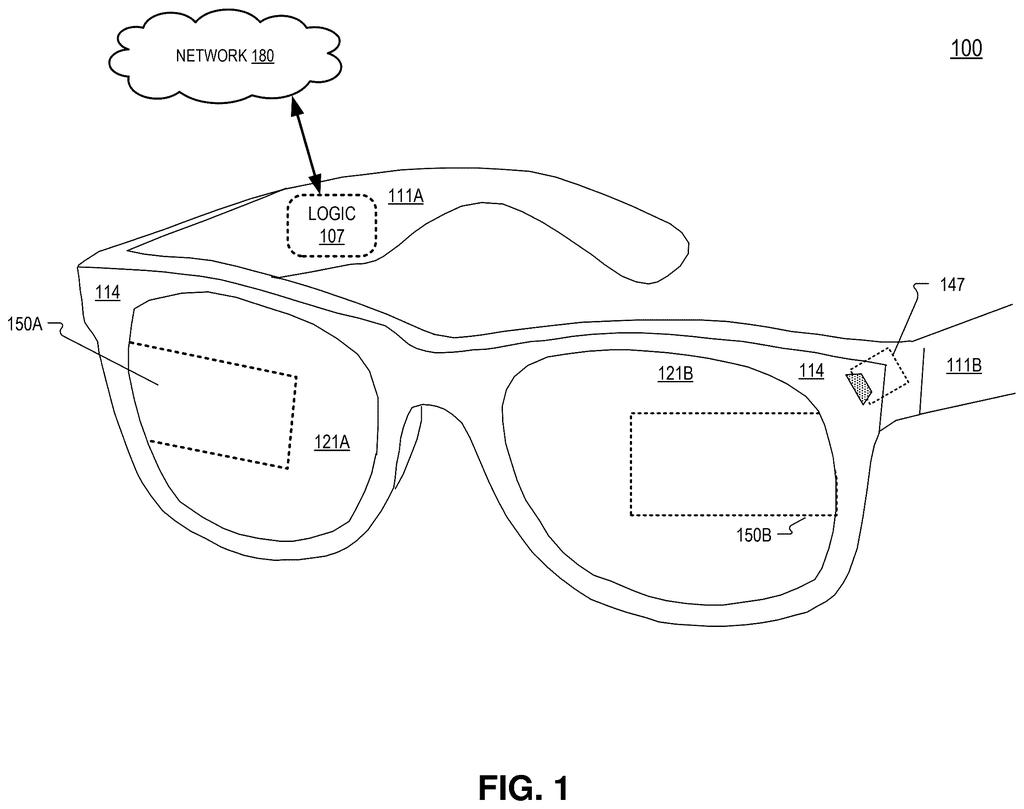
What Meta's tilted-image AR display actually does
Imagine you're designing a pair of AR glasses, and the tiny screen that makes the picture is a rigid little rectangle. It has to sit at a certain angle, which forces a bulge somewhere on the frame, usually near your temple. Nobody wants a lump on the side of their glasses.
Meta's patent has a workaround. Instead of using the whole screen, it draws the picture on a tilted rectangle inside it, rotated somewhere between 10 and 45 degrees. A tiger drawn there would look crooked on the chip, but the optics in the lens turn it back upright before it reaches your eye.
The lights behind the screen are tilted to match, so they only light up the part in use. The price is that you use fewer of the screen's pixels, so the picture is a bit less sharp. Meta says that loss can be kept slight.
a Liquid Crystal on Silicon (LCOS) display including LCOS display pixels arranged in rows and columns forming a rectangle, wherein the LCOS display is configured to drive a digitally offset image onto an angularly offset portion of the LCOS display pixels that is angularly offset from the rectangle formed by the rows and columns; …
Translation: The glasses tilt the digital picture diagonally across the rectangular screen grid to save physical space.
How the tilted image gets straightened out
The filing describes a head-mounted display built around an LCOS display (liquid crystal on silicon, a tiny reflective chip where each pixel either passes or blocks light). Its pixels sit in a normal grid of rows and columns forming a rectangle. The chip is told to drive a digitally offset image onto a smaller block of pixels that is rotated relative to that grid. Every other pixel is driven dark.
A light source layer supplies the light, and its lights are angled to match the tilt. The claims say the lights can have rectangular emission regions whose sides are turned by the same offset angle. They also cover ten or fewer lights, with examples of two green LEDs plus one red and one blue, or two red, two blue and one larger green. The lights can be mini-LEDs or laser diodes, flashed in red, green and blue sequence while the pixels change in sync.
The tilted picture then goes into a geometric waveguide (a see-through lens that steers light with its shape, using bevels, angled mirrors or gratings) that sends it to the eyebox, the spot where your eye sits. The waveguide, or an angled reflective surface in the claims (20 to 75 degrees), rotates the image back to upright.
Because only the used patch is lit, the filing says electrical energy is saved.
A display system includes a Liquid Crystal on Silicon (LCOS) display and a light source layer. The LCOS display includes LCOS display pixels arranged in rows and columns forming a rectangle.
Translation: The hardware relies on a standard rectangular microdisplay paired with a custom light source.
Why a tilted image could slim down AR glasses
If you have ever looked at bulky smart glasses, you know the display hardware is a big reason they look the way they do. The filing says the rectangular chip limits where engineers can put it, which creates protrusions on the frame. Letting the picture sit at an angle gives designers more freedom to tuck the display into a smaller, nicer-looking frame.
That matters for something you wear on your face all day. Lighting only the used part of the chip could also trim power draw, which helps battery life in tiny glasses. The catch is a lower pixel count for the image, so sharpness is the thing to watch if this ever shows up in a product.
Meta's 74th filing we've tracked since May in the AR glasses race builds on single-beam eye and room scanning and picking objects by eye and hand.
The cost here is easy to name: Meta would pay for a whole display chip but only use part of it. A tilted rectangle inside a rectangle cannot fill the corners, so some pixels sit dark and the picture has fewer dots than the chip could produce. Meta's own description calls this counterintuitive and says the loss can be kept slight, though it gives no figure.
The other cost is a tighter bond between parts. The lens has to straighten the picture perfectly, so any error in that step would show up as a crooked or warped image, and the display and lens can no longer be designed separately.
Still, for glasses people have to wear all day, a slimmer frame is worth more than a few lost pixels. The trade reads as sensible.
Get our take in your Top Stories
Liked this breakdown? Add Patentlyze as a preferred source on Google, and our plain-English take shows up more often in your Top Stories the next time Meta patent news breaks.
There are more where this came from
We read every patent application Big Tech publishes and send you the ones worth knowing. Plain English, free, every week.
The drawings
12 drawing sheets from US 2026/0309985 A1 · click any drawing to enlarge


Want this weekly breakdown for a company we don't cover? Patentlyze Pro →
Be the first to weigh in