
Meta Patents a Nose-Bridge Disparity Sensor to Keep AR Displays Perfectly Aligned
If the two tiny displays inside a pair of AR glasses drift even slightly out of alignment, your brain turns that misalignment into a headache. Meta's latest patent describes a precision sensor system — mounted right at the nose bridge — that constantly monitors and measures that drift to sub-arcminute accuracy.
What Meta's AR display alignment sensor actually does
Imagine reading subtitles floating in the air through AR glasses, but the text looks doubled or slightly offset — like a 3D movie with the glasses off. That's what happens when the two displays inside AR glasses fall out of alignment. Even a tiny shift, invisible to the eye, can cause eye strain and break the illusion entirely.
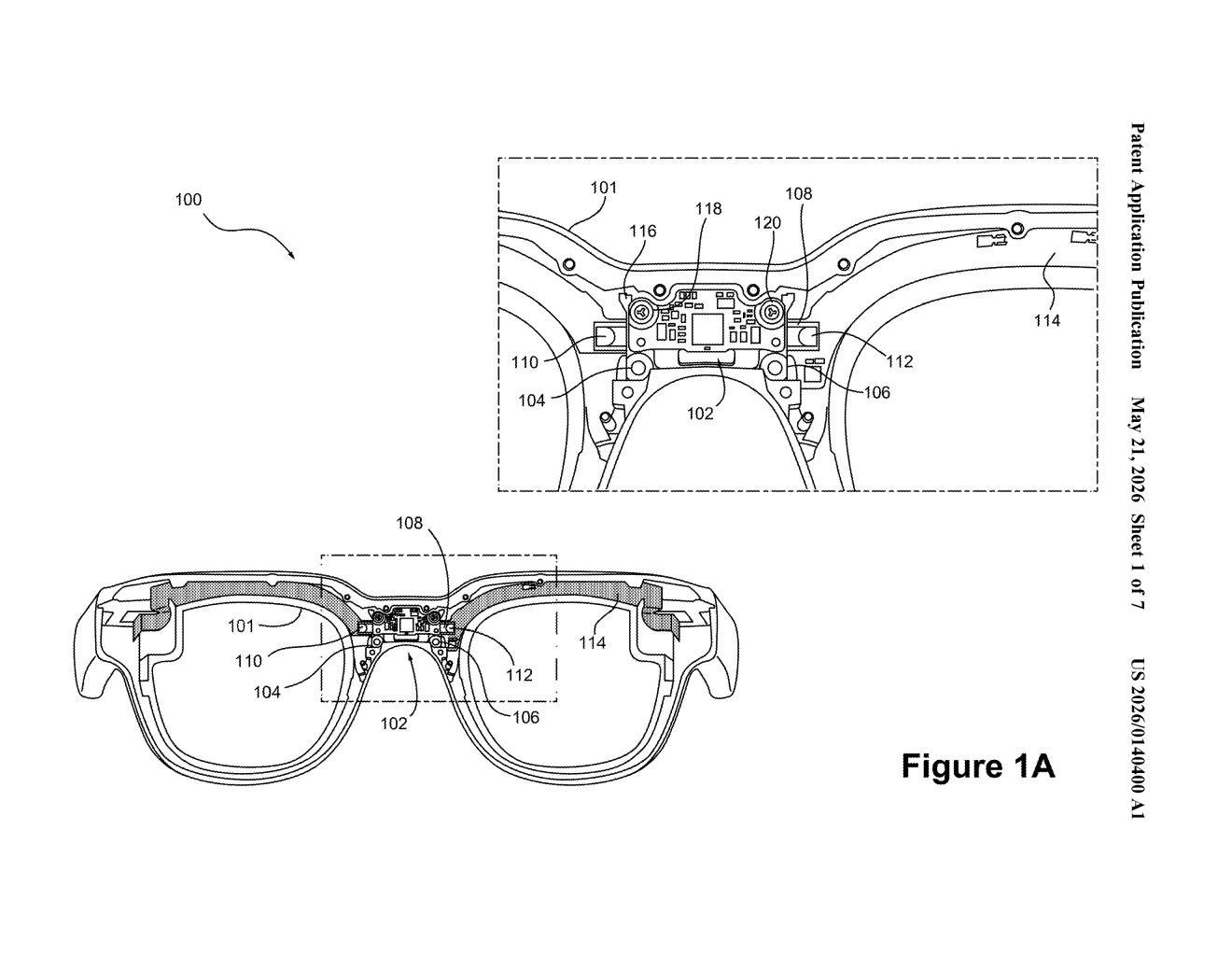
Meta's patent describes a small sensor assembly tucked into the nose bridge of AR glasses. It captures light from both displays simultaneously and compares them to detect any mismatch — a process called disparity detection. Think of it like a spell-checker, but for your lenses.
The clever part is the mounting itself. The sensor's light combiner — the optical element that merges the two beams for comparison — is bonded to a bracket with a specialized adhesive that holds it so rigidly it can flex less than one arcminute. For reference, one arcminute is 1/60th of a degree. That's the kind of precision you'd expect in a telescope, not a pair of glasses you wear to the grocery store.
How the light combiner and bracket hit sub-arcminute precision
The patent describes a disparity sensor — an internal measurement tool, not a camera you'd use for AR content — that lives at the nose bridge of an AR headset. It has three core components:
- Light combiners: An optical element (likely a beamsplitter or similar optic) that gathers light output from emitters attached to each of the two displays and merges them into a single optical path for comparison.
- Image sensor: Captures the combined light from both displays to produce data about how well — or poorly — the two displays are spatially aligned. The output of this sensor is used to calculate disparity (the positional difference between what the left and right display are showing).
- Bracket: A mounting structure designed to sit at the nose bridge. It holds the image sensor and light combiner together and attaches them to the headset frame.
The critical engineering detail is in how the light combiner attaches to the bracket. It uses an adhesive specifically chosen to allow less than five arcminutes of deflection along the combiner's major axis (and less than one arcminute of warpage in other directions per the abstract). One arcminute is 1/60th of a degree — a tolerance level typically associated with precision optics and surveying instruments.
The nose bridge location is deliberate. It's physically central to both displays and mechanically stable, making it the ideal anchor point for a sensor that needs to measure both sides of the headset with equal accuracy.
Why display alignment is make-or-break for AR glasses
AR glasses live and die by optical precision. If the two displays drift — due to heat, mechanical stress, or just the daily wear of being sat on — the user experiences double vision, eye fatigue, or a broken sense of depth. Real-time disparity monitoring at this tolerance level would let the headset detect and correct for that drift before you ever notice it, which is a meaningful step toward making AR glasses wearable for hours at a time.
The nose bridge mounting choice also signals something about Meta's industrial design direction: this is a component designed to fit inside a glasses-style form factor, not a bulky headset. The fact that the patent obsesses over sub-arcminute mechanical tolerances in a consumer wearable bracket suggests Meta is serious about bringing laboratory-grade optics into something you'd actually put on your face.
This is genuinely interesting precision engineering work, not a high-concept moonshot. The obsession with arcminute-level tolerances in a consumer bracket tells you that Meta's AR glasses team is solving hard, unglamorous problems that determine whether these devices are actually comfortable to use. It's the kind of patent that doesn't make headlines but represents exactly the work that separates a prototype from a shipping product.
There are more where this came from
We read every patent application Big Tech publishes and send you the ones worth knowing. Plain English, free, every week.
Want this weekly breakdown for a company we don't cover? Patentlyze Pro →