
IBM Patents an AI That Designs Power Circuits and Checks Its Own Work
IBM describes an AI that takes a parts list and a voltage target, drafts a circuit, then grades and fixes its own draft until the design meets every requirement.
What IBM's circuit-designing AI actually does
Ever been handed a box of electronic parts and told only what the finished gadget has to do? That is the daily job of an analog circuit designer: pick from a set of parts, wire them together, and hit targets like how little power gets wasted and what voltage comes out. It takes a lot of expertise and a lot of trial and error.
IBM's filing describes an AI that writes the first draft for you. You type up the requirements in plain text: here are the parts you may use, here is the minimum efficiency, here is the output voltage you want. A language model, the same family of technology behind chatbots, proposes a wiring layout.
Then the system gives that draft a score and feeds the score back to the AI, which tries again. It keeps looping until the design meets every requirement, and only then hands it over.
receiving an instruction prompt specifying a plurality of design constraints, including a component pool for the analog circuit, a minimum efficiency for the analog circuit, and output voltage for the analog circuit …
Translation: The system starts with user goals like parts available, power efficiency, and target voltage.
How the AI gets graded and redraws its design
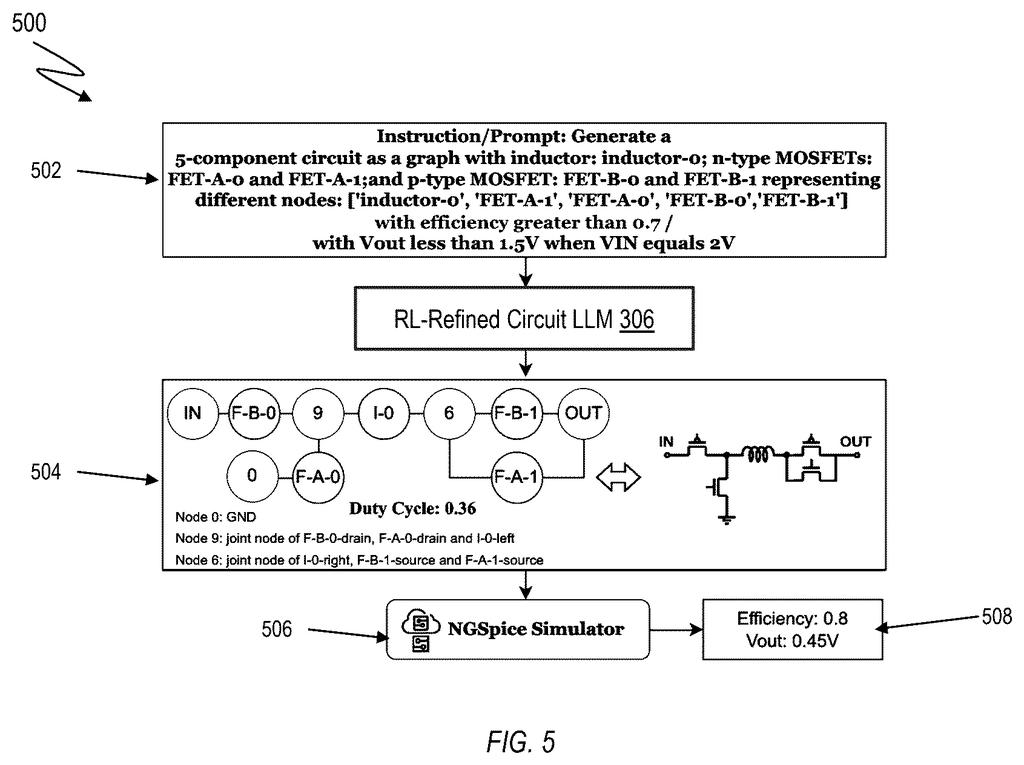
The core method has a few steps. You give the system a written instruction prompt listing the constraints: a pool of allowed components, a minimum efficiency, and a target output voltage. A fine-tuned LLM (a large language model, the text-generating kind of AI, retrained on circuit examples) returns a circuit topology, meaning which parts are used and how they connect.
To teach a text model about circuits, the filing converts each circuit's netlist (the standard list of parts and their connections) into a language-like format it calls incident encoding. The model is trained on pairs of prompts and matching netlists.
Then comes the feedback loop, built on reinforcement learning (improving by chasing a score instead of copying examples). A reward function grades each draft using a weighted mix of three estimates:
- A trained classifier judges whether the circuit is valid.
- A prediction model estimates its efficiency.
- A second prediction model estimates its output voltage.
The draft, its score and the original prompt go back into the model, which revises the design. This repeats until the constraints are met. The filing also describes a version that uses proximal policy optimization (a common way to nudge a model toward higher scores), and says a verified design may be automatically fabricated into an integrated circuit.
… defining a reward function that evaluates the circuit topology based on criteria and calculating a reward score for the circuit topology …
Translation: An AI scoring system judges how well the proposed circuit design works.
What this means for people who design circuits
If this works the way the filing describes, engineers who design power circuits (the kind that convert one voltage into another inside chargers and electronics) could skip much of the slow, manual trial and error. Instead of running a full simulation for every guess, cheaper scoring models handle the first round of grading, which the filing says reduces the number of simulation runs needed.
For you, the effect would be indirect: faster design cycles for the power parts inside the devices you buy. The filing reports that its validity checker scored 92% on one measure, but its worked example of a design session is hypothetical, so treat this as a research-stage approach. It targets the people who build electronics, and the people who buy them would only feel the results later.
IBM's 36th filing in the AI assistant and agent patents we've tracked since May builds on earlier work like teaching chatbots to respond like specialists and an agent that runs meetings.
Nothing here needs new hardware. It is software built on a language model plus a few small scoring models, so the shortest route to a product is an add-on for the design tools engineers already use. The hard front-loaded work is data: someone has to collect a large set of circuits paired with their requirements, and train the checkers that grade each draft.
The filing's own examples stay narrow, with transistors and inductors aimed at efficiency and voltage targets. That points to power converters as the first realistic use. Anything broader, like radio or sensor circuits, would need its own training data and its own graders.
The sensible bet is an assistant that offers a good first draft while a human engineer signs off. That idea is within reach, and the filing reads as an early step toward it.
Get our take in your Top Stories
Liked this breakdown? Add Patentlyze as a preferred source on Google, and our plain-English take shows up more often in your Top Stories the next time IBM patent news breaks.
There are more where this came from
We read every patent application Big Tech publishes and send you the ones worth knowing. Plain English, free, every week.
The drawings
7 drawing sheets from US 2026/0310867 A1 · click any drawing to enlarge


Want this weekly breakdown for a company we don't cover? Patentlyze Pro →
Be the first to weigh in