
Google Patents a Preview Sketch You Can Edit Before AI Draws the Final Image
What if you could move a package from one hand to the other in an AI image before the AI even draws it? A Google patent application describes a rough preview you edit first, then send off for the final picture.
What Google's AI image preview editor does
Ever asked an AI to draw something, then kept retyping your request to fix small stuff like which way a person is facing or how zoomed in the shot is? Every retry starts over from your words alone, and the AI may still miss.
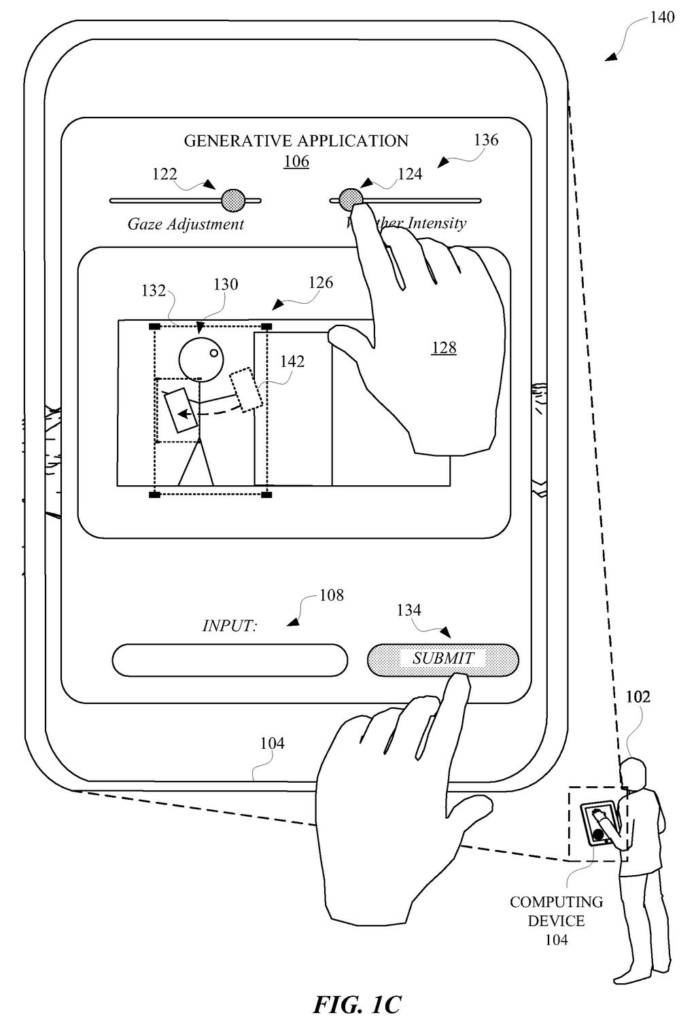
Google's patent application describes a different order of events. When you ask for an image or video, your device first shows a rough preview, a simplified version built from much less data. Alongside it come controls picked to fit your request: a box to zoom in on a person, a slider for where they look, another for how stormy the weather is. You can even drag a package from one hand to the other.
Only after you finish tweaking does the app send your original request plus your edits to a powerful server, which draws the final version. The goal is to get it right the first time, so you spend less time and computing power on do-overs.
… causing visual content editor interface to be rendered at the display interface of the computing device in response to receiving the request, wherein the visual content editor interface includes an intermediate representation of the generative visual content that a user can modify by providing inputs to the visual content editor interface; …
Translation: The system opens an editor showing an early draft that you can change before the final image is made.
How the rough draft gets sent to the server
When you submit a request for an image or video, the app first builds an intermediate representation: a stripped-down draft that uses far less data than the finished product. The filing says it might have fewer colors, lower resolution, or fewer shapes, and one claim says it may contain no AI-generated content at all.
Next, the app picks editing controls that match your words. One described method turns your request into an embedding (a string of numbers that captures what the text means) and compares it with stored embeddings tied to different controls. Close matches get shown. In the filing's examples, a person gets a gaze control and a bounding box (an adjustable frame for zoom and focus), while an outdoor scene gets a weather or time-of-day control.
Then the work is split up:
- The draft and the controls are made on your own device, per claim 11, without relying on a heavy AI model.
- Your edits and the original request go to a remote computer running the trained models.
- That computer sends back the final image or video, which carries much more data than the draft.
The filing also describes saving your editing choices, with permission, as training data so future drafts start closer to what people want.
Such adjustments can involve annotating the intermediate representation, adjusting orientation, zoom, gaze, or other features of the intermediate representation.
Translation: You can fix things like the angle, framing, or eye direction right on the preview sketch.
Why fewer re-tries matters for AI image apps
If you have ever retyped an image request just to nudge a pose or a camera angle, this patent is aimed at that chore. Editing a cheap draft first could mean fewer do-overs, and the filing says each do-over is expensive for the servers doing the drawing.
For Google, the pitch is mostly about saving computing power across huge numbers of users, with a nicer experience as a side effect. The filing also says a draft can coax out visual details you might struggle to put into words until you see them. It frames the idea around Google's automated assistant and other generative apps, but it names no specific product, so treat it as a design idea for now.
Google's 64th filing we've tracked in AI photo editing since May builds on earlier applications like one on copying text styles and one on how light alters photos.
Claim 1 is short and wide. It asks for five things: take a request for an image or video, show an editable preview, accept your changes, send those changes along with the original request to a trained AI model, and show the result. It says nothing about how small the preview must be, which controls appear, or whether the work happens on your phone or a server.
Those details live in the narrower claims, such as the box around a person (claim 5) and the phone-then-server split (claim 11). Read at face value, claim 1 could describe nearly any AI image tool that has you edit a draft before the final picture appears. A claim this wide often gets trimmed during examination, so claims 5 and 11 may end up doing the real work.
The idea itself is sensible and easy to picture: fix the sketch before paying for the painting. Whether it matters depends on how tightly Google words the final claims.
Get our take in your Top Stories
Liked this breakdown? Add Patentlyze as a preferred source on Google, and our plain-English take shows up more often in your Top Stories the next time Google patent news breaks.
There are more where this came from
We read every patent application Big Tech publishes and send you the ones worth knowing. Plain English, free, every week.
The drawings
7 drawing sheets from US 2026/0311404 A1 · click any drawing to enlarge


Want this weekly breakdown for a company we don't cover? Patentlyze Pro →
Be the first to weigh in