
Amazon Patents a Way to Send AI Picture-Quality Fixes Inside Your Video Stream
Amazon is filing a patent for a system that bundles AI model updates inside the same stream that delivers your video, letting your TV or phone apply picture improvements the moment it receives them.
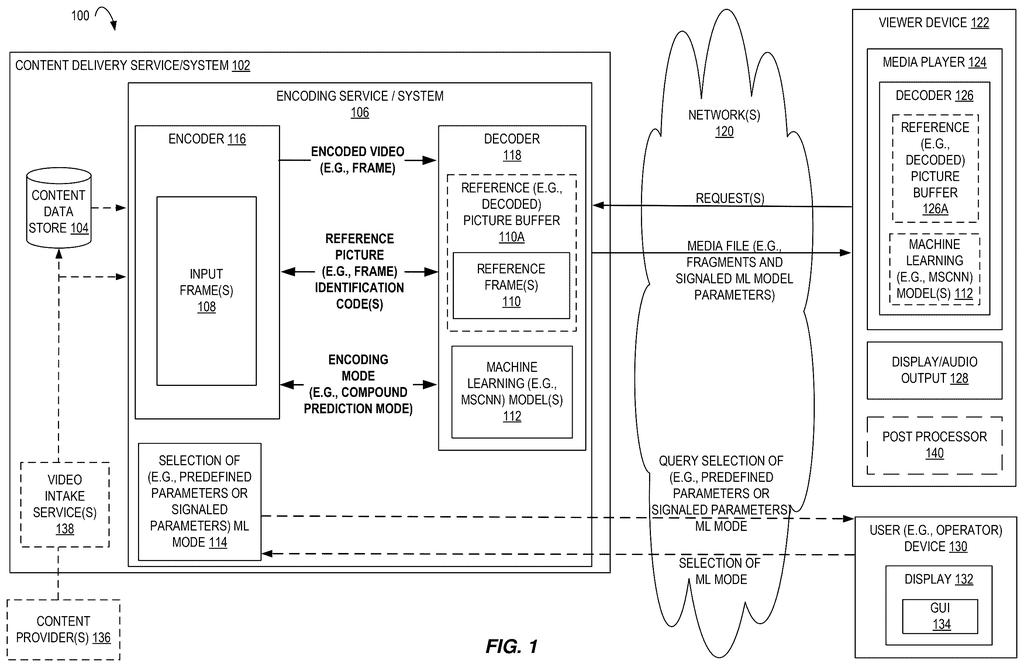
How Amazon's AI picture fix travels with your video
Imagine watching a movie and the video streaming service automatically sends a tiny AI "tune-up" alongside the footage, so your screen can clean up blurry or blocky sections in real time. That is essentially what this patent describes.
Amazon's system analyzes each video frame on its servers before sending it to you. It runs the frame through an AI model that looks at the image at two different zoom levels, high detail and lower detail, then blends those observations to figure out the best way to fix up the picture. That process produces a small set of instructions, called model parameters, that tell your device's copy of the same AI exactly how to improve this particular piece of video.
Instead of sending you a generic AI upgrade that works the same for every show, Amazon would ship a custom mini-update tuned to each piece of content, packed right into the normal video file you're already downloading.
… transmitting the one or more model parameters for the machine learning model and an encoded frame of the encode from the content delivery service to a viewer device comprising an instance of the machine learning model.
Translation: Amazon sends both the compressed video and the AI fix instructions to your device.
How the dual-resolution feature map gets packed into the stream
The patent covers a pipeline that runs at Amazon's content delivery service (think the servers behind Prime Video) rather than on your device.
Here is the sequence the claim describes:
- A video frame is encoded in the standard way, converting pixel data into a compressed mathematical form and back again.
- An on-server machine learning model examines the resulting pixel values at two resolutions: the full native resolution and a shrunken version of the same block.
- The lower-resolution features are scaled back up (upsampled) to match the full-resolution features, then the two sets are combined to generate a "modified" version of the frame that the AI has cleaned up or enhanced.
- From that improved frame, the system extracts model parameters (the numerical weights that define how the AI behaves) that are specific to this video content.
- Those parameters are bundled into the bitstream alongside the conventionally encoded frame and sent to the viewer's device, which carries an identical copy of the model ready to apply them.
The dual-resolution trick matters because video compression introduces artifacts (blocky patches, ringing around edges) at different scales. Examining the image at both scales lets the model catch problems a single-resolution pass might miss, then encode a fix that travels with the video itself.
… utilizing machine learning model parameters in a bitstream of a compressed video.
Translation: Embedding artificial intelligence settings right inside the standard video stream.
What this means for streaming quality on Prime Video
For viewers, this could mean sharper, cleaner images without requiring a faster internet connection. The AI enhancement happens on your device, guided by server-generated instructions tailored to the specific movie or show you're watching, rather than a one-size-fits-all filter applied after the fact.
Amazon's steady investment in video-quality AI puts this filing in a broader pattern of trying to differentiate streaming quality at the infrastructure level. If this approach works at scale, it shifts some of the computational work from your TV back to Amazon's data centers, which is a meaningful trade-off: Amazon's servers are far more powerful, and the custom per-content parameters would theoretically outperform any fixed enhancement chip built into consumer hardware.
This is the seventh Amazon filing in our Enterprise AI coverage since May, joining earlier work on a robot swapping skill modules and Echo predicting your speech.
Claim 1 is broad in an interesting way. It does not claim a particular AI architecture or a specific type of artifact removal. It claims the general act of generating parameters from a dual-resolution feature process and shipping them inside the video bitstream. That scope, if the claim survives examination, would cover a lot of ground.
In practice, any competitor building a content-adaptive AI enhancement system that sends model updates alongside encoded video would need to work around this claim. That includes approaches used in video-upscaling chips or client-side AI filters that receive server-supplied guidance, which are areas several hardware and streaming companies are actively exploring.
The narrowing detail is the specific dual-resolution feature step: full-resolution features and lower-resolution features that get upsampled and merged. A competitor could arguably sidestep the claim by using a single-resolution model or a fundamentally different multi-scale architecture. So the claim is broad in its distribution method but narrower in its prescribed AI structure, which is a typical tradeoff in software patent drafting.
There are more where this came from
We read every patent application Big Tech publishes and send you the ones worth knowing. Plain English, free, every week.
The drawings
86 drawing sheets from US 2026/0270452 A1 · click any drawing to enlarge


Want this weekly breakdown for a company we don't cover? Patentlyze Pro →