
Qualcomm Files Patent for Home Internet Boxes That Move Their Own Antennas
Some home internet boxes physically move their own antennas with a small motor, and finding the best angle can take tens of seconds or even minutes. Qualcomm's new patent is about keeping your connection alive while that happens.
What Qualcomm's moving-antenna patent does
A home internet box sits on a shelf by the window. Inside, a small motor slowly slides one of its antennas into a new position, hunting for the angle that gives the cleanest signal. While that happens, that antenna can't send or receive anything.
Qualcomm's patent is about making that awkward pause easier on you. Before the box starts moving, it tells the network its plan: how long each shift takes, how many positions it will try, and which of its other antennas can keep talking in the meantime. The network can then plan around the pause instead of guessing.
When the search ends, the network tells the box which position and signal direction worked best, and the box uses them from then on.
transmit, to a network node, control information that indicates one or more parameters associated with a beam training procedure for multiple antenna panels of the UE that are mechanically displaceable relative to each other …
Translation: The internet box tells the network how its moving parts will adjust to catch the best signal.
How the box and network plan each move
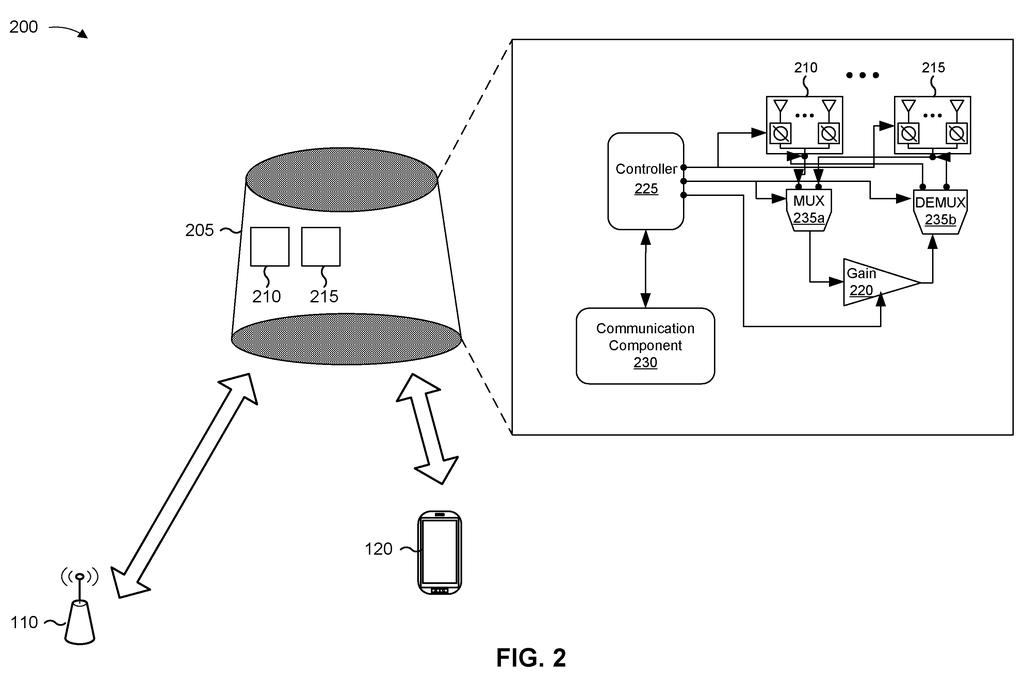
The filing describes a device (called a "user equipment," or UE; the main example is a home or office internet box) with several antenna panels, at least one of which a motor can physically move. The filing says cheaper boxes use small antenna arrays (4x4 elements, versus 8x8 or 16x16 on pricier ones) and rely on moving parts to make up for the smaller size.
The core process is beam training: the box and the network try different narrow, aimed signal directions (called beams) to find the best pair. One panel is the anchor and stays put. The other is the displacement panel and moves. The procedure alternates between movement periods and training periods.
Before starting, the box sends the network control information with parameters such as:
- How long it needs to switch from one position and beam setup to the next
- How many positions the moving panel will visit
- Which pre-trained beams the anchor panel will use while the other panel moves
- A rank change (rank is the number of data streams sent at once)
The network can then send a rate control configuration. In the filing's example, the box uses rank 2 while moving and rank 4 while training, with no back-and-forth messages. Afterward, the network picks the preferred beam pair and panel position using measures like download rate, interference, and latency.
… relative mechanical displacements between the multiple antenna panels during the beam training procedure …
Translation: The physical shifting of the device's internal antennas while it searches for a stronger connection.
Why cheaper home internet boxes could gain
The practical payoff is fewer hiccups. Today, a box that repositions an antenna can leave the network guessing, which costs extra messaging and can add delay. If the box announces its moves in advance, the network can keep your link going on the anchor panel and spend less effort on constant adjustments.
The bigger picture is cost. The filing frames moving antennas as a way to build cheaper home and office internet boxes with smaller antenna arrays, using less power and giving off less heat. If that design catches on, signaling like this is what keeps those cheaper boxes from feeling slow or flaky when they adjust.
Qualcomm's 501st filing in our Qualcomm coverage since May adds to a thread that includes the radio-mapping tags patent and the shelf-label decoder filing.
Shipping this takes two parties. The motorized antenna hardware is the easier half: the filing treats motors, reflectors and movable panels as things some home internet boxes already use. The harder half is the messaging, because the network has to understand what the box is telling it before any of it helps.
That points to a long road. A device maker can't ship this alone. Carriers and their network equipment suppliers would need matching software, and the filing itself notes the settings could be fixed by a wireless standard. The shortest path to a product is one carrier and one box maker agreeing on these messages for a single home internet line.
For you, the payoff would be modest: fewer dropouts while your box reaches for a better angle. It is a narrow fix for a cost-cutting design, and a long way from a headline feature.
Get our take in your Top Stories
Liked this breakdown? Add Patentlyze as a preferred source on Google, and our plain-English take shows up more often in your Top Stories the next time Qualcomm patent news breaks.
There are more where this came from
We read every patent application Big Tech publishes and send you the ones worth knowing. Plain English, free, every week.
The drawings
10 drawing sheets from US 2026/0312662 A1 · click any drawing to enlarge


Want this weekly breakdown for a company we don't cover? Patentlyze Pro →
Be the first to weigh in