
Qualcomm Patents a Way for Home 5G Routers to Report Their Own Antenna Failures
When the little motor that steers your home 5G router's antenna starts to wear out, the router currently has no way to tell the network. Qualcomm wants to change that with a system where the device automatically reports its own mechanical decline.
What Qualcomm's self-reporting antenna system actually does
You're streaming a movie through your home 5G router and the picture keeps stuttering, even though your neighbor's identical router works fine. The culprit might be a tiny motor inside your router that physically points the antenna toward the nearest cell tower, and that motor is wearing out.
Qualcomm's patent describes a fix: the router monitors its own antenna hardware, and when it detects that things are degrading, it sends an official message to the network saying, in effect, "my capabilities have changed, please work with what I have now." The network then adjusts the connection accordingly, rather than continuing to demand performance the router can no longer deliver.
The result is that a slowly failing router might still hold a usable connection instead of suddenly dropping out. The device manages its decline gracefully, which is a lot better than the current situation where hardware failure is invisible until the connection just dies.
… at least one communication parameter of the second set of communication parameters is degraded relative to the first set of communication parameters based at least in part on a mechanical degradation of the one or more mechanically-displaceable antenna panels …
Translation: The router tells the network that its moving antenna parts are broken, which forces it to use lower quality settings.
How the device detects and broadcasts antenna degradation
The patent covers customer premises equipment, or CPE, which is the technical name for the box that sits in your home or office and connects you to a 5G cellular network (think of it as the wireless equivalent of a cable modem).
Many high-performance 5G home routers use mechanically steerable antenna panels: small motors physically rotate or tilt the antenna array to find the best signal direction. The patent addresses what happens when those motors degrade over time through normal wear.
The core mechanism works in two steps:
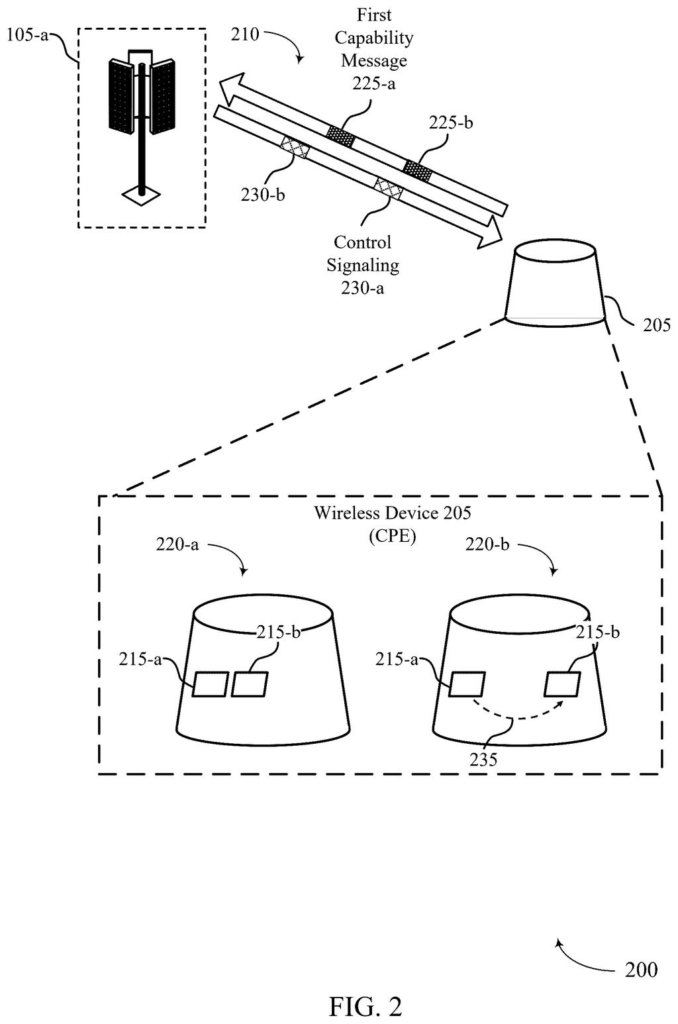
- The device transmits a first capability message to the network, declaring what it can do (antenna angles it can reach, signal strengths it can achieve).
- When the device detects mechanical degradation, it sends a second capability message with a reduced set of parameters, explicitly flagging that its performance has dropped.
The network (a base station, in practice) receives the updated capability report and reconfigures the link, for example by reducing data rate demands or switching beam configurations, to match what the hardware can actually deliver. This dynamic capability reporting is already common in 5G for software-level changes, but applying it to physical motor wear is the specific contribution here.
A wireless device, such as a customer premises equipment (CPE), may transmit a first capability message indicating a first set of communication parameters associated with one or more mechanically-displaceable antenna panels of the wireless device.
Translation: Home internet routers can send a status report to the network about the current health of their moving antenna components.
What this means for fixed 5G home internet reliability
For anyone using a fixed wireless home internet service, this matters because the alternative to graceful degradation is a sudden, unexplained outage. A router that can tell the network it's declining gives the network a chance to compensate, and gives the service provider a signal that a technician or replacement unit may be needed.
The broader picture is that 5G home internet is expanding fast, and the reliability of the physical hardware (not just the radio signal) is becoming a real-world concern. This filing sits alongside other antenna and link-management work tracked in the latest Big Tech patents, as chipmakers like Qualcomm race to make fixed wireless hardware as self-managing as possible.
That makes this Qualcomm's 332nd filing in our Qualcomm coverage since May, adding to work like the battery-pull state saver and the cell-to-satellite switcher.
The shortest path from this patent to a shipped feature is actually short, which is unusual in antenna engineering. The hardware (motorized panels) already exists in commercial 5G CPE products. The capability messaging framework (called UE capability reporting) already exists in the 5G standard. What this patent adds is the specific trigger: use a mechanical health signal to update that existing message.
That means no new chipset, no new antenna design, and no new network protocol is required. A firmware update on the device side plus a corresponding change to how base station software interprets degraded capability reports could, in theory, carry this to market.
The open question is instrumentation: how does the router actually measure motor wear reliably? The patent doesn't specify a sensor method, which is the part that would need the most engineering work before this becomes a product feature.
Get our take in your Top Stories
Liked this breakdown? Add Patentlyze as a preferred source on Google, and our plain-English take shows up more often in your Top Stories the next time Qualcomm patent news breaks.
There are more where this came from
We read every patent application Big Tech publishes and send you the ones worth knowing. Plain English, free, every week.
The drawings
13 drawing sheets from US 2026/0255188 A1 · click any drawing to enlarge


Want this weekly breakdown for a company we don't cover? Patentlyze Pro →
Be the first to weigh in