
Qualcomm Files Patent for Shelf Labels That Unscramble Data From Battery-Free Tags
A battery-free tag can send a scrambled message that is mostly padding. Qualcomm's patent lets the shelf label next to it decide whether to unscramble and shorten that message before passing it on.
What Qualcomm's shelf labels do with tag data
Ever mailed a one-line note inside a thick, padded security envelope? The envelope weighs far more than the note, and you pay postage on all of it. Something similar happens with the tiny battery-free tags a store could stick on products or crates. They run on energy pulled from radio waves, and their messages are scrambled for privacy. A reading just a couple of characters long can swell to about 40 once it is locked up.
Qualcomm's patent has the electronic shelf label nearby act as a middleman. When a scrambled message arrives, the label decides: unscramble it and send on the short version, or pass the bulky package along untouched. It weighs how big the message is, how far it sits from the store's wireless access point, and how much power it has left.
The goal is to save energy on the labels, since every extra second of broadcasting costs power, and some labels run on small coin-cell batteries.
receive, via the one or more transceivers, from an energy harvesting tag, an encrypted payload …
Translation: The shelf label gets a scrambled message sent by a battery free price tag.
How a label decides to decode or just pass along
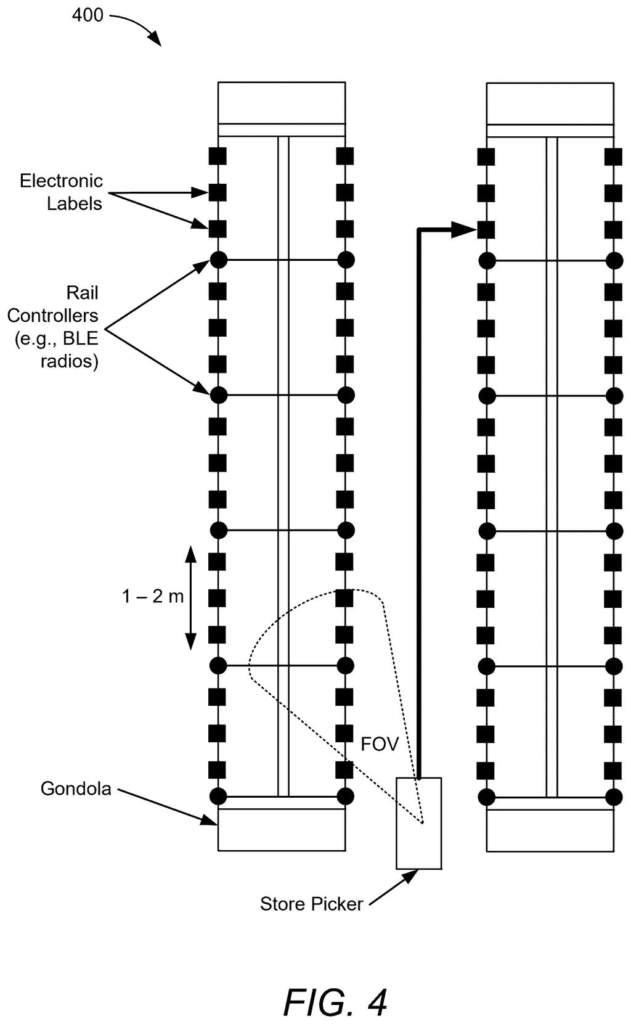
The filing describes a store system with three layers: battery-free energy harvesting tags (called eTags) stuck on products, electronic labels on shelves, and a network component such as a wireless access point or management server. An eTag collects energy from radio signals, stores it in a small capacitor, and sends out a Bluetooth Low Energy beacon (a short wireless broadcast) carrying an encrypted payload (its scrambled data). The filing says an eTag can harvest energy from a transmitter as far as 20 meters away.
The claimed electronic label receives that payload and then takes one of two paths: send on a decrypted version, or forward the encrypted one untouched. The dependent claims spell out the criteria:
- Size: decrypt if the payload is under a threshold size, forward as-is at or above it.
- Distance: decrypt when the label is at or beyond a threshold distance from the access point, since smaller packets need less transmit power over long hops.
- Processing cost: for example, AES-256 (a stronger encryption standard) takes more work than AES-128.
- Stored energy and priority: how much power the label has left, and how important the tag or payload is.
To decrypt, the label needs the matching security key (the secret code that reads the message). Each payload carries an unencrypted key identifier, a plain label saying which key to use. Keys can arrive from the server over a Bluetooth GATT link (a standard connection for exchanging data), or a small set can be stored in the label and updated dynamically by the network.
A label can also forward all, part or none of a decrypted payload based on priority, so low-priority readings can be skipped.
… transmitting, to a network component, (1) a decrypted payload generated by decrypting the encrypted payload or (2) the encrypted payload without decryption …
Translation: It either decodes the data locally or passes it on still scrambled depending on the rules.
Why battery-free tags lean on shelf labels
If you shop at a big store, you will not see anything different on the shelf. The practical effect is behind the scenes: cheaper, lower-power tracking of inventory, crates and pricey items like electronics, with the shelf labels already on the aisles taking on extra work.
The filing treats this as a tradeoff between radio time and computing effort, and the answer can shift label by label. It also means a shelf label can read what a tag is reporting, which makes the handling of keys, including who gets which one and when, a point retailers would want to get right.
Qualcomm's 499th filing in our Qualcomm coverage since May adds to a run that includes the cell-signal driving patent and the smart shelf tag patent.
The shortest route to a product here is firmware. The filing's own description gives labels a radio and a processor, so the decrypt-or-forward choice is mostly code, plus a list of keys pushed out from the store's management software.
The harder parts sit outside the patent. The battery-free tags are described as still being developed, and a store needs a safe way to hand out keys before any label can decode anything. Labels without their own radio, which rely on a shelf rail controller, would need that controller to do the work instead.
So this is sensible plumbing for a future store network. Its rollout is tied to when the tags themselves show up, and the payoff is modest: slightly shorter messages and a bit less power spent per reading.
Get our take in your Top Stories
Liked this breakdown? Add Patentlyze as a preferred source on Google, and our plain-English take shows up more often in your Top Stories the next time Qualcomm patent news breaks.
There are more where this came from
We read every patent application Big Tech publishes and send you the ones worth knowing. Plain English, free, every week.
The drawings
12 drawing sheets from US 2026/0312943 A1 · click any drawing to enlarge


Want this weekly breakdown for a company we don't cover? Patentlyze Pro →
Be the first to weigh in