
Google Files Patent for Turning a Typed Sentence Into a 3D Object You Can Spin
Type 'a green toaster' and this Google patent application describes a system that hands back a 3D model you can rotate. It draws one picture first, then invents the other angles. The stated aim is a cheap, endless supply of practice rooms for AI.
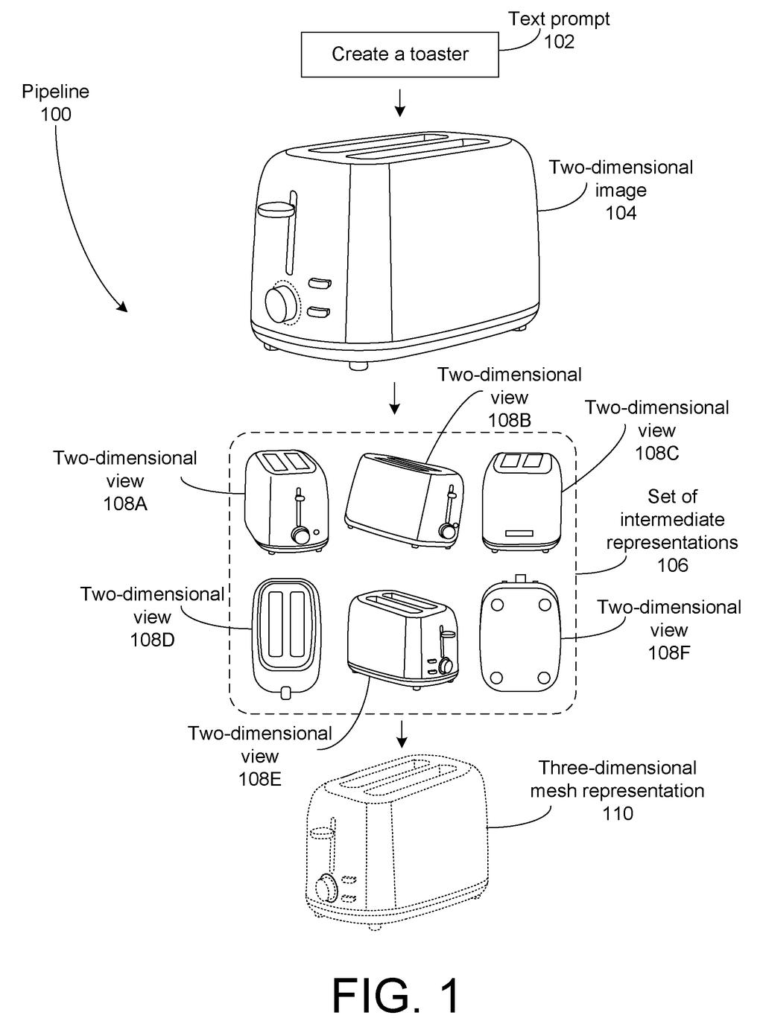
What Google's text-to-3D object patent does
Imagine you type 'a green toaster, suitable for a Japanese kitchen' and moments later you can spin a digital toaster around and check its back, sides and underside. That is the idea behind this Google patent application.
The system doesn't build the object in one shot. It first paints a single picture of the toaster from your description. Then it works out what the toaster would look like from the back, the top and other angles, making sure every view agrees on details like where the handle sits. Finally it stitches those views into a 3D model made of points, lines and surfaces.
Google's own main use is practical: filling virtual rooms with lots of different objects, so computer-vision software can learn what real rooms look like.
generating a first two-dimensional image of an object based on: a prompt describing the object; and a transformation of a first representation of the object based on a probability of a first feature being included in the first two-dimensional image of the object …
Translation: The system makes a flat picture from your text description by guessing what details should be in it.
How one picture becomes a spinnable 3D model
The method has three steps. First, a text-to-image diffusion process (software that starts with random noise and cleans it up step by step until a picture matching your words appears) makes a first 2D image. The description says prompts can include phrases like 'in an empty white background' and 'in the middle' so the object isn't cropped, and the object can be cut out from its background.
Second, a multi-view diffusion process takes that picture plus a set of camera poses (the position and direction of a virtual camera) and generates images from other angles. A variational auto-encoder (a neural network that squeezes an image into a compact form and expands it back) lets this work happen on compressed versions, which is faster. All views are generated together, so a handle on the left in the front view lands in the matching spot in the side and back views.
Third, the system builds a 3D representation from those views. The description's example uses a Neural Radiance Field (a neural network that learns, for any point in space, whether something is there and what color it is), then converts that cloud of points into a mesh, the standard format of points, edges and surfaces that graphics software reads.
The filing also describes a prompt generator that mixes lists of objects, materials, colors and themes into many varied prompts, and a step that drops finished objects into a floor plan.
… generating a three-dimensional representation of the object based on the first two-dimensional image of the object and the second two-dimensional image of the object.
Translation: It then combines multiple flat angles to build a final 3D model you can rotate.
Why Google needs digital toasters to train AI
For you, the first effect is probably indirect. The filing's main stated purpose is making synthetic training data: thousands of varied virtual rooms, so AI that estimates depth, outlines objects and reconstructs scenes can learn without anyone photographing real kitchens. Robots and navigation software depend on that sort of practice.
The description also points to games, virtual reality, architectural visualization and simulation, where anyone who needs a 3D chair or lamp usually has to model one by hand or hunt for one. Typing the request instead would save that time. It is a patent application, though, so nothing here says a product is on its way.
Google's 20th filing in the AI simulation work we've tracked since May builds on earlier applications like one on tracing light rays and one on building lifelike scenes.
The problem is bigger than it sounds. A computer that learns to see a kitchen needs thousands of kitchens, with every chair, mug and toaster labeled, and building each 3D object by hand is slow, expensive work. Typing a sentence and getting a usable object back goes straight at that bottleneck.
The approach matches the size of the problem. Generating all the views together so they agree with each other is the step that decides whether the final object looks solid or lumpy, and the filing puts it at the center. The prompt generator that mixes colors, materials and themes into endless variations shows Google is aiming at volume.
Whether the results hold up is something a patent cannot tell you. The filing gives no quality numbers, so its claims of speed and clean output are the company's word for now.
Get our take in your Top Stories
Liked this breakdown? Add Patentlyze as a preferred source on Google, and our plain-English take shows up more often in your Top Stories the next time Google patent news breaks.
There are more where this came from
We read every patent application Big Tech publishes and send you the ones worth knowing. Plain English, free, every week.
The drawings
5 drawing sheets from US 2026/0320908 A1 · click any drawing to enlarge


Want this weekly breakdown for a company we don't cover? Patentlyze Pro →
Be the first to weigh in