
Google
Google · AI / ML · Filed Sep 23, 2025 · USPTO published Sep 17, 2026 · Sep 17 release
Google Patents a Faster Tool for Building Lifelike Scenes Without Blurry Edges
When AI systems reconstruct a 3D scene from photos, the results can be riddled with jagged edges and missing details. Google has filed a patent for a faster, cleaner approach that attacks both problems at once.
- Publication number
- US 2026/0278918 A1(US20260278918A1)
- Applicant
- Google LLC
- Filed · Published
- Sep 23, 2025 · Sep 17, 2026
- Inventors
- Jonathan Tilton Barron, Benjamin Joseph Mildenhall, Dor Verbin, Pratul Preeti Srinivasan, Lars Peter Johannes Hedman
- Status when we published
- Waiting for an examiner
- Document
- 20 claims
- US classification
- 345/427
- Parent application
- National Stage Entry of PCT/US2023/085765 (filed Dec 22, 2023)(PCTUS2023085765)
What Google's NeRF aliasing fix actually does for 3D images
Ever tried to zoom in on a photo only to find it turns into a blocky mess? AI-generated 3D scenes have the same problem, and fixing it usually means a much slower rendering process.
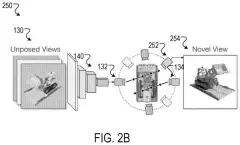
Google's patent describes a system for building 3D scenes from ordinary 2D photos, a technology called Neural Radiance Fields (or NeRF). The tricky part: existing fast versions of NeRF use a grid structure that doesn't understand distance or scale, so close-up or far-away views end up with jagged edges and missing chunks of the scene.
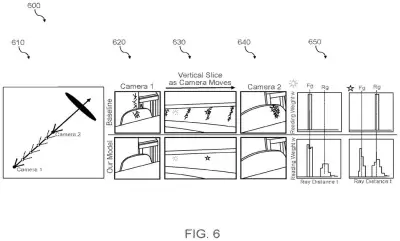
The new approach samples the scene in a cone shape (the way a camera lens actually sees the world) and uses a mathematical smoothing technique to fill the grid more accurately. The result, according to Google, is fewer errors and faster training time than previous methods, which is a combination that's proven difficult to pull off.
… sampling a plurality of samples along a sampling direction of the multidimensional representation according to a multisampling pattern, the multisampling pattern representing a conical frustum …
Translation: The system shoots cone shaped rays into a digital 3d scene to gather color and depth data from multiple points at once.
How the cone-sampling and Gaussian method removes jagged edges
NeRF models work by learning, from a set of 2D photos, how a 3D scene looks from any angle. Faster NeRF variants speed things up by storing scene information in a feature grid, a 3D lookup table the model can query quickly. The problem is that grids have a fixed resolution, so when you ask for a view at a scale the grid wasn't built for, you get aliasing: jagged edges, flickering textures, or missing detail.
Google's system tackles this by changing how it samples the scene when building the grid. Instead of sampling along a thin ray (like a laser pointer), it samples along a conical frustum (the cone-shaped volume a camera pixel actually captures). This is a more realistic model of how a lens works at different zoom levels and distances.
From those cone samples, the system generates isotropic Gaussians (smooth, bell-curve-shaped blobs that represent uncertainty about exactly where a point is in space). Those blobs are then interpolated (blended) into the feature grid, effectively letting the grid understand scale and smooth over the gaps that cause artifacts.
The output goes into a proposal model, a lightweight neural network that focuses rendering effort on the parts of the scene that actually matter, and the final result is a clean 2D view of the scene from any angle.
… these grid-based approaches lack an explicit understanding of scale and therefore often introduce aliasing, usually in the form of jaggies or missing scene content …
Translation: Traditional fast 3D rendering methods struggle to understand object sizes, which causes jagged lines and visual glitches.
What this means for AI-generated 3D photography and maps
NeRF technology is at the center of how companies like Google build photorealistic 3D maps, street-view reconstructions, and AR experiences from real-world photos. Right now, the fastest NeRF methods trade away image quality, while the highest-quality methods train too slowly for practical use. A system that closes both gaps at once matters across a wide range of products from mapping to content creation.
For you as an end user, the downstream effect could be sharper, more accurate 3D scenes in products like Google Maps or Google Photos, especially in tricky situations like aerial imagery at different zoom levels, where aliasing problems are most visible.
Google's 18th filing in the AI simulation space we've tracked since May adds to a run that includes one mapping 3D scenes from photos and one where AI rehearses future moves.
Source: US 2026/0278918 A1 at the USPTO (PDF). Full patent text and figures are in the official publication.
Get our take in your Top Stories
Liked this breakdown? Add Patentlyze as a preferred source on Google, and our plain-English take shows up more often in your Top Stories the next time Google patent news breaks.
Add Patentlyze on Google
One click.
There are more where this came from
We read every patent application Big Tech publishes and send you the ones worth knowing. Plain English, free, every week.
The drawings · 11 sheets
11 drawing sheets from US 2026/0278918 A1 · click any drawing to enlarge


Show the other 3 sheets


More from Google
All 1,127 Google patents →
More in AI simulation
All 192 AI simulation patents →
Adobe
Adobe Patents an AI That Builds 3D Scenes From a Text Prompt
Nvidia
Nvidia Patents a Way for Cameras to Track Exactly Where Objects Are Moving in Video
Nvidia
Nvidia Patents an AI That Reads Text Instructions to Move Robot Arms in 3D
Nvidia
No comments yet