
Google Files Patent to Fix the Flicker in 3D Scenes Built From Photos
Turn a handful of photos of a room into a 3D scene, and the picture often shimmers as the camera moves through it. Google's new patent application goes after that flicker by rebuilding the scene from solid, hard-edged shapes instead of fuzzy blobs.
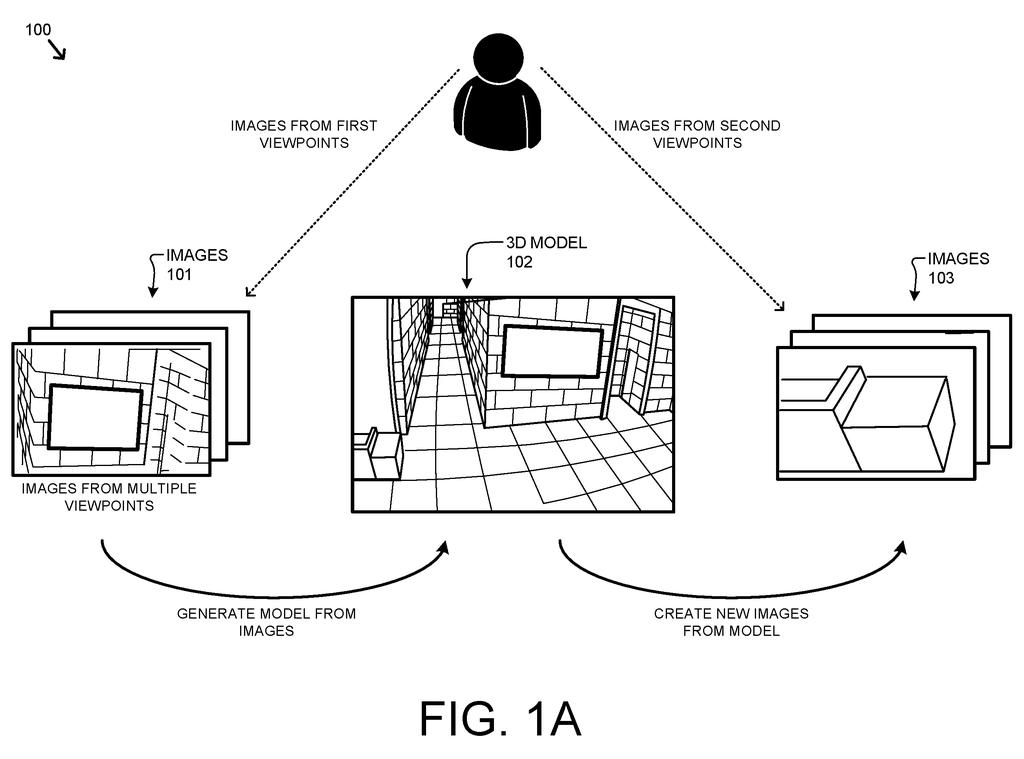
What Google's solid-shape 3D scenes actually do
A video glides through a 3D model of a living room built from a handful of photos, and the edge of the couch shimmers, pops in and out, and wobbles as the camera moves. If you have ever seen a 3D scan that looks slightly unstable when you move around it, that is the flicker Google is going after.
The filing describes building the scene out of lots of small, solid blobs (ovals, basically) instead of fuzzy clouds that fade out at the edges. Each blob is equally see-through all the way across and has a clear boundary, so there is less guesswork about how to blend them where they overlap.
The system then sends a line of sight out for every pixel, sorts the blobs it passes through from nearest to farthest, and adds up how much light each one blocks. The result is a picture from an angle nobody photographed, with less shimmer along the way.
… generating a three-dimensional representation of the environment, the three-dimensional representation being defined by a set of shapes, the set of shapes having a shape including a density that is constant, the density indicating at least light absorption for the shape; …
Translation: The system builds a 3D scene using shapes that have a steady, unchanging density to absorb light.
How Google sorts shapes along each light ray
Google's filing starts with a set of photos of a place, such as a living room, taken from different angles. From them, the system builds a 3D model out of many small shapes, usually ellipsoids (stretched spheres), each with a position, size, orientation and color.
The key detail is that each shape has a constant density, meaning it absorbs light at the same rate throughout (density here is a measure of how opaque the shape is). A popular current method, 3D Gaussian Splatting (a technique that builds scenes from soft, fuzzy blobs), blends overlapping blobs with a shortcut called alpha compositing (a simple layering of transparency values). The filing says that shortcut can cause flickering when the camera moves, and hard-edged shapes avoid it.
To make an image from a new viewpoint, the system works in three steps:
- Ray casting: for each pixel, a ray (a line from the virtual camera) is sent into the scene, and the shapes it crosses are sorted nearest to farthest using a tree of bounding boxes (a Bounding Volume Hierarchy).
- Integration: as the ray enters and leaves each shape, the density steps up and down, and the system adds up the light absorbed and the color contributed.
- Refinement: while the scene is being trained from the photos, shapes are added, split or pruned, and the tree is rebuilt after each round.
The claims cover the core idea plus several optional pieces: organizing shapes by position or bounding box, summing densities along a ray, updating the set of shapes, and using ellipsoids.
… generating a three-dimensional representation of the environment using a set of shapes or primitives with a constant density, the density defining light absorption for each shape.
Translation: It maps out the space in 3D using uniform shapes designed to handle lighting consistently.
What this means for 3D video from your photos
The practical payoff is steadier video when a virtual camera moves through a scene built from ordinary photos. The filing's own background points to uses like games, virtual reality and digital twins (3D copies of real places), where shimmering edges break the illusion fast.
There is a tradeoff the filing admits: more shapes mean finer detail but higher rendering cost, so the number of shapes can be chosen to fit the hardware. The filing does not name a product. The examiner's first review rejected the claims as filed, which is routine at this stage and usually followed by amendments, so the final scope may look different.
Google's 875th filing in our Google coverage since May continues a run that includes turning text into a 3D object and skipping unnoticed avatar moves.
You would notice this one in the first five seconds of a virtual walkthrough: edges that hold still instead of shimmering. That is a small benefit on paper, but it matters to anyone looking at a 3D scan of a home, a store or a game level, because a wobbling picture reads as broken.
You would never see the patent itself, only a smoother demo. The filing gives no speed numbers and no side-by-side comparisons, so how much cleaner the video looks stays an open question.
Fixing a visible glitch is a better pitch than adding yet another feature. If the approach holds up, the people who benefit most are those who make and watch 3D scenes, and they would feel it without ever knowing why.
Get our take in your Top Stories
Liked this breakdown? Add Patentlyze as a preferred source on Google, and our plain-English take shows up more often in your Top Stories the next time Google patent news breaks.
There are more where this came from
We read every patent application Big Tech publishes and send you the ones worth knowing. Plain English, free, every week.
The drawings
6 drawing sheets from US 2026/0320905 A1 · click any drawing to enlarge


Want this weekly breakdown for a company we don't cover? Patentlyze Pro →
Be the first to weigh in