
Intrinsic's New Patent Covers Software That Automatically Programs Robots for Factory Work
Alphabet's robotics software unit has filed a patent application for software that works out how a robot should hold, flip and re-grip a metal part. The goal is to spare engineers from coding each move by hand.
What Intrinsic's robot job planner actually does
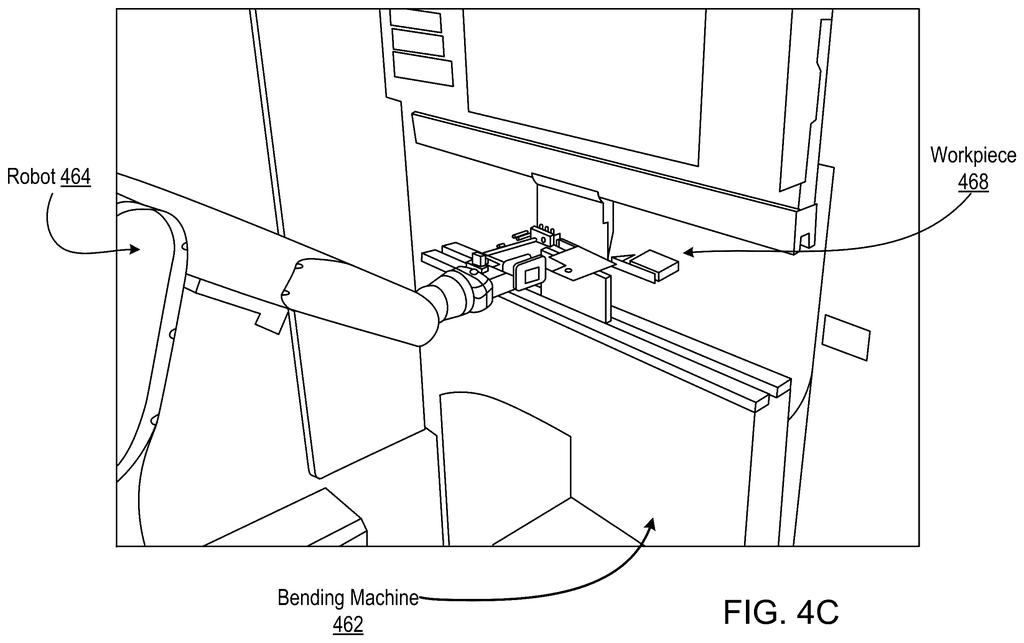
A robot arm lifts a flat sheet of metal off a pallet and feeds it into a bending machine. After the first bend, it has to grab the sheet in a different spot, because the place it was holding is now the place that needs bending. Today, a programmer usually codes every one of those moves by hand, and redoes the work whenever the part or the gripper changes.
This patent application from Intrinsic describes software that works out the sequence on its own. You give it the shape of the part at each stage and the tools the robot has, and it maps the possible ways to get from raw sheet to finished piece. Then it picks the best route, weighing things like speed, safety and stability.
The result is a step-by-step to-do list for the robot. It can even include a detour to a re-grasp station, where the robot sets the part down and switches from a suction cup to a pinch gripper.
… generating, for one or more state nodes, one or more grasp annotations that specify how the workpiece can be grasped by the robot in a state represented by the state node …
Translation: The software figures out the best way for the robot to pick up the part at every single step.
How the planner maps a workpiece's every state
The system starts with poses: the position and tilt of the part relative to the machine at key moments (for a bending job, lying flat, after the first bend, after the second). Each pose becomes a state node, one dot on a map of every condition the part can be in.
For each state, the software lists the ways the robot could hold the part. The filing calls these grasp annotations: from the left or right, horizontally or vertically, with a suction tool or a pinch tool. Each task, such as picking the sheet off a pallet, gets paired with one of those grips and becomes a line (an edge) linking one state to the next. Before adding a task, the system can check feasibility using inverse kinematics (the math that tells you whether the arm's joints can actually reach a position).
Next, it searches the map for the best route using criteria such as feasibility, speed, safety, stability, cost and efficiency. The description names standard search methods (greedy best-first and A*), with scores like how many robot joints move, how many grips change, or how many tools get used.
The winning route is converted into a behavior tree, a branching to-do list. Control nodes such as sequences, branches and loops set the order, and the leaves are action nodes, the individual robot moves. A real-time control system then runs the tree.
Why robot grip planning matters on the factory floor
The filing's own background says robots tending machines have needed "immense amounts of manual programming," and that adding a new part or a new gripper means reprogramming everything. Software that rebuilds the plan automatically could make new parts and tool changes much less painful for factories that make metal parts in small batches.
Bending is the worked example, but the filing also lists stamping, welding, grinding and polishing, including polishing car body panels and wheels. It is a patent application, so nothing here says a product is coming. Still, it shows where robot software is heading: you describe the part and the tools, and the planning gets done for you.
One more thing to know: the patent office has already approved this application, and Intrinsic has paid the fee to have it issued, so it should become a granted patent soon. The final granted claims may read a little differently from the version described here.
Google files its fourth patent in our robot grasping and movement watchlist since August, adding to work like the two-model reuse system and open-ended object commands we've tracked.
The big design choice here is turning every grip, tool and bend into a branching map of options. That makes the plan flexible, but each extra grip or tool multiplies the possible routes. A search over all of them could balloon, which is probably why the filing leans on search shortcuts that score routes as they go.
The second cost is setup. The planner can only be as good as what it is told about the part, the gripper dimensions and the machine, and the filing lists a lot of that data. Someone still has to feed it in and keep it accurate.
Still, the alternative is an engineer hand-coding every move and redoing it for each new part. Against that, trading some upfront data work for automatic plans reads as a good bargain, and a sensible, practical step for factory robotics.
Get our take in your Top Stories
Liked this breakdown? Add Patentlyze as a preferred source on Google, and our plain-English take shows up more often in your Top Stories the next time Google patent news breaks.
There are more where this came from
We read every patent application Big Tech publishes and send you the ones worth knowing. Plain English, free, every week.
The drawings
8 drawing sheets from US 2026/0307249 A1 · click any drawing to enlarge


Want this weekly breakdown for a company we don't cover? Patentlyze Pro →
Be the first to weigh in