
Disney Patents a Camera System That Tracks Your Moves Without Knowing Who You Are
Disney wants a screen that waves back at you, ducks when you duck and splashes when you raise your arms, all without ever learning who you are. The trick is a plain webcam and some very simple averaging.
What Disney's anonymous body tracking does
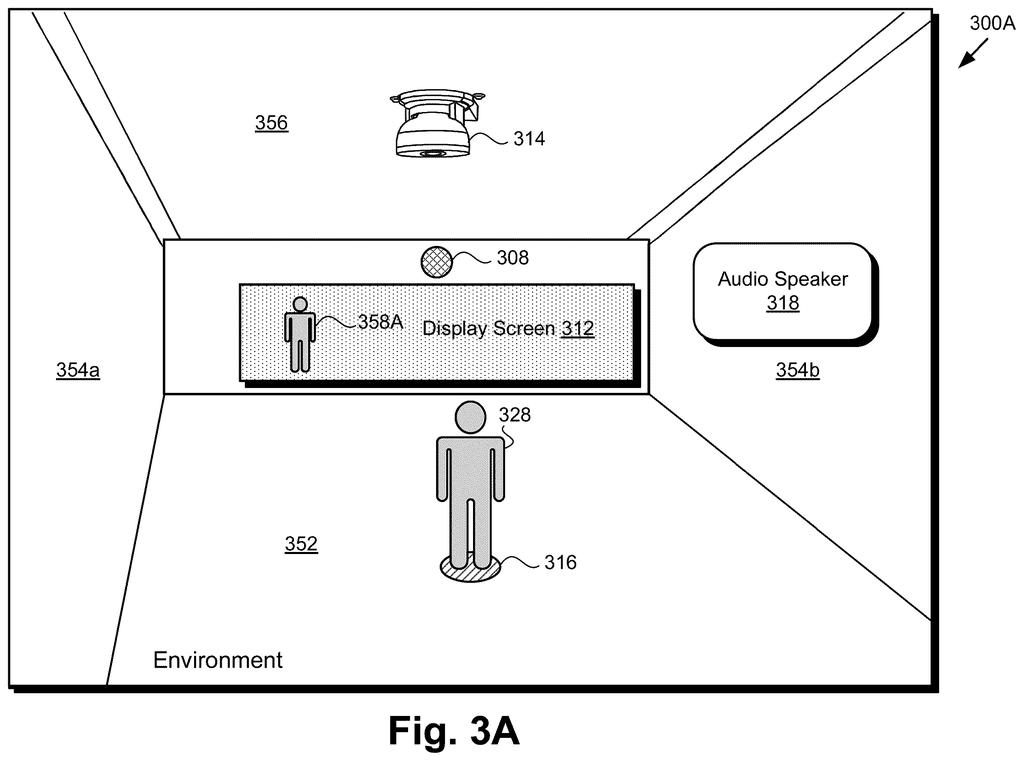
You walk into a movie theater lobby, and an animated ocean wave on a big screen turns to look right at you. Step to the left and its gaze follows. Raise both arms and it throws up a splash.
That is the scene Disney describes in this patent application. A single ordinary webcam watches the room and finds spots like your eyes, ears and shoulders. The system then averages those spots into one point for your head or torso and follows that single point as you move.
Because only the average is kept, the numbers on file say where a body is and say nothing about whose body it is. Disney also says this data stays inside the computer and is never sent elsewhere, so a whole crowd can play without anyone being identified.
… average the respective locations of the plurality of physical features to determine a position data for at least one anonymized body segment of the user; …
Translation: It combines body parts into a nameless lump so it can track motion without knowing who is there.
How a webcam guesses distance without depth
The setup has three parts: a computer, a sensor and a display. The sensor can be an everyday color camera (RGB) with no depth-sensing hardware. The display can be a screen, but the filing also lists lights, speakers and haptic actuators (devices that make surfaces vibrate, such as in a floor or wall). It can also be an AR or VR headset.
The software follows a fixed sequence:
- Detect presence: it decides someone is standing close enough to the sensor to count.
- Find features: it matches the camera image against a database of pictures of human features (eyes, ears, shoulders, hands) to locate them, optionally with a trained ML model (software that learned the pattern from examples).
- Average them: the locations are merged into one position for a body segment such as the head, torso or hands.
- Track changes: it watches how that position moves over time.
- React: it works out where you are, your posture or a gesture, and triggers an effect.
Without a depth sensor, distance is estimated by comparing your detected height or shoulder width with average human dimensions. A dropping head and torso reads as crouching, two raised hands as raised arms, and one raised hand as a wave. If you turn your head and only one eye or ear is visible, the system still produces a position. The filing gives 60 frames per second as an example update rate.
… detect, using sensor data, the presence of a user, identify, using the database and the sensor data, respective locations of physical features of the user, …
Translation: The system uses sensors and a database of body parts to spot people and find where they are standing.
Why privacy-first tracking suits public spaces
If you have ever walked past an interactive display in a lobby, museum or stadium, you have probably wondered what the camera is recording about you. This patent application is built around that worry. It aims for a screen that responds the instant you move while keeping data that cannot say who you are. Public venues where visitors have not agreed to give up privacy rights are exactly the settings the filing names.
The cost side matters too. The filing says the approach runs on off-the-shelf equipment and does not need a prepared room, so a venue would not need special sensors. For you, that could mean more playful screens in more places, and less reason to feel watched by them.
One more thing to know: the patent examiner has already issued a final rejection on this application. Disney can still amend the claims or appeal, and nothing described here has been approved yet.
Disney's 55th filing we've tracked since June in our Disney coverage follows patents like the dubbed-dialogue timing fix and the self-checking mug designer.
Little has to be invented for this one. The document says an ordinary webcam and off-the-shelf equipment are enough, so the work is software and artwork rather than new hardware.
The shortest route to something real is a lobby screen tied to a movie, like the ocean wave example. Someone has to train the detector that finds eyes and hands, draw the reactions, and tune the distance and motion settings, and the filing even describes an operator panel for exactly that tuning. Every piece is familiar, which makes this close to a shippable idea.
The privacy pitch deserves a careful look. Averaging a few points into one makes the stored data thin, yet the camera is still an ordinary camera pointed at people. The promise rests on the data staying inside the computer, and that is a design choice the venue has to honor.
Get our take in your Top Stories
Liked this breakdown? Add Patentlyze as a preferred source on Google, and our plain-English take shows up more often in your Top Stories the next time Disney patent news breaks.
There are more where this came from
We read every patent application Big Tech publishes and send you the ones worth knowing. Plain English, free, every week.
The drawings
5 drawing sheets from US 2026/0310288 A1 · click any drawing to enlarge


Want this weekly breakdown for a company we don't cover? Patentlyze Pro →
Be the first to weigh in