
Google Files Patent for a Shortcut That Skips Avatar Movements You Wouldn't Notice
In a virtual crowd of thousands, most of the avatar movements your device is told to draw are ones you would never notice. Google's patent application describes a way to score each movement and send the noticeable ones first.
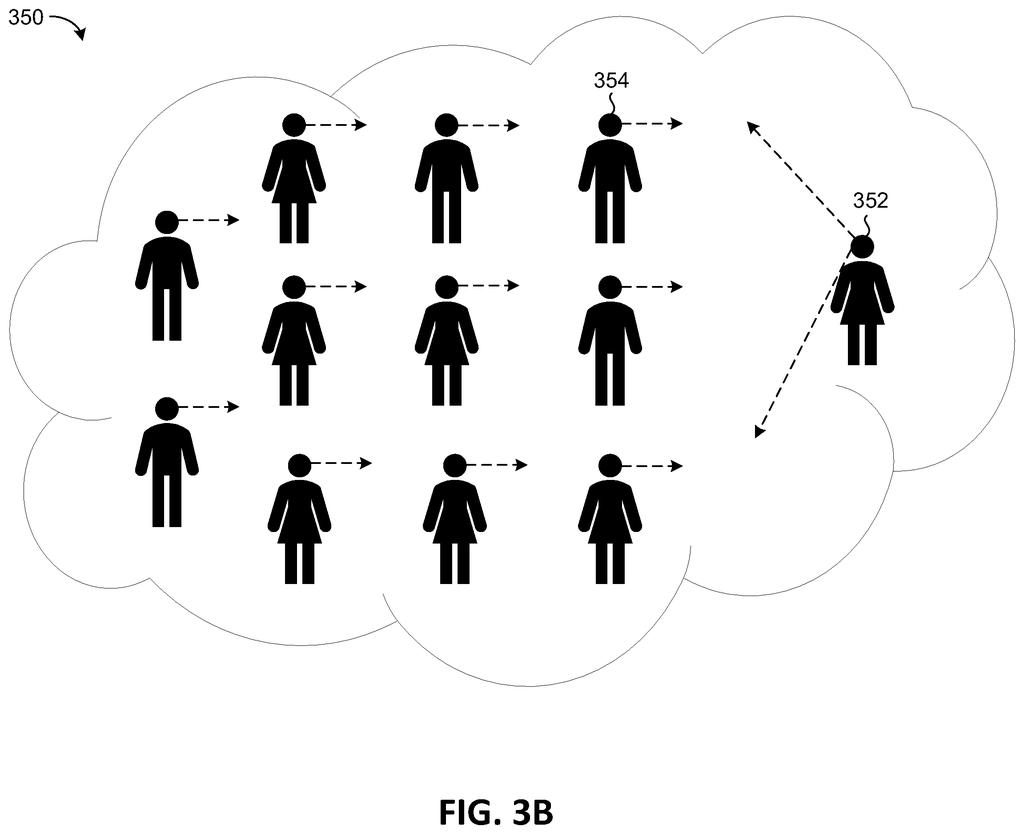
What Google's avatar update filter actually does
A few thousand avatars fill a virtual concert, and every one of them is waving, nodding or dancing. Your device gets instructions for each of those moves, even for the avatar twenty rows behind you that you will never look at.
Google's patent application describes a server that gives every requested movement a priority score based on how likely you are to notice it. An avatar facing you and talking scores high. One far away and turned the wrong direction scores low. High scorers get sent to your device first, and the lowest can be dropped entirely.
The goal is less data flying around and less work for your device, so the parts of the scene you actually watch stay smooth. The filing also lets your device guess what an avatar will do next. When the guess is right, the real update matters less.
… determining, by the processing device, a first update priority score for the first update and a second update priority score for the second update; …
Translation: The system figures out which graphical changes matter most by assigning them priority scores.
How Google scores which avatar moves get sent first
The patent covers a platform (the server that runs a shared virtual space) that sends a client device (your phone, laptop or headset) renderings of several 3D objects. Those objects can be whole avatars or parts of one avatar. When requests come in to change how those objects look or move, the platform gives each update a priority score and acts on the updates according to those scores.
The filing lists many things that can feed into a score:
- Visibility: whether the object is in front of you and close enough to see details.
- Time since the last update for that object on your device.
- How many other objects in the space can see it.
- Motion and audio: how much the object moves and how loud its audio is.
- Distance to you and to whatever others are focused on.
- Prediction accuracy (more on that below).
Scores can come from a trained machine learning model (software that learns patterns from past examples) or from plain hand-written rules, such as distance thresholds. In the example, scores run from 0.0 to 1.0. Updates then go into a waiting line, or queue, for each device, with high scores at the front. A newer request for the same object can replace an older one, and updates below a cutoff may never be sent.
Your device can also run its own model that predicts an avatar's next motion and report the guess to the server. The server compares it with the real update. A wrong guess raises the priority, and the filing's example is a predicted high-five that turns out to be a thumbs up, scored at roughly 50 to 75 percent accurate. If accuracy falls below a threshold, the real update is sent so the device's model can retrain.
At least one of the first rendering of the first 3D object or the second rendering of the second 3D object is updated based on the first update priority score for the first update and the second update priority score for the second update.
Translation: Only the high priority objects get refreshed on screen while the rest are skipped.
Why Google's patent matters for crowded virtual events
If you have ever watched a video call stutter or a game chug when a room fills up, you know the problem: every person in the room demands a share of your connection and your battery. Skipping movements you would never see could leave more bandwidth and processing power for the avatars in front of you, and for everything else your device is doing.
The idea applies to virtual meetings, parties, concerts and sporting events, the crowded settings the filing names. Phones, laptops and headsets on weak connections would have the most to gain, since they have the least room to spare. The filing offers no measured savings, so the benefit stays a design goal for now.
Google's 873rd filing in our Google coverage since May follows applications like Wing's drone landing words and the dark-focus camera fix.
Almost everything here is software. No new headset, chip or sensor is needed, just a server that already knows where each avatar stands and which way it faces. That puts the idea close to something a virtual-world team could build with data it already has.
The shortest route to a working version is the simple one the filing itself describes: hand-written rules based on distance and viewing angle. The learning models, one for scoring and one for guessing movements, need training data from real crowds first, which takes a platform with plenty of users.
The filing gives no figures on how much bandwidth it would save, so the size of the payoff is unproven. Even so, a skip-what-nobody-sees trick is easy to test and easy to switch on in a crowded virtual room.
Get our take in your Top Stories
Liked this breakdown? Add Patentlyze as a preferred source on Google, and our plain-English take shows up more often in your Top Stories the next time Google patent news breaks.
There are more where this came from
We read every patent application Big Tech publishes and send you the ones worth knowing. Plain English, free, every week.
The drawings
11 drawing sheets from US 2026/0320922 A1 · click any drawing to enlarge


Show the other 3 sheets


Want this weekly breakdown for a company we don't cover? Patentlyze Pro →
Be the first to weigh in