
Nvidia Files Patent for Scrambling the Clues Hackers Use to Rebuild Private Images
Sharing the small updates an AI learns from can leak the private images it trained on. Nvidia's patent filing teaches a network to play the thief first, then scramble what gets shared.
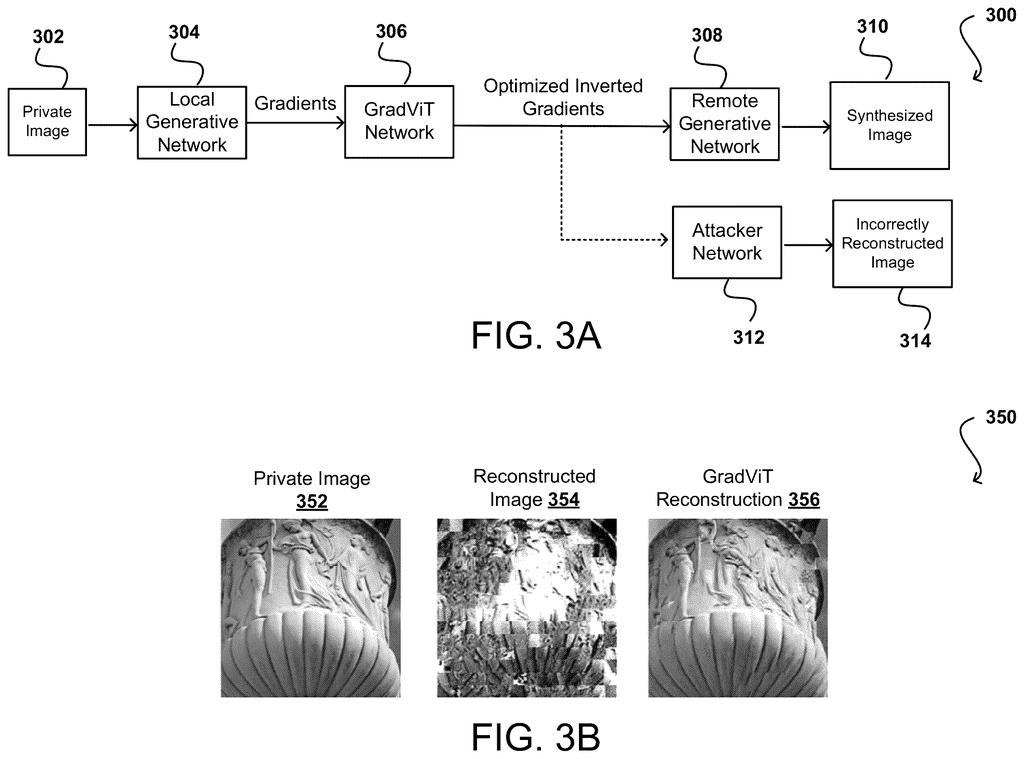
What Nvidia's image-scrambling patent actually does
You're training an AI on a pile of private images, and your computers need to swap the small updates the model learns along the way. Here's the catch: anyone who intercepts those updates can use them to rebuild the original images, sometimes in startling detail.
Nvidia's patent application turns that attack against itself. A neural network first plays the thief, trying to reconstruct the private images from the updates. Then it uses what it learned to add carefully chosen noise to the updates being shared, so a real thief who intercepts them ends up with muddled, wrong pictures.
The filing says the images the AI itself produces still keep their accurate detail. Only the stolen version falls apart.
one or more circuits to use one or more neural networks to determine noise to be added to one or more images of one or more objects based, at least in part, upon one or more features of the one or more objects.
Translation: Specialized hardware uses AI to figure out how to scramble specific parts of a picture.
How Nvidia's AI plays the thief to stop theft
The core claim is broad: a neural network decides how much noise (small, deliberate distortions) to add to images, based on what is in them. The narrower claims and the description fill in how. Nvidia calls its network GradViT, a vision transformer (an image AI that chops a picture into small patches and studies how they relate).
The setup starts with a generative network (an AI that makes images) trained on private pictures. As it learns, it produces gradients, the small adjustments to its internal settings after each round of training. Those gradients get shared with other machines, and an attacker who intercepts them can try to work backward to the original images. GradViT is trained to be that attacker, starting from random static and nudging it toward the private image.
That training balances three goals:
- Gradient matching: the rebuilt image should produce the same adjustments as the real one.
- Image prior: the rebuilt image should look like a natural photo, judged using statistics from a separate ResNet-50 network.
- Patch prior: neighboring patches should line up at their edges, so the pieces land in the right places.
A scheduler (a timer that changes how much each goal counts) starts with gradient matching alone. Around the halfway point it halves that weight and switches on the realism goal. Once trained, the system produces altered gradients to send out. The filing says an attacker using them converges on a wrong answer with far less detail, while images the AI generates keep accurate detail.
Apparatuses, systems, and techniques are presented to introduce noise or variation into images.
Translation: Methods are introduced for adding visual static or random changes to photos.
Why shared AI training makes privacy leaks a risk
If you ever contribute photos or faces to an AI training effort, the practical risk is leakage: the updates passed around during training can be enough to rebuild the originals. This filing points at a defense that alters those updates before they leave the secure site. That matters most in multi-node training or federated learning (many devices training one model together), where updates travel across networks.
For Nvidia, whose hardware runs this kind of training (the filing mentions its DGX servers), protecting the data flowing through that hardware gives customers a reason to trust shared training setups. The filing includes face images among its examples, an area where a leak would hurt most. Whether the protection holds up outside Nvidia's own tests is not something the document shows.
Nvidia's fourth filing we've tracked since July in our on-device AI privacy watchlist builds on earlier work like training across computers without sharing data and choosing a network via federated learning.
Leaked training data is a real problem for anyone who handles sensitive images. The filing says an attacker who intercepts a model's updates can rebuild batches of original pictures, including faces, at high resolution, up to 30 images or more at a time. If an AI learned from private faces or photos, a leak like that exposes real people.
The fix matches the size of that problem well. Nvidia trains its own attacker, then uses what that attacker learns to decide how to scramble what gets shared. Defending against a specific, well-understood attack this way is a sensible plan.
A caution on scope: the first claim is written very broadly, covering any neural network that picks noise for images based on what is in them. The detailed protection lives in the description and the narrower claims, and the evidence offered is the company's own observation of how close the reconstructions came.
Get our take in your Top Stories
Liked this breakdown? Add Patentlyze as a preferred source on Google, and our plain-English take shows up more often in your Top Stories the next time Nvidia patent news breaks.
There are more where this came from
We read every patent application Big Tech publishes and send you the ones worth knowing. Plain English, free, every week.
The drawings
56 drawing sheets from US 2026/0320983 A1 · click any drawing to enlarge


Show the other 48 sheets


Want this weekly breakdown for a company we don't cover? Patentlyze Pro →
Be the first to weigh in