
Microsoft Patents an AI System That Spots Private Data Before It Leaks
What if your company's software could automatically notice that a document contains someone's private phone number before that document ever left the building? That is exactly what Microsoft has filed a patent to do.
How Microsoft's leak-detection AI actually works
Does your company ever handle files that might accidentally contain someone's personal details, a home address, a private salary, a medical record? Catching those slips before they become a breach is harder than it sounds, especially at scale.
Microsoft's new patent describes a system that works like a fact-checker with a very specific job. When a document comes in, the system pulls out the name of a person or organization mentioned in it (the "subject entity") along with a detail linked to that name (the "feature," like an address or phone number). It then asks an AI model, trained on publicly available information, what details are publicly known about that same person or organization. If what is in the document does not match the public record, the system flags it as potentially confidential and takes protective action.
The idea is that truly private data, things that only appear in internal records, will look unfamiliar to an AI trained only on public sources. That gap between "what the AI knows" and "what the document says" becomes the signal.
… determining, based on comparing first feature with the second feature, that the first feature is not associated with the subject entity in the public dataset; and responsive to determining that the first feature is not associated with the subject entity in the public dataset, causing a data security mitigation action to be performed.
Translation: The system blocks the data or alerts someone when a detail does not match known public facts.
How the ML extractor flags mismatched entity features
The patent describes a pipeline with three main stages:
- Entity and feature extraction: The system reads input data (a file, a message, a form) and identifies a "subject entity" (a person, a company, a place) plus a feature associated with it (a phone number, a salary figure, a street address).
- Public-dataset comparison via ML feature extractor: The extracted entity name is sent to a machine learning model that was trained exclusively on public data. The model returns whatever feature it associates with that entity from public sources. Think of it as asking Wikipedia and the open web, "What do you know about this name?"
- Mismatch detection: The system compares the feature from the document against the feature the AI returned. If the document's feature does not appear in public records for that entity, the system concludes that the feature is likely private or confidential.
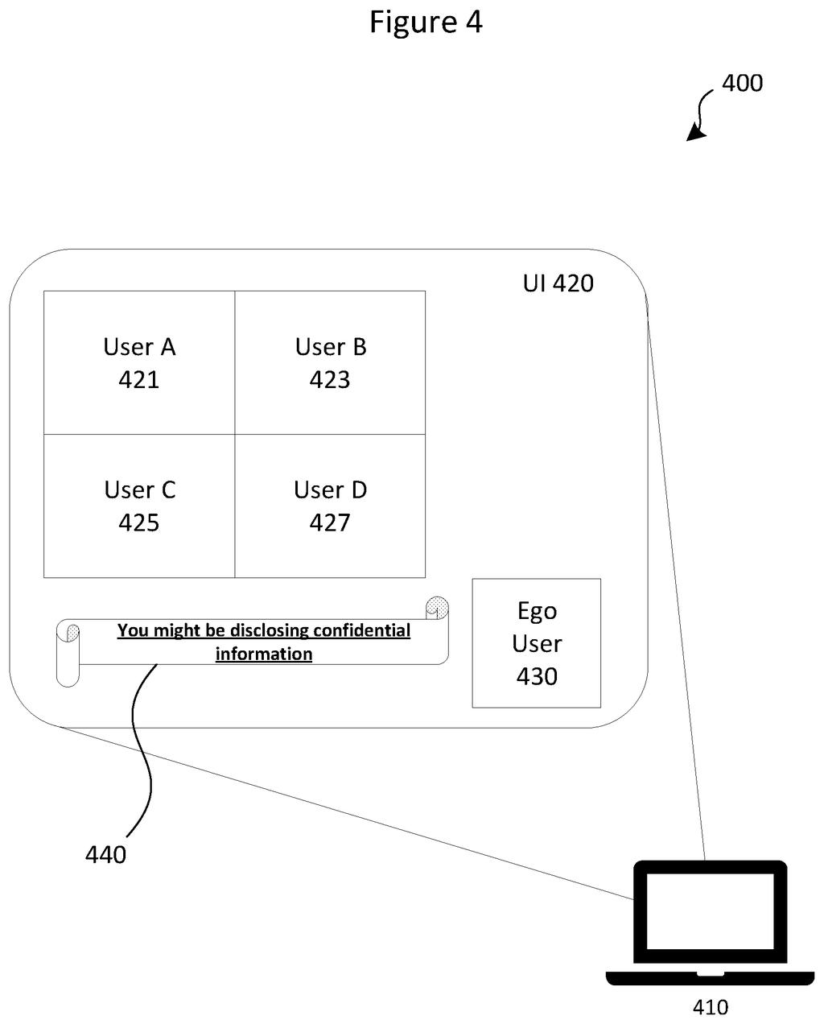
When a mismatch is confirmed, the system triggers a data security mitigation action. The patent does not lock in a single response; possible actions include blocking the data from being transmitted, alerting a security team, redacting the sensitive field, or logging the event for review.
The core insight is using public knowledge as a baseline. Information that is already out there in the world is, by definition, not a leak. Information that is not out there but shows up in an internal document is a candidate for protection.
A subject entity and a first feature associated with the subject entity are extracted from input data. An indication of the subject entity is submitted to a machine learning feature extractor trained on a public dataset and entity-feature associations expressed in the public dataset.
Translation: The software scans normal text to find names and details, then checks them against what an AI learned from public sources.
What this means for data privacy tools inside businesses
For businesses that handle large volumes of documents, manually checking every file for private data is not realistic. Existing tools often rely on pattern matching (looking for things shaped like a phone number or a Social Security number), which generates a lot of false alarms and misses unusual formats. A system that cross-references what the AI knows publicly about a specific named person adds a layer that pattern matching alone cannot provide.
If this approach works reliably in practice, it could make automatic data-loss prevention tools far more precise, reducing both missed leaks and the flood of false positives that cause security teams to tune out alerts. For end users, the downstream effect would be stronger guarantees that your personal information stored with an employer or healthcare provider is less likely to escape in a document that was never meant to be shared.
Microsoft's 12th filing we've tracked since August in our on-device AI privacy watchlist adds to work that includes shrinking AI models and scrubbing medical audio.
The entire system runs on software, with no new hardware required. The main prerequisite is a trained model that already knows what public information exists about people and organizations, and Microsoft runs models of that scale today.
The shortest route to a working product is attaching this detection layer to a tool that already handles documents before they leave a company. The logic is straightforward: compare a piece of information about a person against what the public record shows, and raise an alarm when the two do not match.
The real engineering work is getting that alarm reliable enough to trust. Someone who recently changed jobs or has a thin public profile could trigger false flags, while a leak that happens to mirror public data might pass through undetected. That gap between a sound idea and a dependable daily feature is what stands between this patent and something a company would actually ship.
There are more where this came from
We read every patent application Big Tech publishes and send you the ones worth knowing. Plain English, free, every week.
The drawings
8 drawing sheets from US 2026/0300540 A1 · click any drawing to enlarge


Want this weekly breakdown for a company we don't cover? Patentlyze Pro →
Be the first to weigh in