
Microsoft Files Patent for an AI That Reads Software Test Records and Recreates the Bugs
Microsoft's patent teaches an AI to read the messy notes software writes while it's being tested and decide which ones matter. It then works out the exact steps that caused them, so testers can replay the moment.
What Microsoft's AI test-log reader actually does
Every time a company tests a new version of its software, the test machines jot down thousands of little notes about what just happened: a button was clicked, a page loaded, something crashed. Somebody has to sift through all of it to find the notes that matter.
Microsoft's patent hands that sifting job to an AI language model. Instead of engineers writing rules for what counts as important, the system simply asks the AI, in plain English, whether each note describes something worth flagging. If the answer is yes, the system also works out the exact clicks and taps that led up to it, so testers can replay the moment later and check whether a bug was fixed.
The result is a testing setup that needs fewer hand-built filters and can read notes written in almost any format.
providing input to a natural language processing system (NLPS) trained to identify events of interest using event data corresponding to an event occurring during testing of software …
Translation: The system feeds software test logs into an artificial intelligence trained to spot significant moments.
How the AI decides a log message matters
The filing describes an automated software testing setup. Test machines (real or virtual computers) run the software while a testing agent, a program that acts like a user, clicks buttons, enters text and calls online services. Along the way, the software writes log file messages, mostly free-form text meant for humans, and telemetry events, which are structured records of things like failed operations or calls to outside services.
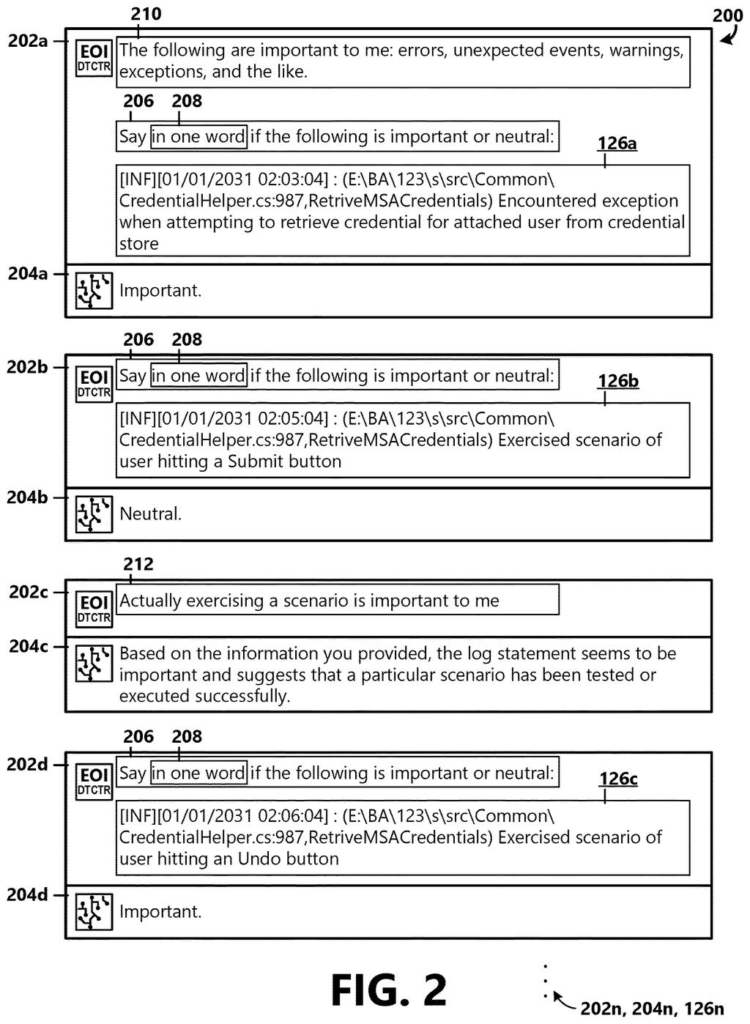
An event of interest detector builds a prompt (the written instruction given to an AI language model) for each message. The prompt holds the message plus a request such as "Is the following log message indicative of an event of interest?" It can also say what format the answer should take, like "in one word," and may include examples of confirmed events. If the model answers "important," the event is recorded and can be given a category such as error, timeout or completed task.
The claims go a step further: the system generates a mapping from the event to an action sequence, the chain of actions that produced it. One described method matches timestamps between the event and the recorded actions and software states. Testing agents can then replay that sequence on a later version of the software to see whether the event happens again.
The description also says flagged events can be sent to a health dashboard or an alert system, and that the AI can be corrected mid-conversation if it labels something wrongly.
… events of interest are mapped to action sequences of interest that can be replayed to reproduce events of interest without requiring event of interest criteria to be defined …
Translation: Detected problems are converted into replayable steps so engineers can automatically recreate the exact bug.
Why software testers could spend less time on rules
If you use software, the payoff is indirect: bugs that testers catch before release are bugs you never meet. The filing's argument is that teams now spend real time and money writing rules that tell testing tools what counts as a problem, then rewriting those rules whenever the software changes. Letting a language model read the messages directly could cut that setup work and make it faster to get a new product into automated testing.
The replay piece matters too. A flagged crash is only useful if someone can make it happen again, and this patent ties each flagged event to the steps that caused it. That makes it easier to check later whether a fix actually worked. This is a patent application about testing tools, so it describes behind-the-scenes machinery rather than anything you would tap on.
Microsoft's 538th filing in our Microsoft coverage since May follows applications like cheaper math for AI and answers from screenshots.
The trade here is easy to state: you swap rules you write yourself for a judgment you have to trust. A hand-written filter does the same thing every time. A language model reading a message might call it important on Monday and neutral on Tuesday, and the filing itself shows the AI getting one message wrong until a follow-up prompt corrects it.
That cost matters in a testing tool, because a missed event means a bug slips through, and a flood of false alarms means engineers stop reading the alerts. The design softens the risk by letting testers add examples and a plain description of what they care about, and by replaying the flagged steps to check whether the event really happens again.
When the alternative is maintaining piles of hand-built rules, the trade is worth making, as long as people still spot-check the AI's calls. Nothing in the filing says how often the model gets it wrong, and that number decides how useful this turns out to be.
Get our take in your Top Stories
Liked this breakdown? Add Patentlyze as a preferred source on Google, and our plain-English take shows up more often in your Top Stories the next time Microsoft patent news breaks.
There are more where this came from
We read every patent application Big Tech publishes and send you the ones worth knowing. Plain English, free, every week.
The drawings
6 drawing sheets from US 2026/0319875 A1 · click any drawing to enlarge


Want this weekly breakdown for a company we don't cover? Patentlyze Pro →
Be the first to weigh in