
Microsoft Files Patent for Teaching AI to Sharpen Blurry Game Graphics
Teaching an AI to sharpen blurry game frames takes matched pairs of sharp and blurry images, and those pairs are hard to get. Microsoft's patent application builds a second AI whose only job is to fake the blurry halves.
What Microsoft's blurry-copy training trick does
A game console draws a busy city street at a modest resolution so the action stays smooth. Then an AI fills in extra sharpness before the picture reaches your TV. That AI has to be taught, and teaching it takes thousands of matched pairs: a sharp frame and a blurry copy of the exact same frame.
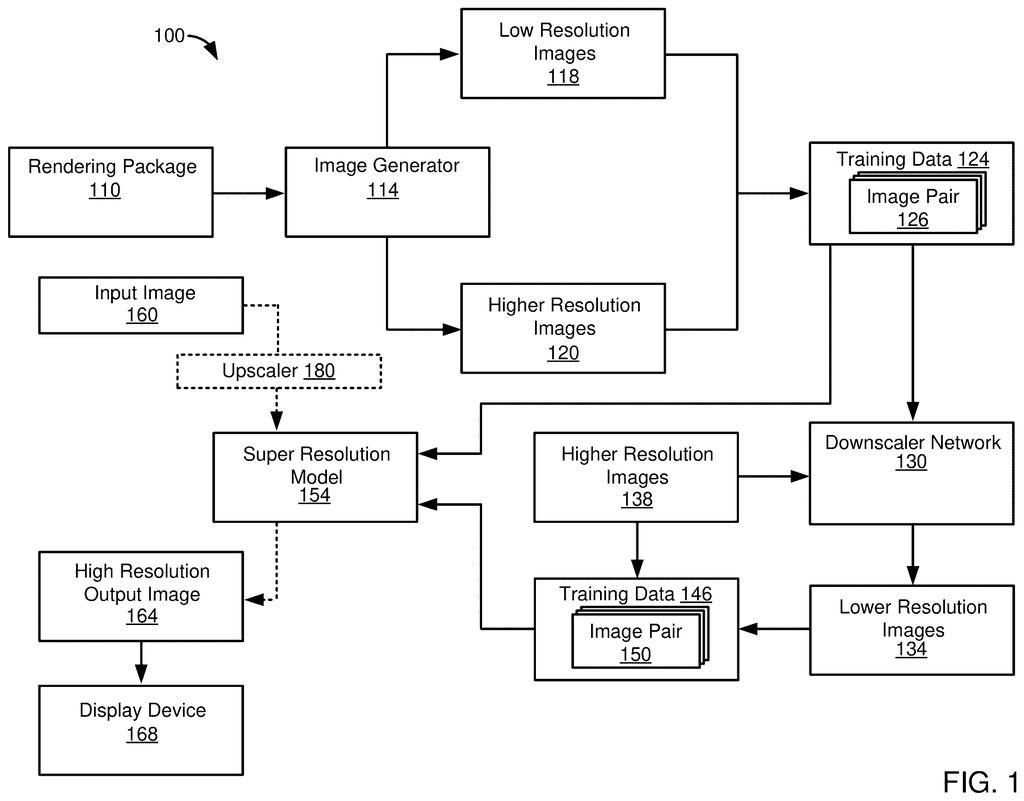
Good pairs are hard to come by. Microsoft's patent application describes a workaround. First, a game engine renders a carefully scripted scene twice, once sharp and once blurry, with time frozen so nothing moves between the two versions. Those pairs teach a second AI to make realistic blurry copies of any sharp image.
From there, studios can feed that second AI sharp frames from one specific game and get a large supply of tailor-made pairs. Your console or PC would only need the finished sharpening AI.
… training a downscaler network with a first set of a plurality of image pairs of the high- and low-resolution images; generating additional high-resolution images with the first image generator; processing the additional high-resolution images generated by the first image generator with the downscaler network to produce additional low-resolution images; …
Translation: The system trains a network to shrink pictures so it can build a large library of matching high and low quality images.
How the blurry-frame maker is trained and used
The process starts with a rendering package: a scripted, non-interactive scene with fixed camera paths and seeded randomness (so the same inputs always produce the same frames). A game engine renders it at two resolutions from a single processing event. The filing describes freezing the simulation clock so animation, physics and particle effects sit at the same instant in both versions.
Those matched pairs train a downscaler network, a neural network (software that learns patterns from examples) that shrinks sharp images into low-resolution ones. The goal is a copy with the same flaws as a game's real low-resolution output, such as blur, noise and compression artifacts.
Next, the engine generates additional high-resolution frames, for example from a particular game title. The downscaler turns each into a low-resolution partner, producing a second, much larger set of pairs. The super-resolution model (the AI that adds detail) is then trained on that second set.
The filing also describes:
- Deploying the finished model to a different device, such as a console, PC or phone, without shipping the downscaler.
- Running the model on images that are already full size, to refine textures and cut artifacts without changing the resolution.
- Mixing real engine pairs with downscaler pairs, starting mostly with the real ones.
The trained super-resolution model processes low-resolution images to generate enhanced images with improved detail and reduced artifacts.
Translation: The finished AI takes blurry or pixelated graphics and cleans them up to look much sharper.
Why sharper game frames depend on training data
The practical payoff is sharper games on hardware that cannot draw every pixel. Studios often render below a display's full resolution to keep frame rates up, and a detail-adding AI works best when it learned from frames that resemble the game it is touching up. This patent application describes a way to produce that training material in bulk for a single title, including text-heavy screens that the filing says these models often struggle with.
It also helps teams that cannot modify a game engine's code to output two resolutions at once, a limit the filing calls out. And because the downscaler is only needed during training, the finished model could be the only piece that reaches your device. The filing adds that the feature can switch itself off if your device is too slow, rather than make the game stutter.
Microsoft's ninth filing in the AI image and video space we've tracked since June follows earlier applications on frequency-aware image training and AI video call backgrounds.
If this works as described, you would notice it in small things: crisper text on screen, fewer jagged edges, and textures that hold up when a game renders below your TV's full resolution. You would never see the part Microsoft is patenting, because it happens earlier, inside a studio's training process.
The benefit depends on a studio tuning a model to its own game, which the filing treats as the point. A model trained on one title's own frames should handle that title's quirks, such as on-screen text, better than a general-purpose one. The filing also describes switching the feature off on devices that cannot keep up, so a weak machine would get the normal picture instead of a stuttering one.
As a patent on a training recipe, it is plain plumbing. Better plumbing is how a modest machine ends up with a sharper picture, and most players would take that.
Get our take in your Top Stories
Liked this breakdown? Add Patentlyze as a preferred source on Google, and our plain-English take shows up more often in your Top Stories the next time Microsoft patent news breaks.
There are more where this came from
We read every patent application Big Tech publishes and send you the ones worth knowing. Plain English, free, every week.
The drawings
10 drawing sheets from US 2026/0306944 A1 · click any drawing to enlarge


Want this weekly breakdown for a company we don't cover? Patentlyze Pro →
Be the first to weigh in