
Sony Files Patent for Game Streaming That Sharpens the Action and Softens the Rest
Sony's patent application says the road in a racing game deserves 60 frames per second, while on-screen text can be refreshed once per second.
What Sony's priority-based game streaming does
You're deep in a racing game on a cloud service, and your connection hiccups. The road ahead turns blurry, even though the scoreboard in the corner stays perfectly crisp. That's a bad trade, and it's the one Sony is trying to avoid in this patent application.
The idea is that not everything on screen deserves the same video quality. A machine learning model (software trained on examples) looks at the objects in each frame and ranks them by importance. The things that matter most, like the road or a boss character, get sharp, smooth video. Less important things, like a stats display, the sky, or on-screen text, get a lower-quality version that uses less data.
The result is a stream that spends your internet bandwidth where it counts for the game.
… generating an encoded video by encoding portions of the video frame corresponding to the plurality of objects at encoding quality levels set based on the priority level information …
Translation: It builds the final video by making important parts look sharp and letting less important parts look blurry.
How the model ranks a racing game's road and sky
Claim 1 describes a pipeline for streaming video. The system looks at each frame, identifies the objects in it, and passes data about them to a machine learning model (software trained on labeled examples). The model returns a priority level for each object. The encoder (the software that compresses video for sending) then sets the quality of each portion of the frame to match, and the video goes out over a network.
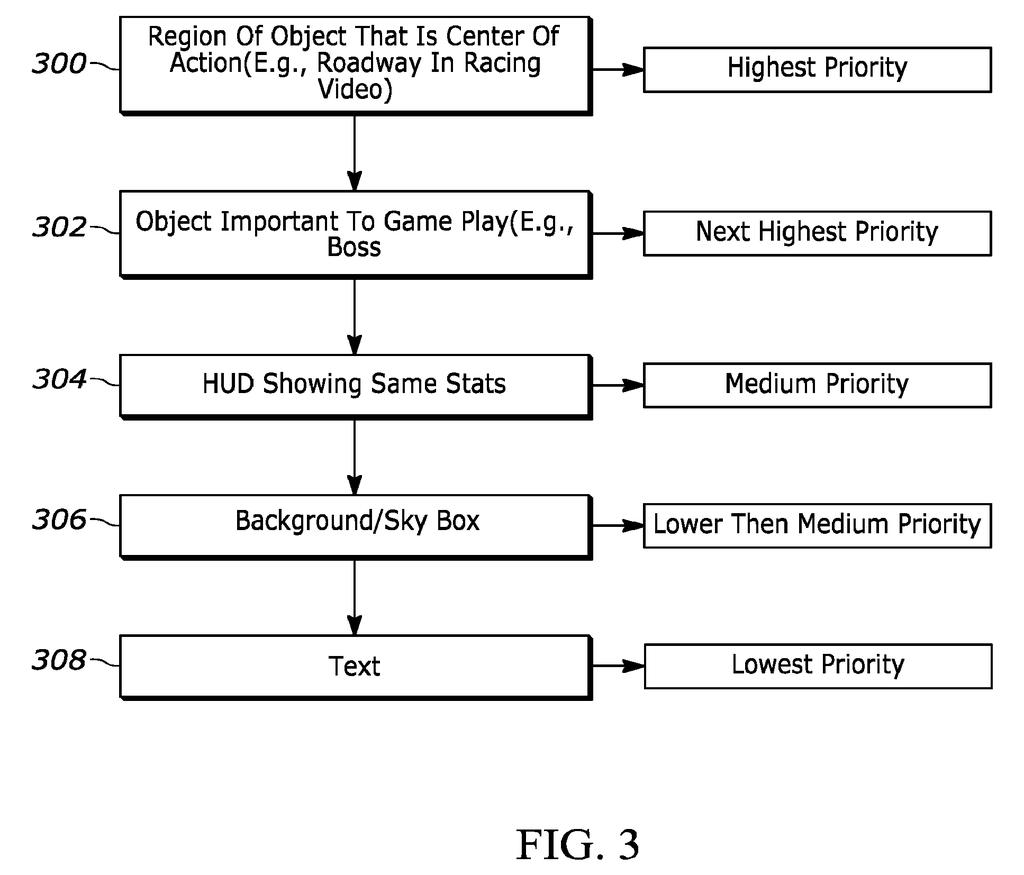
The description gives a worked example for a racing game:
- The road at the center of the action: 4K detail at 60 frames per second
- A boss character: 2K at 30 FPS
- A heads-up display with game stats: HD at 10 FPS
- Sky and background regions: standard definition at 5 FPS
- On-screen text: standard definition, refreshed once per second
Priority can come from signals such as whether an object is a target, whether the player is looking at it (via gaze-tracking cameras), whether the controller is interacting with it, or whether the game engine flags it. The model is trained on game objects paired with priority levels.
On the receiving end, the filing describes a frame-interpolation model (software that fills in extra frames between the ones received) that can raise a slow-updating object's frame rate. It would be used only for high-priority objects to avoid adding delay. Quality can also rise or fall with network latency (the lag between sending and receiving).
… apply a range of spatial and temporal resolutions to various objects in the same game depending on the priority of the objects in the game …
Translation: The system changes the detail and smoothness of different game items based on how much they matter.
What this means for cloud gaming on shaky Wi-Fi
If you play games through a cloud service, or stream from a console to another screen, the quality you see depends on how much data your connection can carry. Spending that data on the road, the enemy, and whatever you're looking at, instead of the sky or a stats panel, could keep the parts you care about sharp when your connection gets shaky.
The filing names PlayStation as an example device, and Sony's description frames the problem as balancing quality against bandwidth and latency. As a patent application, it shows how Sony is thinking about that trade. It says nothing about whether any service will work this way.
Sony's 17th filing we've tracked in our GPU rendering race watchlist since July builds on one that predicts future frames and one that catches new objects, pushing its rendering AI work further.
Read the claim, and the title misleads. It says upscaling, but claim 1 covers encoding: finding objects in a video frame, asking a machine learning model how much each one matters, and compressing each at a quality level that matches its rank before sending the video over a network.
The wording is wide. Claim 1 says 'a video,' so games are not required; game objects only appear in claim 8, which covers how the model is trained. Frame rate and resolution changes wait until claims 4 through 6.
The catch is the model. Claim 1 requires the priority ranking to come from a machine learning model, so a service that hard-codes 'always downgrade the scoreboard' would fall outside its wording on its face. Inside that limit, it reaches any video service that ranks on-screen objects with a trained model, a wider net than a game-streaming patent sounds.
Get our take in your Top Stories
Liked this breakdown? Add Patentlyze as a preferred source on Google, and our plain-English take shows up more often in your Top Stories the next time Sony patent news breaks.
There are more where this came from
We read every patent application Big Tech publishes and send you the ones worth knowing. Plain English, free, every week.
The drawings
10 drawing sheets from US 2026/0315929 A1 · click any drawing to enlarge


Show the other 2 sheets


Want this weekly breakdown for a company we don't cover? Patentlyze Pro →
Be the first to weigh in