
AMD Files Patent to Let Graphics Chips Pull Game Visuals Straight From Storage
Every time a game shows you a new brick wall or a patch of grass, your graphics card has to get that image from somewhere. AMD's patent application describes a way for the graphics chip to fetch it on its own, without checking in with the main processor first.
What AMD's texture-fetching patent actually does
Imagine you're sprinting through a video game city and you round a corner. Your graphics card suddenly needs the picture of a brick wall, at just the right sharpness for how close you're standing. Today, that request often takes a long detour: the graphics chip taps the main processor on the shoulder, the processor hunts down the file, and the file gets copied through a couple of waiting areas before it arrives.
AMD's patent application describes a shortcut. The graphics chip works out ahead of time which texture pieces a scene will need, fetches them early, and keeps its own address book of where each one lives. When the moment comes, it asks the storage directly.
The main processor stays free for other jobs, and the game spends less time waiting when the scenery changes fast.
transmit a memory request for texture data to a memory device, wherein the memory device stores the memory request in a command queue of the memory device; receive the texture data responsive to execution of the memory request by the memory device; and render a texture using the texture data.
Translation: The processor asks the storage drive for game graphics and then uses them to draw images on screen.
How the GPU finds and requests texture blocks
A texture is the image wrapped onto a 3D object, like the grain on a wooden crate. Games keep each texture in several sizes called mipmaps (the same picture shrunk into smaller and smaller versions), so a far-off crate uses a small version and a close one uses the sharp version. Picking the right size is called choosing the level of detail.
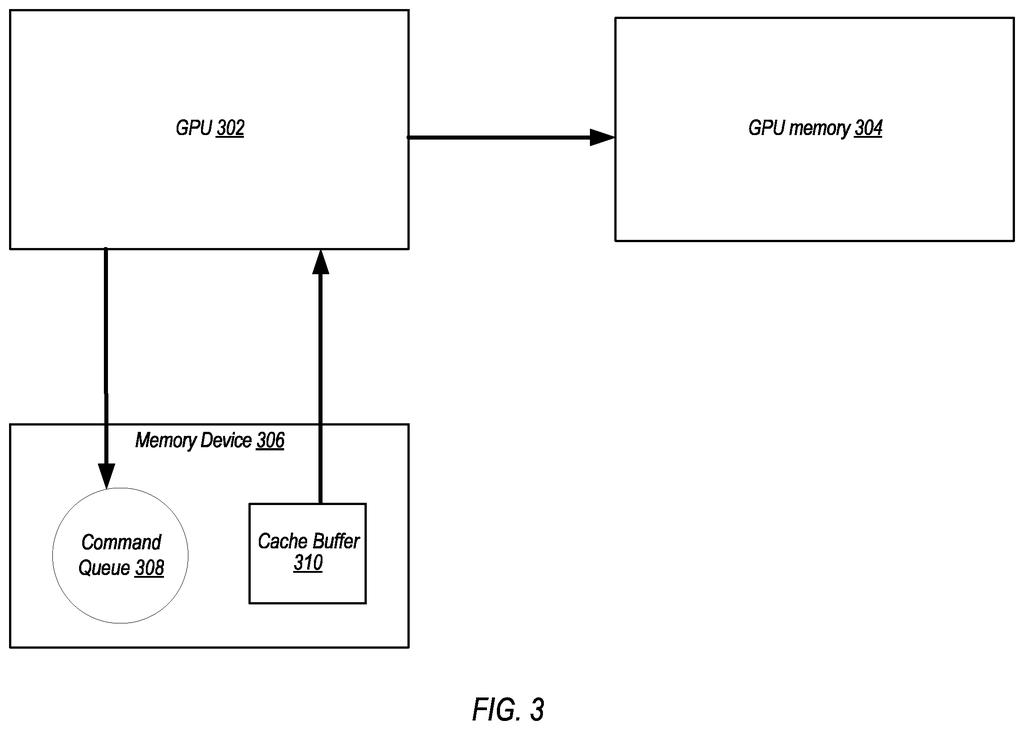
The claims center on a change in who does the asking. The graphics processor sends a memory request for texture data to a memory device. The device puts that request in its own command queue (a waiting line of read and write jobs handled in order), carries it out, and returns the data, and the processor then renders the texture. Dependent claims add that this can happen without calling on the CPU to look up where the data sits, and that the request can be a direct memory access request (one chip reading memory without the main processor handling each step).
The description fills in the rest:
- The GPU identifies what it will need and prefetches (loads early) those pieces, guided by level of detail.
- It keeps a list mapping each block of texture data to its address and detail level.
- Shader code (the small programs that paint the screen) works out the level of detail at render time.
- The GPU checks that the data is ready before it uses it.
One described option is a solid-state drive reached over the NVMe standard (a common fast-storage interface).
A prefetch of the source texture data is caused based on level of details associated with the source texture data. Further, a list data blocks of the source texture data and a mapping between each data block and corresponding allocated memory address space allocated to each data block on the memory device is maintained.
Translation: The system loads visual assets ahead of time by keeping track of where everything is stored on the drive.
Why this matters for gaming PCs and graphics cards
If this works as described, the practical gain is less waiting. The filing says today's path runs each texture request through the graphics driver, the operating system and the main processor, and that those layers add overhead and delay. Cutting them out frees the processor for other game work and could make scenes load in faster when you turn a corner or jump to a new area.
The filing names a gaming system or personal computer as the setting and points to large game worlds as the example. As a patent application, it shows a design direction for graphics hardware, with no product attached.
AMD's 22nd filing we've tracked since June in the GPU rendering race watchlist adds to earlier applications like one blocking GPU memory access and one skipping unnecessary GPU work.
The bet in this design is that the graphics chip can predict what it needs better than the middle layers can react to it. Prediction has a price: every wrong guess loads texture pieces that never get used, which burns memory space and bandwidth.
The design also hands more bookkeeping to the graphics side, including the address list and the ready checks. It relies on the storage device and the graphics chip agreeing on a protocol that a system programmer defines. That means more work for game and hardware makers, and more places for a mismatch to cause trouble.
Even so, the trade reads as worth it. Removing a processor round trip from something that happens constantly in a game is a cheap cost to accept, and the failure mode, a little wasted memory, is mild next to the delay it avoids.
Get our take in your Top Stories
Liked this breakdown? Add Patentlyze as a preferred source on Google, and our plain-English take shows up more often in your Top Stories the next time AMD patent news breaks.
There are more where this came from
We read every patent application Big Tech publishes and send you the ones worth knowing. Plain English, free, every week.
The drawings
6 drawing sheets from US 2026/0311286 A1 · click any drawing to enlarge


Want this weekly breakdown for a company we don't cover? Patentlyze Pro →
Be the first to weigh in