
Nvidia Files Patent for an AI Newsletter Builder That Reads Social Media Posts for You
Nvidia has filed a patent application for software that reads a pile of social posts and articles, ranks them by topic, and has an AI write the newsletter. It can even let you chat with past issues.
What Nvidia's AI newsletter builder actually does
Every morning, somebody at a company scrolls through X, blogs and news sites hunting for what actually mattered in their field overnight. Most of it is repeats, noise or posts that rank high only because they went viral.
Nvidia's patent application describes software that does that scrolling for you. It pulls in posts and articles from accounts and sites it is pointed at, throws out near-copies, and sorts what's left into topics such as AI agents or AI safety. For each topic it picks the freshest, most-engaged items and hands them to an AI model, which writes a short headline and summary with a link back to the original.
The results get poured into a ready-made layout, basically a newsletter, and sent by email or shown on a dashboard. You could then ask follow-up questions, like what happened with AI agents in the past two months, and the system learns which topics you care about.
… apply the subset of the plurality of embeddings as input to at least one language model (LM) to cause the at least one LM to generate a plurality of modified content and corresponding metadata …
Translation: Feed the organized posts into an AI model to rewrite them and add tags.
How posts become ranked, summarized digests
Claim 1 covers the core loop. The system collects content records (posts, articles, papers) from data sources and turns them into embeddings: lists of numbers that capture what a piece of text is about, so similar posts get similar numbers. It ranks those embeddings within each category, picks the top subset, and feeds that subset to a language model (an AI text generator). The model produces rewritten content, such as summaries and headlines, plus metadata like source links and timestamps.
A template then arranges everything into a final output, delivered through email, a web dashboard or an API (a way for other software to request the data).
The description layers on more:
- Cleanup: near-duplicate posts (the example threshold is over 98% similar) are removed, and personal details such as usernames can be redacted.
- Ranking: items are scored on freshness and popularity, such as likes and shares.
- Trend detection: embeddings are grouped into clusters, another model describes each cluster as a trend, and the system searches for more content to update the ranking and the newsletter.
- Chat and personalization: your question is embedded and matched against stored issues, and past conversations are clustered to learn your interests.
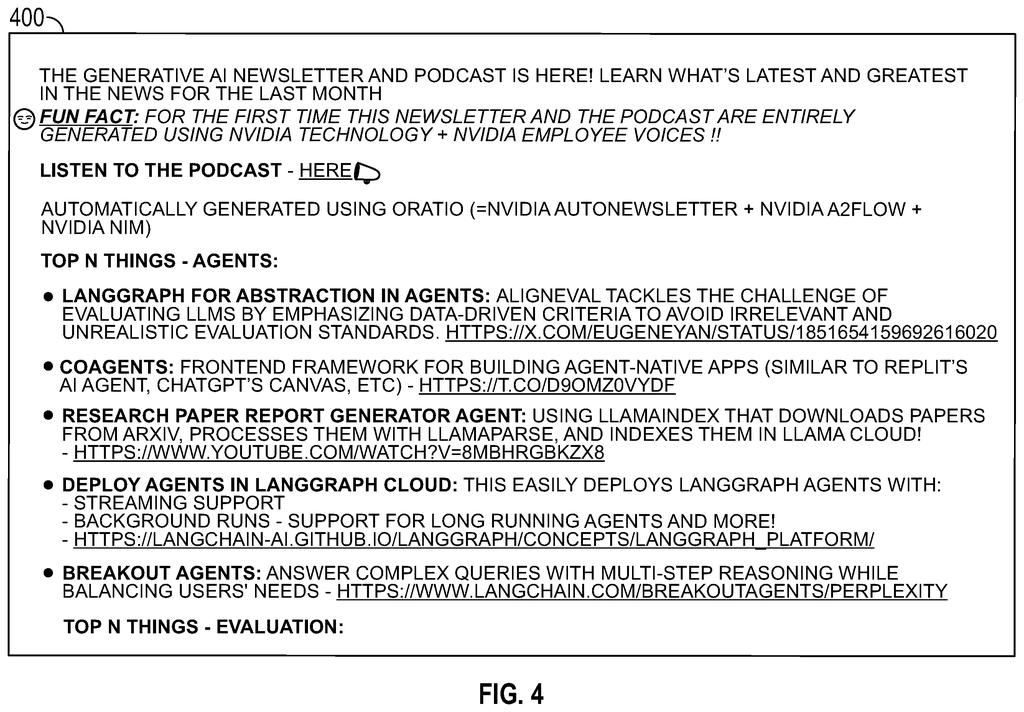
The filing's sample output is an AI newsletter with ranked sections for topics like agents and evaluation. It names Nvidia's own NeMo Curator and NeMo Retriever tools as example components.
Various examples, systems, and methods are disclosed relating to a content curation pipeline.
Translation: The patent describes a system that automatically collects and organizes online content.
What this means for anyone drowning in feeds
If you've ever tried to keep up with a fast-moving field through social feeds, this is the chore the patent targets: finding the signal, cutting the repeats, and delivering a digest that fits your interests. The filing lists uses from news curation to internal company search and customer support, so the same pipeline could feed a team newsletter or a chatbot that answers questions about last month's news.
The example tools named in the filing are Nvidia's own AI software (NeMo Curator, NeMo Retriever), so the document doubles as a recipe for how those pieces fit together. It is still an application: the patent office's first review rejected the claims as filed, a routine step that usually leads to amendments.
Nvidia's 45th filing we've tracked in our Enterprise AI coverage since May adds to a run that includes a circuit board flaw spotter and indoor robot positioning.
Claim 1 is wide. It needs content records from a data source, embeddings ranked within a category, a language model that rewrites the content and attaches metadata, a template, and an interface. It never mentions social media, news or newsletters. Those details appear only in the description and the narrower claims.
Read literally, that covers a large share of AI digest tools: anything that sorts items by topic, has an AI model summarize the top ones, and pours the result into a fixed layout. If it were granted this wide, it would stake a claim on that basic recipe. The trend clustering, chat questions and personalization are extras in later claims, so claim 1 stands on the basic loop alone.
Wide claims often get narrowed during review, and this application is in that stage. The final version will likely lean on the trend-detection and personalization pieces, where the filing gets specific.
Get our take in your Top Stories
Liked this breakdown? Add Patentlyze as a preferred source on Google, and our plain-English take shows up more often in your Top Stories the next time Nvidia patent news breaks.
There are more where this came from
We read every patent application Big Tech publishes and send you the ones worth knowing. Plain English, free, every week.
The drawings
12 drawing sheets from US 2026/0320096 A1 · click any drawing to enlarge


Show the other 4 sheets


Want this weekly breakdown for a company we don't cover? Patentlyze Pro →
Be the first to weigh in