
Google Files Patent for an AI That Reads Your Clicks Like a Sentence
Google's patent teaches a chatbot-style AI to read your clicks as if they were words, then finish the sentence by guessing what you'll do next.
What Google's click-sequence AI actually does
You open a shoe store's website, read a review, leave, and come back three days later to buy a pair. Every one of those steps gets logged, and companies would love to guess the next step before it happens.
Google's patent treats those logged steps like words in a sentence. It trains the same kind of AI that powers chatbots on huge piles of click histories, so it learns the rhythm of how people behave online. Then it can continue your story: given what you've done so far, what are you likely to do over the next week?
The clever part is flexibility. Today, a company often needs a separate prediction tool for each question and each time frame, like a 7-day model and a 28-day model. Here, one trained model answers many questions, and you can even ask what-if questions, like what happens if you return tomorrow.
… training, by the computing system, a generative language model using the first structured event data; …
Translation: The system teaches an AI using records of past user actions.
How the model builds each predicted click
The patent describes training a generative language model (the AI behind chatbots, which writes output one piece at a time) on structured event data instead of English. Each event, such as a page view, a tap on an app button, or opening a notification, acts like a word. A session acts like a sentence, and a user's whole history acts like a document.
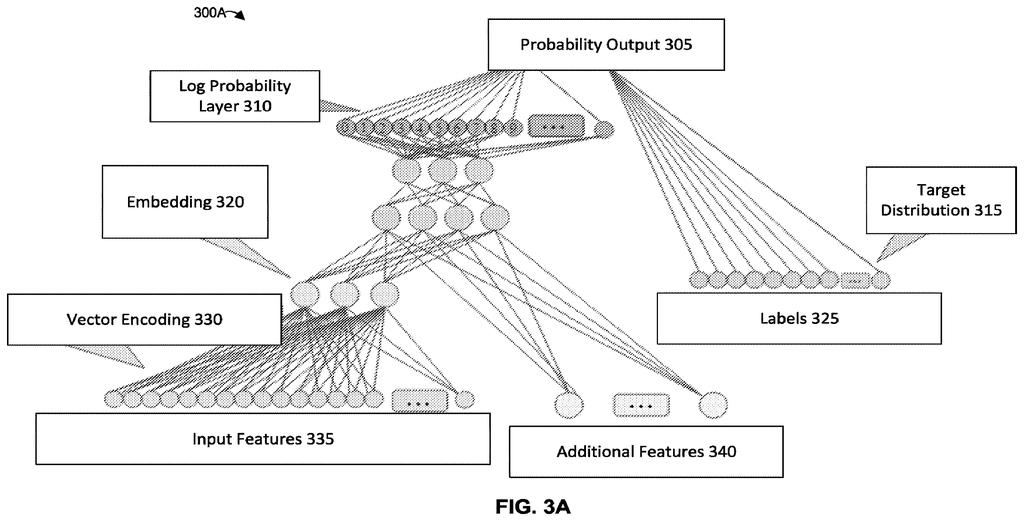
Events also carry metadata: the time between events, user identity, location, and device details. That creates two problems. The number of possible event-plus-detail combinations is enormous, and most histories are only a few events long. The filing handles the first with embeddings (lists of numbers that place similar things close together), and the second by predicting each new event in pieces, easy details first and harder ones, like the page address, later, each using the pieces before it.
At prediction time, the system feeds in a user's recent events and lets the model keep generating future events until it hits a stop marker. Ordinary analytics then scan the generated events for answers, such as whether the user will buy, leave, or what their lifetime value might be. The behavior and the time window can be changed without retraining, and claim 14 covers getting different outputs from the same model.
The filing also describes what-if inputs: a theoretical future visit, or a branching past, like an ad the user saw two days earlier. It adds an optional confidence score based on how often a similar outcome appears in the training history.
… predicting, at least in part by applying the second structured event data as an input to the trained generative language model, third structured event data representative of behavior associated with the user …
Translation: The AI uses recent clicks to guess what the user will do next.
What this means for ads and the sites you use
If you browse, shop, or use apps, the practical effect would be on what you see, not what you do. The filing names advertising, content design, and layout optimization as the uses, and says a team could change the question or time window quickly, without waiting on a new model. The description names Google Analytics as one example source of event data.
For advertisers and website owners, the appeal is speed and cost. Instead of building a new predictor for every question, they would ask one trained model many things, including what if questions about a user returning tomorrow or seeing an ad two days earlier. For you, that could mean pages and ads reacting more closely to your habits.
Google's 74th filing we've tracked in AI assistant and agent work since May adds to a run that includes a fixed-size memory patent and a memory that stops growing.
Google's idea here is almost entirely software: take the click histories that ad and analytics tools already collect, train a language model on them, and let it predict what a user will do next. No new device, no new sensor, nothing to install.
The main thing that has to exist before this ships is a reliable way to turn a marketer's plain question into instructions the model can actually follow. The filing acknowledges this gap directly by describing a separate translation step to handle it.
If it works, the effect for most people would be invisible, a reshuffled page or a different ad. Whether it outperforms today's narrower prediction tools is an open question, since the document offers no accuracy numbers to judge by.
Get our take in your Top Stories
Liked this breakdown? Add Patentlyze as a preferred source on Google, and our plain-English take shows up more often in your Top Stories the next time Google patent news breaks.
There are more where this came from
We read every patent application Big Tech publishes and send you the ones worth knowing. Plain English, free, every week.
The drawings
6 drawing sheets from US 2026/0320373 A1 · click any drawing to enlarge


Want this weekly breakdown for a company we don't cover? Patentlyze Pro →
Be the first to weigh in