
Google Patents an AI Assistant That Remembers How You Like Your Answers
Ask an AI assistant for restaurants, add 'only vegetarian' as a follow-up, and by next week it has forgotten. Google's patent application describes an assistant that remembers your follow-ups and applies them for you.
What Google's remembered follow-ups do for you
Right now, when you ask an AI assistant for restaurants in your city, it hands back everything, and you have to follow up with 'only vegetarian ones.' Next week you get to do it all over again. The assistant can't tell which of your requests were one-time asks and which are how you always want things.
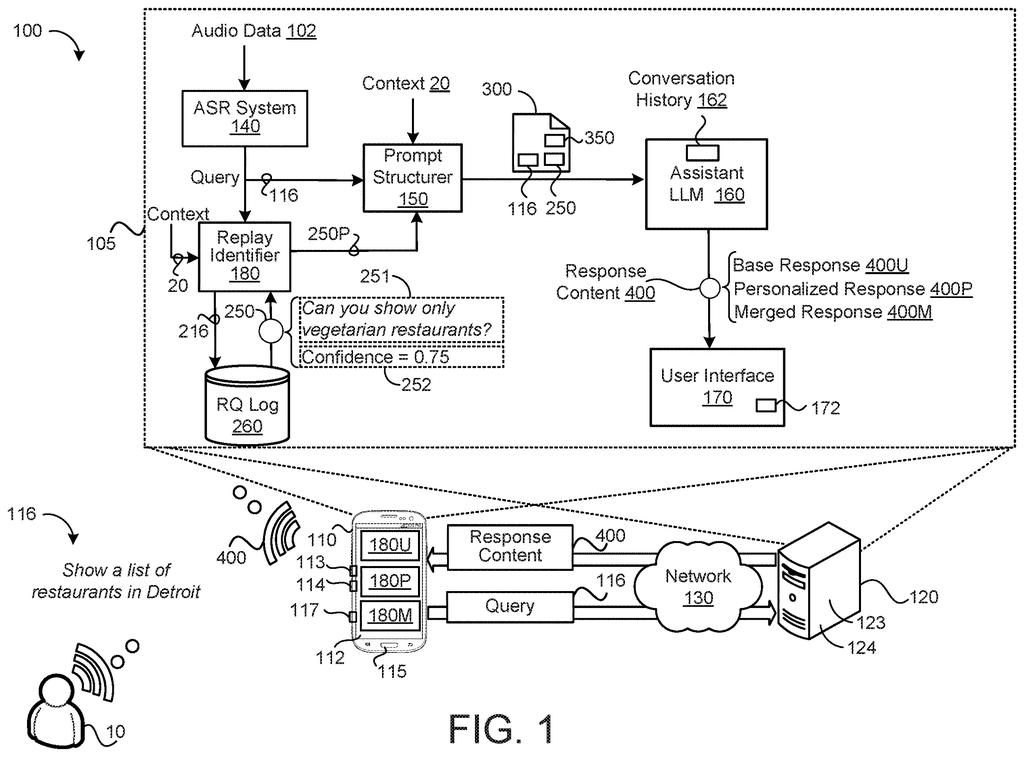
Google's filing describes a fix. The assistant keeps a log of your past follow-up requests. When you later ask a similar question, it finds the follow-up that fits and folds it into your new question automatically. Ask about restaurants in Detroit, and the vegetarian ones could be marked or listed first without you saying a word.
The claims in this version focus on a related idea: the assistant bundles your question with your recent history into one combined request, then answers that. It can also show you the plain answer next to the personalized one, in case you wanted the full list this time.
… receiving local context associated with the natural language query, wherein the local context comprises recent user history information associated with the user; structuring a composite prompt based on the natural language query and the local context; prompting, using the composite prompt, the assistant LLM to generate a personalized response …
Translation: The system combines your current question with your recent history to build a custom prompt for the AI.
How the assistant picks which old request to reuse
The filing starts from a simple problem: a language model (the AI behind a chatbot) can't easily tell which of your preferences are permanent, which change over time, and which depend on the situation. Dinner with a vegetarian friend is not the same as dinner alone.
The description's answer is a refinement query log. Every time you correct or narrow an answer, the follow-up is saved, paired with the original question that triggered it. When a new question arrives, a neural network turns it into an embedding (a numerical fingerprint of its meaning) and finds the closest past questions. A ranking model then throws out follow-ups that don't fit. In the filing's example, 'show me ones on the ocean' gets dropped for a Detroit search because Detroit has no ocean.
Each saved follow-up carries a confidence score based on how often and how recently you used it. That score decides how the request is built:
- Low confidence: two separate requests, showing you both the plain and personalized answers.
- Medium: one combined request that asks the model to answer and mark the matches, for example in bold.
- High: a single rewritten sentence, such as 'show me a list of vegetarian restaurants in Detroit,' which is cheaper to process.
The claims in this continuation center on building that combined request from your question plus local context, such as your recent activity.
… processing the natural language query to identify, from a log of refinement queries each previously input by the user for instructing the assistant LLM to refine a corresponding previous response generated by the assistant LLM, a preferred refinement query that is relevant to the natural language query.
Translation: It looks back at past follow up instructions you gave the AI to figure out your preferred style for the new answer.
Why this could end the 'only vegetarian' retyping
The practical payoff is fewer repeated corrections. If you use an assistant on your phone, in your car, or on a speaker, you could stop restating the same preferences every time. The filing also treats speed as a goal: the combined and single-sentence versions need fewer round trips to the model than the two-step version.
The risk is a wrong guess. Your past follow-up may not apply today, and the filing's hedge is to show both lists when confidence is low. It also adjusts its confidence based on what you click, raising it when you engage with the personalized results and lowering it when you go for the plain ones. That feedback loop is what keeps this from becoming an assistant that boxes you into old habits.
Google's 37th filing we've tracked since May in our AI assistants that remember you watchlist builds on earbuds that recap conversations and merged search questions.
Of everything in this filing, the idea sits close to shippable. It needs no new hardware. A phone or server, a language model, and a saved list of your past follow-ups are enough, and the matching step uses standard text-comparison methods.
What has to exist first is trust. An assistant that remembers you asked for vegetarian once must guess whether you meant it forever or just for one dinner. The filing answers with a confidence score that rises when you click the personalized results and falls when you ignore them. It is a cheap, reasonable way to guess.
The shortest route to a product is a small add-on to an existing chatbot, probably with an off switch. The harder conversation is about storing a log of your habits, and the filing says little about it.
Get our take in your Top Stories
Liked this breakdown? Add Patentlyze as a preferred source on Google, and our plain-English take shows up more often in your Top Stories the next time Google patent news breaks.
There are more where this came from
We read every patent application Big Tech publishes and send you the ones worth knowing. Plain English, free, every week.
The drawings
8 drawing sheets from US 2026/0311689 A1 · click any drawing to enlarge


Want this weekly breakdown for a company we don't cover? Patentlyze Pro →
Be the first to weigh in