
Samsung Files Patent for Typing in a Custom Wake Word for Home Appliances
Samsung's filing lets you pick a wake word by typing it, then has your device speak that word to itself to learn what to listen for. Your own voice never has to be recorded to set it up.
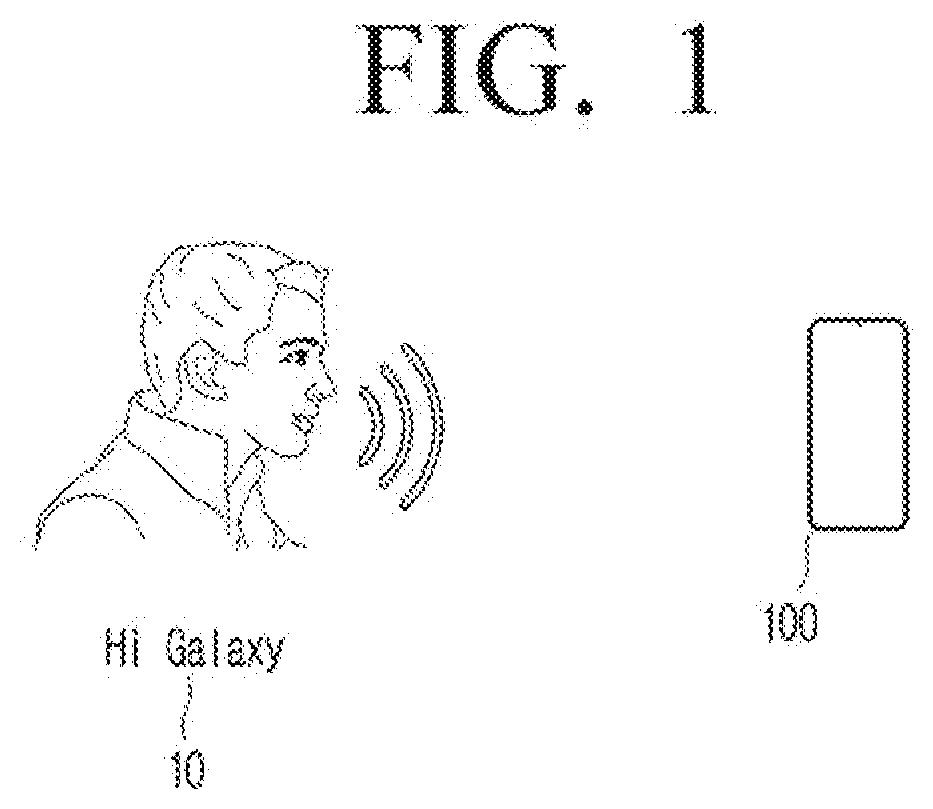
What Samsung's typed wake word patent does
You say the wake phrase from the couch, and every appliance in earshot perks up at once. Or the one you meant stays asleep because the dishwasher is running. Samsung's patent application goes after both problems.
Instead of a fixed, factory-set phrase, you type the word you want. The device turns your text into a computer-spoken voice, boils that audio down to a compact numerical fingerprint, and saves it. Later, when you speak, it makes a fingerprint of your voice and checks how close the two are. Close enough, and it wakes up.
Because the saved fingerprint comes from a generic synthetic speaker, your accent, your pitch and the noise in the room on setup day don't get baked in. Want a new wake word? Type another one.
based on text, obtain a synthetic voice, wherein the text is based on a user input; obtain a first embedding, based on the synthetic voice, and store the first embedding in the memory; …
Translation: The system turns your typed text into a computer-generated voice and saves it as a reference.
How a synthetic voice stands in for yours
The core idea starts with text. You type the word or phrase you want as your trigger word. The device runs it through a text-to-speech model (software that reads text aloud) and gets back a synthetic voice saying it.
That audio then goes into a first embedding model. An embedding is a list of numbers that works as a fingerprint for a sound, so similar sounds end up close together. The device stores this first fingerprint. When someone speaks, a second model makes a fingerprint of the live audio, and the device measures the distance between the two. If the distance falls under a set threshold, it treats the speech as the trigger word and acts.
The claims and description add several refinements:
- Length and prosody (rhythm and intonation) data from the speech model is fed in alongside the audio.
- A third fingerprint can be made straight from the text, and a match on either one can count.
- A speech enhancement step removes noise and boosts volume before the live audio is fingerprinted.
- The models are trained on sample recordings that match the word and ones that don't, pulling the right ones close and pushing the wrong ones away.
Change the text and the device makes a new synthetic voice and a new fingerprint. The action isn't limited to waking up: the filing also mentions things like turning a display on or off.
… determine whether the uttered voice corresponds to the text based on a first similarity between the first embedding and the second embedding, …
Translation: It compares what you actually say to the saved voice profile to see if they match.
What this means for a home full of appliances
If you own several voice-controlled devices, you've probably had the wrong one answer. Giving each appliance its own typed wake word is a direct fix, and it saves you from reciting a phrase into a microphone over and over until the device gets it.
The filing uses "Hi Galaxy" as its example phrase and centers on home appliances, but it doesn't name a specific product. It is also a patent application, so nothing here says a feature is coming. Still, a wake word you can rename in seconds, without training the device on your voice, is a plausible everyday upgrade for people with crowded smart homes.
Samsung's 27th filing we've tracked since June in our on-device AI privacy push builds on ideas like a TV that stops listening and animating faces from a photo.
This one sits close to shippable. It needs no new hardware: the microphone is already in the device, and the filing itself says trigger words can be changed through a firmware update or a user setting. The shortest route to a product is a text box in a phone app or on a TV screen, plus a voice-reading model and two small matching models running on the device.
The hard part is trust. A typed word becomes a computer-generated voice, and the device has to match that to real people with different accents and mumbled mornings. Get the threshold wrong and your appliances either ignore you or wake at the TV. The training steps in the filing, using many samples of right and wrong speech, are aimed at exactly that.
So the invention is modest and practical, mostly a setup trick, and its value depends on how well it is tuned. The idea is easy to like, and the engineering work left is in testing it across real homes.
Get our take in your Top Stories
Liked this breakdown? Add Patentlyze as a preferred source on Google, and our plain-English take shows up more often in your Top Stories the next time Samsung patent news breaks.
There are more where this came from
We read every patent application Big Tech publishes and send you the ones worth knowing. Plain English, free, every week.
The drawings
8 drawing sheets from US 2026/0321245 A1 · click any drawing to enlarge


Want this weekly breakdown for a company we don't cover? Patentlyze Pro →
Be the first to weigh in