
Samsung Patents a Way to Animate Your Face From a Single Photo Using Only Your Voice
Samsung has filed a patent for a system that takes one photo of you, traces the shapes of your face, and then animates it in real time to match whatever you're saying, all without sending anything to the cloud.
What Samsung's one-photo talking avatar actually does
Imagine joining a video call or a virtual world as a cartoon version of yourself, built from a single selfie you took two minutes ago.
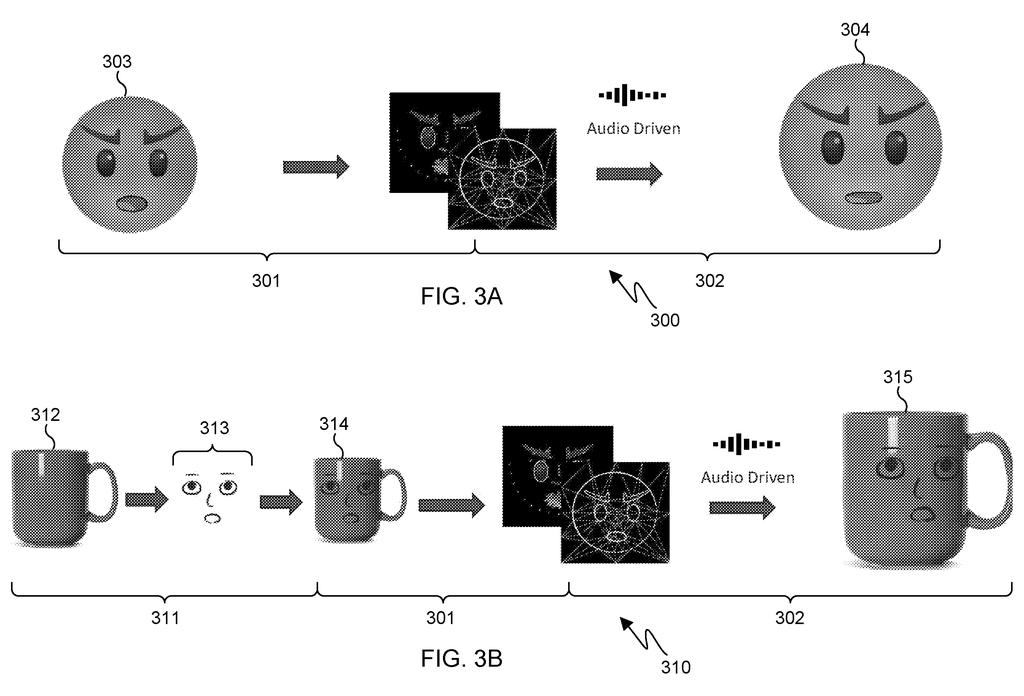
That's the idea here. Samsung's system looks at your photo, finds the outlines of your eyes, mouth, and other features by fitting oval shapes to them, then pins a set of marker points along those ovals. When you speak, a second AI model watches the incoming audio frame by frame and predicts exactly how each marker point should move to match the sound. The result is an animated avatar that mimics your lip movements in real time.
The whole process runs on the device itself, so your photo and your voice never leave your phone or headset. For anyone cautious about uploading biometric data to a server, that's a meaningful distinction.
… determining facial features for the user input image using ellipse fitting to the contour lines and ellipse filtering to keep only specified ones of the facial features; …
Translation: The software draws shapes around face parts to figure out where the eyes, nose, and mouth are located.
How the system maps your face and syncs it to speech
The patent describes a two-stage pipeline, both stages running locally on the device.
Stage one: face mapping. The system feeds your photo into a first AI model that detects edges, finding the outlines of facial regions. It then applies a technique called ellipse fitting (think of it as drawing the best-fitting oval around each feature like your eyes or mouth) and filters out any ovals that don't match a meaningful face part. The surviving ellipses get a set of landmark points placed along them, essentially a dot-grid that defines the geometry of your face.
Stage two: audio-driven animation. As you speak, your audio is broken into short chunks called frames. A second AI model reads the acoustic features of each frame (pitch, energy, phoneme shape) and predicts where each landmark point should move to match that sound. It then warps the original photo image by nudging pixels according to those predicted point positions, producing a new frame of animation.
Key design choices:
- Only one input photo is required, no video capture, no 3D scan
- Both models run on-device, avoiding cloud round-trips
- Ellipse filtering acts as a noise gate, discarding spurious edge detections before any animation happens
- The warp step deforms the actual photo pixels rather than rendering a separate 3D model, keeping compute costs low
… generating an animated avatar by warping the landmark points for the user input image based on the predicted positions of the landmark points.
Translation: The system moves those face points around to make the still photo talk and match the audio.
What this means for XR headsets and private avatar creation
For XR headsets and mixed-reality apps, avatar creation is usually a chore: you sit through a scanning session, upload data, and wait. A one-photo, on-device approach could make drop-in avatars practical for everyday use, especially on a standalone headset with limited bandwidth.
The privacy angle also matters. Because the photo and audio never leave the device, users who are reluctant to hand over face scans to a server get a real alternative. The tradeoff is fidelity: warping a single flat photo will always look less lifelike than a 3D model built from dozens of angles. Whether that's acceptable depends entirely on the use case, and Samsung's filing is clearly targeting lighter, more casual XR experiences rather than photorealistic telepresence.
Samsung's 25th filing we've tracked since June builds on ideas like a privacy-triggered speaker and shielding AI data on load in our on-device AI privacy watchlist.
Samsung's approach here trades depth for speed: instead of building a three-dimensional model of your face, it stretches a flat photo to simulate movement. That shortcut works until the animation asks too much of it, and a wide-open mouth or a tilted head can make the result look like taffy pulling in the wrong direction.
The face-reading method also depends on clean, well-lit images where edges are sharp and distinct. Glasses, dim lighting, or a complexion that blends into the background can all confuse the system at the first step, before animation even begins.
These are real costs, but they land differently depending on what Samsung is actually selling. A cartoon stand-in for a casual video call asks almost nothing of the user and the technology. A feature meant to represent you seriously in a meeting or a social space asks considerably more, and this design probably cannot deliver it.
There are more where this came from
We read every patent application Big Tech publishes and send you the ones worth knowing. Plain English, free, every week.
The drawings
20 drawing sheets from US 2026/0289886 A1 · click any drawing to enlarge


Want this weekly breakdown for a company we don't cover? Patentlyze Pro →
Be the first to weigh in